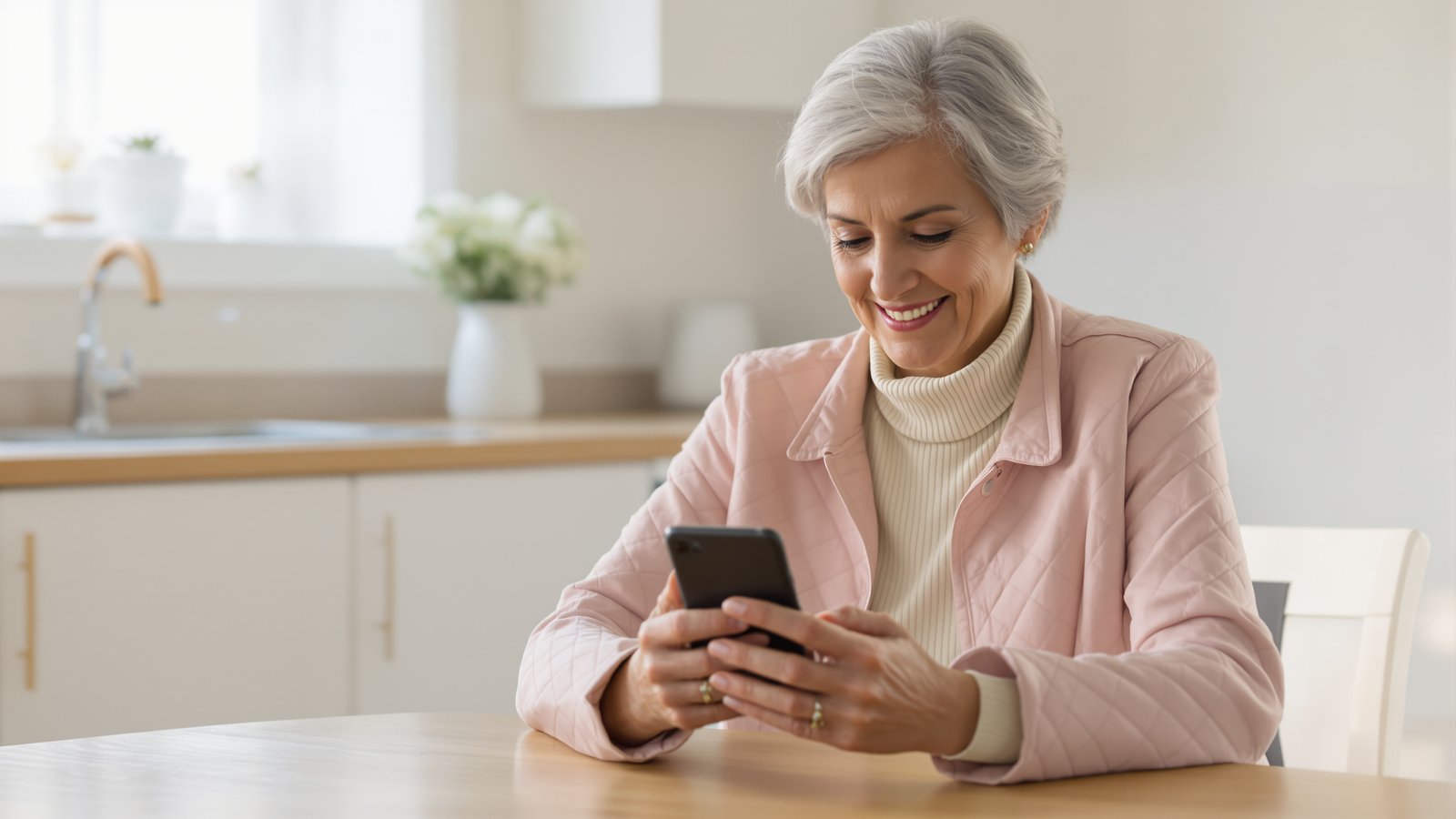
Best Phone for Seniors: iPhone vs Jitterbug
Mom's flip phone died. Kate has to pick something by Sunday. Here's the honest answer.
Saturday morning. Mom's Jitterbug Flip2 died last night. Kate is at her kitchen table with two browser tabs open. One is the new Jitterbug — $99, big buttons, simple menu, Mom would have it figured out in twenty minutes. The other is an iPhone SE — $429, intimidating, but FaceTime, the App Store, and everything Kate's actually using to stay close to Mom.
Kate's brother texts: just get her the Jitterbug, she's 73, don't overcomplicate it. Her sister texts: iPhone, obviously, she needs FaceTime. Kate stares at the tabs. The kids want a video call with Grandma on Easter. Mom wants to send pictures of the garden. The Jitterbug does neither.
She picks the iPhone. She also picks Tiina, because she is not stupid — she knows Mom is not going to learn the App Store on her own. The two purchases together cost less than a single ER visit and they change what Mom can do for the next ten years. Here is why the iPhone wins, and what to do about the part that's hard.
I don't want a senior phone. I want my own phone.
She opened Tiina and asked out loud.
For most older adults, the best phone is an iPhone SE — not because it's the simplest, but because it grows with them. The Jitterbug Flip2 is friendlier on day one and dead-ends in six months when Mom wants to FaceTime a grandkid. Tiina, a voice-first AI companion for older adults, is what makes the iPhone usable from day one — Mom talks to it instead of tapping, so the learning curve flattens out.
If you are stuck choosing between a Jitterbug and an iPhone, it is not because you are bad at tech decisions. It is because the two products are aimed at different versions of Mom — one at the Mom who needs less, one at the Mom who deserves more. They are not the same buy.
Your job is not to find the simplest phone. Your job is to find the phone that does not box her into the smallest possible version of her life — and then to remove the friction from the parts that are hard on day one.
Simple today is a cage in six months.
What you can do this weekend
Saturday morning. Order the iPhone SE — refurbished from Apple or Verizon is fine, around $300. Add it to Mom's existing carrier plan; do not buy a separate senior plan. The plan she has works.
Saturday afternoon. The phone arrives. Sit with Mom and do the setup together. Crank text size up to large. Turn on bold text. Set the wallpaper to a photo of her grandkid. Put eight apps on the Home Screen and delete the rest from view. Install Tiina. Make a grandkid a Favorite contact with a photo. Practice one FaceTime call together.
Sunday. Don't check in. Let her use the phone. She will text you something the first day — usually a heart, or a photo of the cat. Reply normally. The iPhone is not a project anymore. It is just her phone.
Tiina walks your parent through the phone, the call, the photo — out loud, as many times as it takes, and never makes them feel slow.
What this sounds like with Tiina in the room
Tuesday, 10:14 AM. Patricia is at her desk with the iPhone propped against a stack of blue notebooks. She taps the green video icon and FaceTime opens. Keisha answers on the second ring. Hey Grandma. Patricia smiles. Hi sweetheart. I want to show you something. She gets up, carries the phone to the kitchen window, and points it at the rose bushes outside. Three of them opened this morning. Your grandpa planted these in 2003. Keisha says, They're gorgeous, Grandma. Patricia turns the phone back to her own face. I told Tiina to remind me to call you when they bloomed.
Keisha laughs. Grandma, you should start a YouTube channel. Patricia waves her hand. Don't be ridiculous. They talk for twenty-two minutes. Patricia presses the red button. She sits at her desk and looks at the dark phone, then looks at the stack of blue notebooks her husband used to keep his garden notes in, then back at the phone. She wonders, quietly, what a ring light costs.
Mom's iPhone is the phone the grandkids use. She doesn't get a senior version.
The best phone for seniors is the one that grows with Mom — not the one that caps what she's allowed to do. The iPhone SE plus a voice-first companion makes the first six weeks tolerable and the next ten years possible. She gets her granddaughter's face, in real time, in her own kitchen.
Get Tiina on Mom's iPhone →Methodology & editorial policy
Reviewed and updated May 14, 2026 by the Tiina Editorial Team. Re-checked as new federal data, agency updates, or product changes warrant. Sources are linked below; numbers are not composite.
About composite scenarios. Scenes and sample conversations in this article are composite. Names and identifying details are changed; the moment is real.
About Tiina. Tiina is a voice-first AI companion for older adults — an app for iPhone and iPad that your parent opens to talk through a moment that doesn't feel right.
Sharing. Quote freely with a link back to this page. For full reprints, email hello@tiina.ai.
Sources. 3 references — primary sources for the numbers and claims above.View all
- Pew Research: Mobile Fact Sheet — Source for the 61% smartphone ownership rate among adults 65+.. pewresearch.org/mobile
- Apple Accessibility — iPhone for Vision — Reference for the Easy Setup features (large text, bold fonts, display zoom).. apple.com/vision
- AARP: Smartphone Use Among Older Adults — Framing for the shift from feature phones to smartphones in the 65+ cohort.. aarp.org/
Frequently Asked Questions
The easiest phone to operate for seniors depends on tech comfort. For seniors who want true simplicity, the Consumer Cellular IRIS Easy Flip or Jitterbug Flip2 are the easiest day one, with large buttons, a simple menu, and no apps to navigate. For seniors willing to learn slightly more in exchange for video calling, photos, and modern features, an iPhone SE with the Easy Setup turned on (large text, simple Home Screen, eight apps maximum) is the easiest practical smartphone. The right answer is whichever device the older adult will actually pick up. A phone that sits in a drawer because it feels intimidating is not easy, no matter the spec sheet.
AARP does not officially endorse a single phone, but its reviews consistently highlight the Jitterbug Smart4 and Jitterbug Flip2 from Lively, the Apple iPhone SE and iPhone 16e, and the Consumer Cellular IRIS Easy Flip. AARP The Magazine has covered all of these as solid senior options. The Jitterbug models lead for medical alert features and ease of use; iPhones lead for longevity, family ecosystem fit, and capability ceiling. AARP also partners with Consumer Cellular for member discounts on plans, which makes that pairing particularly common. The recommendation generally tracks tech comfort: Jitterbug for low, iPhone for medium to high.
Five strong options: Consumer Cellular IRIS Easy Flip for easiest overall operation, Jitterbug Flip2 for best built-in medical alert features, Apple iPhone 16e for best camera quality and family ecosystem fit, Jitterbug Smart4 for the best simplified smartphone, and the RAZ Memory Cell Phone for seniors with dementia or Alzheimer's. The RAZ shows only photos of contacts, eliminating menus and apps entirely. The right pick depends on whether the senior wants a flip phone or smartphone, and on their tech comfort. For most iPhone-using families, an iPhone SE or 16e with Easy Setup wins on a five-year horizon, even with a steeper first week.
iPhone is generally better for seniors whose families use iPhones, because iMessage, FaceTime, and Find My all work seamlessly across the household. Samsung Galaxy A series phones with One UI Easy Mode are the rough Android equivalent and a strong choice if the family already uses Samsung or Pixel devices. The hardware quality is comparable. The deciding factor is ecosystem fit, since the senior will need help, and help is much easier when the helper uses the same device. Long-term software support also favors iPhone, with 6-7 years of iOS updates versus 4-7 for Samsung depending on the model.