Gift Card Scam: Why It Hooks Older Adults
Dad was at the CVS counter with eight Apple gift cards when his phone buzzed.
James, 79, in Tucson, was at the CVS on Speedway Boulevard with a stack of Apple gift cards on the counter — four $200 cards, four $100 cards, $1,200 total. The cashier, a young woman with a name tag that said Briana, was scanning them slowly. She kept glancing up at him.
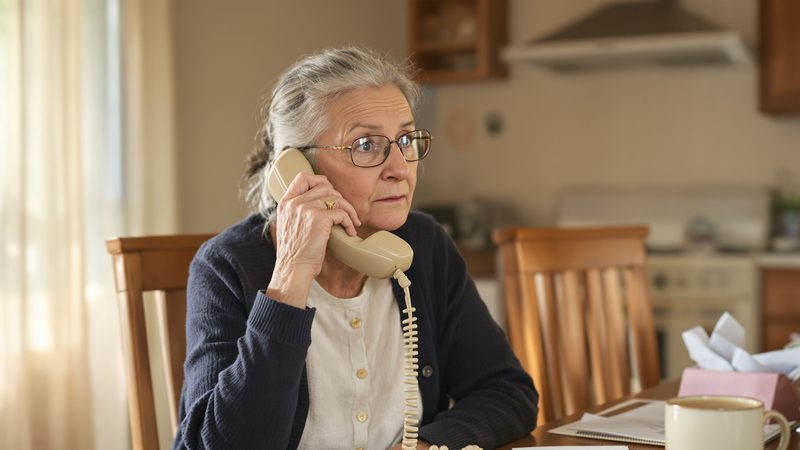
On the phone, pressed to his ear, was a man who had introduced himself as Officer Daniels with the Pima County Sheriff's Department. There was a warrant for James's grandson Damian. Damian had been in a car accident. The bail money had to be in Apple gift cards because the courthouse was closed for the weekend.
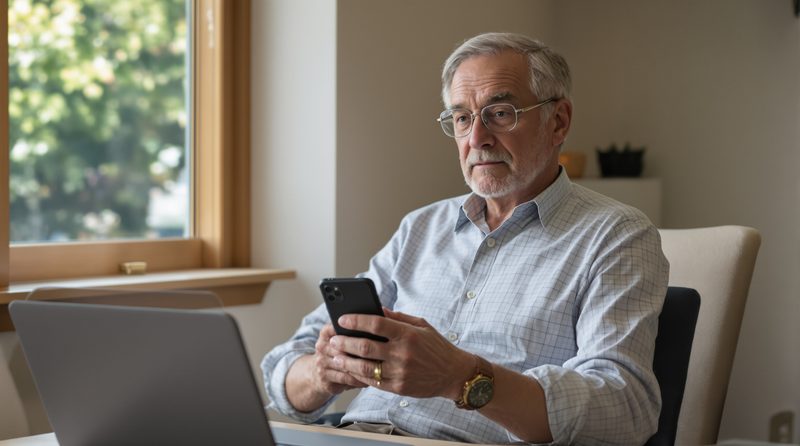
Briana, scanning the last card, asked very gently if James was okay. He said he was fine. Then he looked down at the iPhone in his other hand and remembered his granddaughter showing him the orange circle. He tapped it, turned away from the counter, and quietly asked Tiina if a deputy could really need bail money in Apple gift cards.
The deputy said Damian needed bail money. He said Apple gift cards.
He opened Tiina.
A gift card scam is any scam where the payoff is paid in gift cards — iTunes, Apple, Google Play, Target, Visa prepaid — because gift cards are nearly impossible to trace or recover. No real agency, store, or utility accepts gift cards as payment. With Tiina, a voice-first AI companion for older adults, Dad describes what the caller is asking out loud and gets the answer in one sentence: nobody real takes gift cards. Put them back.
If your dad got as far as the gift card counter, it is not because he is gullible. It is because the script weaponized a name he loves. Once a scammer says your grandson's name, the part of the brain that asks 'wait, why gift cards' goes quiet for thirty or forty minutes. That is the whole window the scam needs.
Your job is not to follow him around the pharmacy. Your job is to give him one interruption — one small, calm voice — between the counter and the codes.
Nobody real takes gift cards.
What's actually happening when the caller asks for gift cards
Gift cards are the cleanest cash-out in the scam economy. Once a senior reads the activation code on the back of a card out loud, the scammer redeems it within minutes — sometimes seconds — and resells the balance on secondary markets. There is no chargeback, no bank trace, no card issuer who can recover the money once the code has been read.
The FTC's Consumer Sentinel Data Book ranks gift card payments among the top loss methods reported by older adults, with reported losses in the hundreds of millions of dollars annually. Median individual losses on gift card scams are high because the script convinces the senior to buy multiple cards at multiple stores — sometimes $5,000, $10,000, more — before the urgency breaks.
The pretexts vary. A grandchild in jail. An IRS warrant. A 'Social Security fraud department.' Amazon refund overpayment that has to be sent back in cards. A computer that needs a fee paid before it can be 'unlocked.' The pretext is just decoration. The payoff is always the same: read the code on the back of the card.
What Tiina does at the counter
James set the phone down for a moment and opened Tiina on his iPhone. He whispered into it, because Briana was still right there. A deputy says my grandson needs bail money in Apple gift cards. Tiina answered immediately. James, that's a scam. No court, no jail, and no real police agency takes bail in gift cards. Your grandson is not in custody. Put the cards back.
He looked at Briana. He told her, quietly, that he was going to put the cards back. She exhaled, like she had been holding her breath the whole time. The cashier in front of him asked if he wanted to step over to a quieter spot and call his daughter. He did.
His daughter Patricia picked up on the second ring. Damian, her son, was fine — at work, twenty miles away. James drove home with the $1,200 still in his wallet and his hands not shaking until he was back in his own driveway.
What changes after Dad walks out without buying the cards
The first save is the loudest. James did not lose $1,200. He did not lose his sense of himself either, which is the bigger save. He went home, he made coffee, he called Damian to hear his voice, and he sat at the kitchen table feeling, for the first time in an hour, like an old man and not a scared one.
Patricia did not have to take his debit card. She did not have to put a daily limit on his bank account or freeze his accounts. She did not have to drive across town to extract him from the store. He came home on his own steam.
The dignity matters here. James still gets to be the grandfather who drops everything when family is in trouble. He just has a faster way to verify which trouble is real.
A scammer counts on no one being there to ask. Tiina is — a companion on the phone who'll talk through any "urgent" call, calmly, before your parent does anything they can't undo.
What you can do for Dad this weekend
First, tell him this one sentence and tell him to tell you it back: No real agency or family member ever asks for payment in gift cards. Make him repeat it. Make him say it back next week. The repetition matters because in the moment, his memory will be racing.
Second, agree on a family code word — a single word that only the two of you and your kids know. If anyone ever calls claiming to be a grandchild in trouble, your dad asks for the code word. No code, no money. The FTC explicitly recommends this practice.
Third, put Tiina on his iPhone so he has somewhere to ask out loud, even from inside a CVS, even with a stranger on the phone. The voice in his ear is loud. Tiina is louder.
What this sounds like with Tiina in the room
James turned slightly away from the CVS counter and whispered into Tiina. Someone says my grandson is in jail and needs bail in Apple gift cards. Tiina answered fast. That is a scam, James. No real agency takes bail in gift cards. Put the cards back and call your daughter to check on Damian. James exhaled. The deputy sounded real. He said my grandson's name. Scammers buy that information. Hearing his name doesn't make the call real. Damian is almost certainly fine. Want me to walk you through calling Patricia right now? He said yes. The cards went back into the basket. The basket went back to the shelf.
Dad puts the cards back now. He calls his daughter from the parking lot.
Tiina lives on Dad's iPhone. When the next 'deputy' or 'IRS officer' or 'tech support agent' asks him to pay in gift cards, he opens Tiina, asks out loud, and gets the calm answer before the codes get read. The wallet stays whole. Nobody real takes gift cards.
Set Tiina up for Dad →Methodology & editorial policy
Reviewed and updated May 14, 2026 by the Tiina Editorial Team. Re-checked as new federal data, agency updates, or product changes warrant. Sources are linked below; numbers are not composite.
About composite scenarios. Scenes and sample conversations in this article are composite. Names and identifying details are changed; the moment is real.
About Tiina. Tiina is a voice-first AI companion for older adults — an app for iPhone and iPad that your parent opens to talk through a moment that doesn't feel right.
Sharing. Quote freely with a link back to this page. For full reprints, email hello@tiina.ai.
Sources. 4 references — primary sources for the numbers and claims above.View all
- FTC — Gift Card Scams — We cited the FTC's explicit statement that no real agency or business accepts gift cards as payment.. consumer.ftc.gov/gift-card-scams
- FTC Consumer Sentinel Data Book — We referenced FTC reporting on gift card losses as a top payment method in elder fraud.. ftc.gov/consumer-sentinel-network
- FBI IC3 — Elder Fraud Report — We referenced IC3 reporting on grandparent-scam pretexts that end in gift card payments.. ic3.gov
- AARP Fraud Watch Network — We referenced AARP's tracking of gift card payment scams targeting older adults.. aarp.org/money/scams-fraud
Frequently Asked Questions
A brushing package — an unordered Amazon or eBay shipment addressed to you — means a third-party seller is using your name and address to post fake verified-purchase reviews. Don't pay for it; under FTC rules you can keep unordered merchandise as a gift. Then change your Amazon and email passwords (your data is already out there), turn on two-factor authentication, and check your credit reports at annualcreditreport.com for accounts you didn't open. Report the package to Amazon (Customer Service → Report Unsolicited Package) and to reportfraud.ftc.gov. Brushing itself is low-harm, but it confirms your personal info is on a scammer's list — assume more scam contacts are coming.
Yes, and the numbers are getting worse. The FTC's Consumer Sentinel logged over 30,000 gift card scam reports and $199 million in reported losses through the third quarter of last year, with 2025 totals expected to land near the same mark. Adults 60+ account for a disproportionate share of dollar losses. Apple, Google Play, Target, and Amazon gift cards remain the top requested brands. No federal agency, no real police department, no court, no utility, no hospital, no bank, and no real business ever asks for payment in gift cards. If a call ends with a gift card request, it is 100% a scam — hang up.
Because gift cards are what fraud investigators call an 'easy depletion method' — money that moves fast and can't be traced. Once you read the 16-digit code from the back of the card, the funds can be drained or resold worldwide within minutes. There is no name attached, no bank account to subpoena, and almost no way to reverse the transaction. Wire transfers can sometimes be recalled within 24 hours, and credit card charges can be disputed — but gift card balances, once read aloud or photographed, are gone. That is why every modern impersonation scam, from IRS to grandkid-in-jail, eventually pivots to gift cards.
Because retail chains have trained cashiers to recognize the warning signs of a gift card scam. Buying multiple high-value cards (often $200 or $500 denominations) while on the phone is a known pattern flagged by the FTC and AARP Fraud Watch. Many stores — CVS, Walmart, Target, Walgreens, Kroger — have policies that empower cashiers to pause the transaction, ask gentle questions, or call a manager. If a cashier asks if you are okay or if someone is on the phone with you, take the question seriously. They are trying to save you thousands of dollars. Step away from the call and answer honestly.