Doctor Appointment Prep for Aging Parents
Yuki packs the folder. Dad packs the questions. Two weeks of small notes change the appointment.
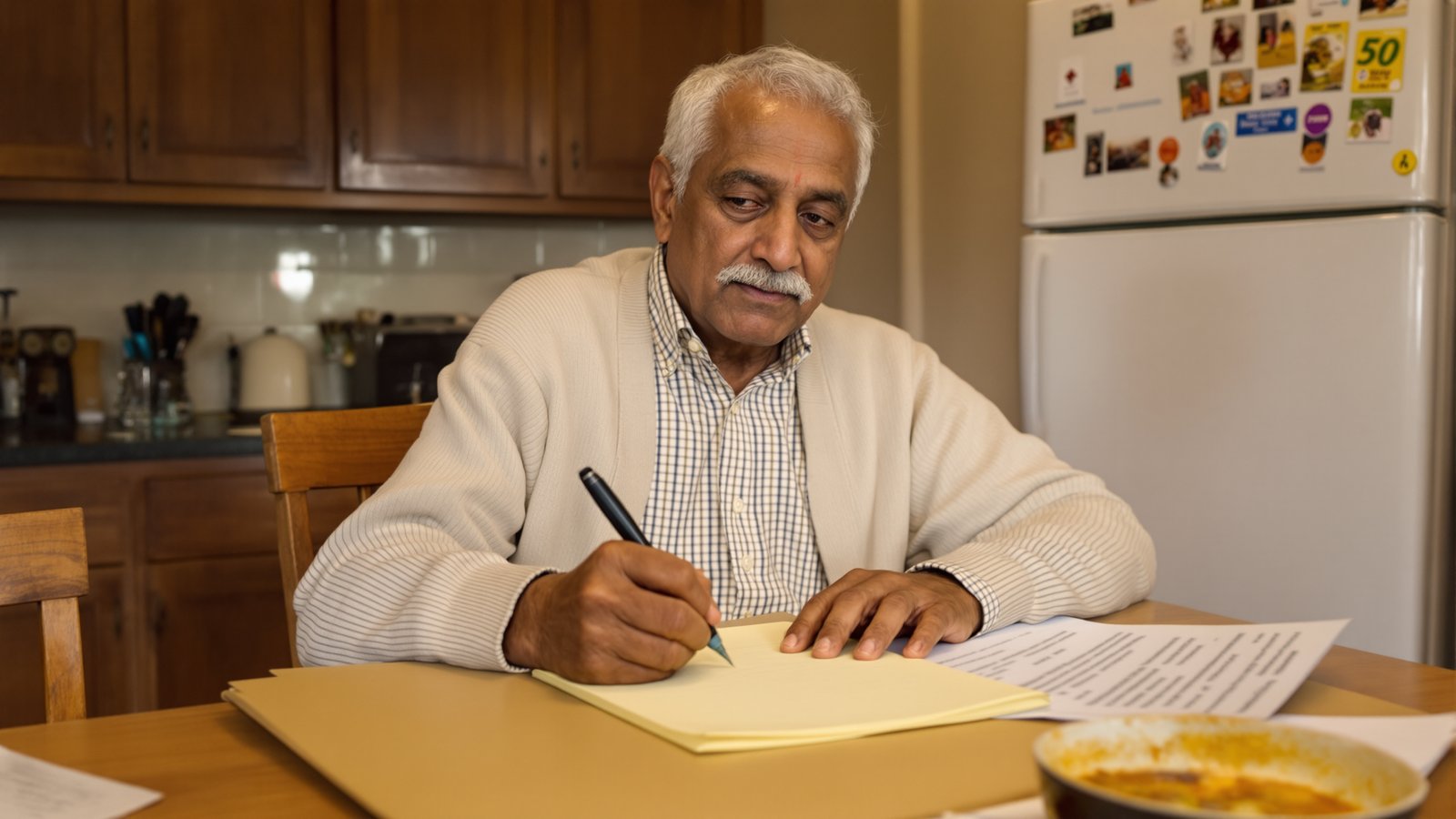
Friday, 6:47 p.m. The appointment is next Thursday. Yuki is at her dad's kitchen table with a manila folder, a yellow legal pad, and the printout from the patient portal. Robert is at the stove stirring a can of soup. "Dad, did your back hurt last week?" she asks. He says, "I don't remember." She writes nothing down because there is nothing to write.
She tries a different question. "How about the dizziness — when did that start?" Robert turns the burner off and thinks. "Sometime. I don't know. The summer maybe." Yuki's pen hovers. "The summer" is not what the cardiologist needs to hear. The cardiologist needs to hear three weeks ago Tuesday, twice, in the morning, after standing up.
Yuki closes the folder. There are six days left and she is supposed to be in Chicago for two of them. The appointment will go the way appointments always go — Dad will say "pretty good," the doctor will adjust nothing, and Yuki will spend Friday night Googling the symptoms her father couldn't remember.
I had a whole list and I just forgot everything when he walked in.
She helped him remember them himself.
Tiina, a voice-first AI companion for older adults, helps your dad talk through a jumbled two weeks and turn it into three clear questions — said out loud once before he ever walks in. For doctor appointment prep with an aging parent: keep a two-week symptom log on a pad (a standing evening reminder helps), write three concrete questions on a notecard, and bring the medication bottles in a bag.
If your dad can't recall last Tuesday's symptoms on Friday, it is not because you didn't ask the right questions. Older adults forget yesterday's headache the same way you forget what you had for lunch on Wednesday. The doctor needs the data anyway — and asking harder will not produce it.
Your job in the two weeks before an appointment is not to interrogate. It is to set up a small, easy daily moment where your dad notices what his body did that day and writes it down — two sentences on a pad. That is the prep. The folder comes second.
Memory is a tool. Build him a tool that fits in his pocket.
Why the doctor's visit goes blank — and the two weeks before don't
Medicare's own visit-prep page leads with this: write down what's been happening since your last visit. They lead with it because nobody does it. Most older adults arrive with a vague sense of "not great" and no specifics. The doctor then has to fish — and a visit that averages about 18 minutes becomes a fishing trip instead of a treatment plan.
The thing your dad's cardiologist needs is not a feeling. It is a pattern. "Dizzy twice in the last two weeks, both times in the morning, both times within ten minutes of taking the new pill" is a different visit from "I get dizzy sometimes." Pattern data only exists if someone wrote it down on the day it happened.
Robert is 78. He is not bad at memory. He is just not in the habit of cataloging his body. Nobody his age was raised that way. The fix is not nagging him. The fix is making the daily noticing tiny and automatic — a one-minute thing he does after dinner, the same time he checks the score.
What works: a two-week symptom log Dad actually keeps
Two weeks out, Robert started a small evening ritual. He put a spiral pad and a pen on the table next to the recliner and asked Tiina to remind him every evening at seven. After his soup, before the news, the reminder came and he wrote two sentences. "Back sore this morning. Dizzy once, right after my coffee." That was it. It took 40 seconds.
He did not do it every day. He skipped Saturday. He did 11 out of 14 days, which is more than enough. On Wednesday night before the Thursday appointment, he sat down with the pad and opened Tiina. He read the two weeks out loud — out of order, half of it grumbling — and talked it through. Saying it to someone is how the pattern surfaced: the dizziness kept landing in the mornings, mostly after coffee. The back was worst getting out of bed. One headache, Tuesday the 7th.
Robert wrote those three lines on a notecard, and under them the three questions he wanted answers to: Is the dizziness the new pill? Is the back something to scan? Can I drive to my brother's in June? Then he said each question out loud once, the way he would say it in the chair, with Tiina coaching the phrasing — start with the dizziness, say when it happens. The folder had one notecard and the pill bottles. That was the prep.
What changes when Dad walks in with two weeks of data
The appointment ran 22 minutes — four more than the standard slot, because there was something to work with. The cardiologist looked at the pattern, lowered the new pill by half, ordered a basic metabolic panel, and said the back was likely musculoskeletal but worth a physical therapy referral. The drive to brother's in June got a green light with a caveat.
Robert left the visit with three decisions instead of three vague reassurances. He drove home. He told Yuki over the phone that night what the doctor said, in his own words — because he had been the one in the conversation. Yuki didn't have to translate the visit back to him.
The bigger thing: Robert kept the evening ritual. After the appointment, he kept writing his two sentences on the pad. The next visit in three months will start the same way — with two weeks of data instead of a blank. He owns his own chart now.
Tiina talks with your parent between your visits — gentle, repeatable, always patient — so the quiet stretches of the day aren't so quiet.
What you can do this weekend before the next appointment
Three steps. First: pick the daily moment. Right after dinner, right before the news, while the coffee maker is heating — whatever already happens. Anchor the new habit to the existing one, and set a standing evening reminder so nobody has to nag. Second: decide what counts as the daily note. Two sentences on a pad. What hurt today. What felt different.
Third: the day before the appointment, sit with him for ten minutes and turn the two weeks of small notes into one notecard. Three patterns, three questions. Have him say the three questions out loud once — a question that has been said out loud survives the waiting room. Put the notecard and the pill bottles in a ziplock bag. Done.
If your dad gets to the office and freezes in the chair anyway, the post on talking to the doctor as a caregiver covers the three sentences that get the room to slow down.
What this sounds like with Tiina in the room
Wednesday evening, Robert in the recliner, the pad in his lap. He opens Tiina on his iPhone. "Doctor tomorrow. I've got two weeks of scribbles here and I don't know what to lead with." Tiina says, "Read me what you've got. We'll sort it out together." He reads — the sore backs, the headache, the dizzy mornings, out of order. Tiina says, "The dizziness came up more than anything else, and almost every time you read it, you mentioned coffee. Start with that tomorrow. Say when it happens." Robert tries it. "I've been dizzy in the mornings, mostly right after my coffee." Tiina says, "Say it just like that. What else do you want to ask him?" Robert says, "The back. And whether I can drive to Cleveland in June." Tiina says, "Three things. That's a list that gets answered. Try the dizziness one once more, from the top." He says it again, smoother this time. He copies the three lines onto the notecard and turns the news on.
Later that night, Yuki calls. Robert tells her, without picking the pad back up, that he is leading with the dizziness — mornings, mostly after coffee — and that the driving question made the list. He has already said it all out loud once. She isn't asking him to remember anymore.
Dad walks into the cardiologist's with two weeks of notes. Not a shrug.
Two sentences after dinner. Eleven days out of fourteen. By appointment day, Robert has a pattern instead of a blank. The doctor adjusts the dose. Robert drives home and tells Yuki what happened, in his own words. The visit belongs to him.
Set Tiina up for Dad →Methodology & editorial policy
Reviewed and updated May 14, 2026 by the Tiina Editorial Team. Re-checked as new federal data, agency updates, or product changes warrant. Sources are linked below; numbers are not composite.
About composite scenarios. Scenes and sample conversations in this article are composite. Names and identifying details are changed; the moment is real.
About Tiina. Tiina is a voice-first AI companion for older adults — an app for iPhone and iPad that your parent opens to talk through a moment that doesn't feel right.
Sharing. Quote freely with a link back to this page. For full reprints, email hello@tiina.ai.
Sources. 4 references — primary sources for the numbers and claims above.View all
- Medicare: How to Prepare for a Doctor's Visit — We used the Medicare visit-prep checklist as the baseline for the notecard contents.. medicare.gov
- Medical Care: Measuring Primary Care Exam Length Using Electronic Health Record Data (Neprash et al., 2021) — Source for the 18-minute visit: across 21 million U.S. primary care visits, the average exam ran 18.0 minutes.. journals.lww.com/lww-medicalcare
- NIA: Talking With Your Doctor — We referenced the NIA's older-adult visit-prep guidance, especially writing symptoms down between visits.. nia.nih.gov/talking-your-doctor
- AMA: Patient Visit Preparation — We cited AMA practice guidance on the value of structured visit prep for complex visits.. ama-assn.org/patient-support-advocacy
Frequently Asked Questions
Start two weeks before the visit, not the night before. Set up a daily evening note where your parent writes down, in two sentences, what hurt today and what felt different — a pad by the chair and a standing evening reminder make the habit stick. Eleven days of small notes beats a 30-minute interrogation the night before. The day before, turn the two weeks into one notecard with three patterns and three questions. Bring the medication bottles in a ziplock bag, the insurance card, hearing aids, and the notecard. Medicare.gov publishes a visit-prep checklist that covers the basics. Use it as a starting point and add the symptom log. The NIA recommends writing concerns in priority order so the most important one gets discussed first.
Don't skip prescribed medications unless the doctor told you to, don't eat or drink anything if fasting labs are scheduled (water only, usually 8-12 hours), and don't put on heavy lotions or makeup if blood pressure or skin checks are on the agenda. Don't show up alone if hearing or memory is an issue. Don't try to remember the symptom history from scratch in the waiting room. The NIA and Medicare.gov both recommend writing things down in the days leading up to the visit instead of relying on recall. And don't bring a list of twelve questions, three is the realistic number for a visit that averages about 18 minutes.
Phrases doctors are trained to treat as red flags include: short of breath, fainting, weakness, numbness, vision changes, unintentional weight loss, blood (in stool, urine, or sputum), and sudden confusion. These elevate concern because they are linked to high-risk diagnoses like stroke, heart attack, internal bleeding, or cancer, and they often trigger faster work-ups or specialist referrals. If any of these apply to your parent, lead the visit with that phrase exactly, not a softer version. If the symptom is new or sudden, don't wait for the appointment — call the office now, or 911. "She seems a little off" gets a different response than "She had sudden confusion on Tuesday that lasted four hours." Specific words move the appointment faster.
Three concrete ones, written on a notecard before you walk in. Standard high-value questions for an older adult visit: Is any current medication contributing to falls, dizziness, or confusion? What is the plan for the most concerning symptom from the last two weeks? Is there anything we should be tracking between now and the next visit? Add one question specific to a recent event — a fall, a new pill, a missed dose pattern. Three questions is the right number. Seven means none of them get a real answer. The NIA recommends ordering questions by priority so the most important one is asked first.