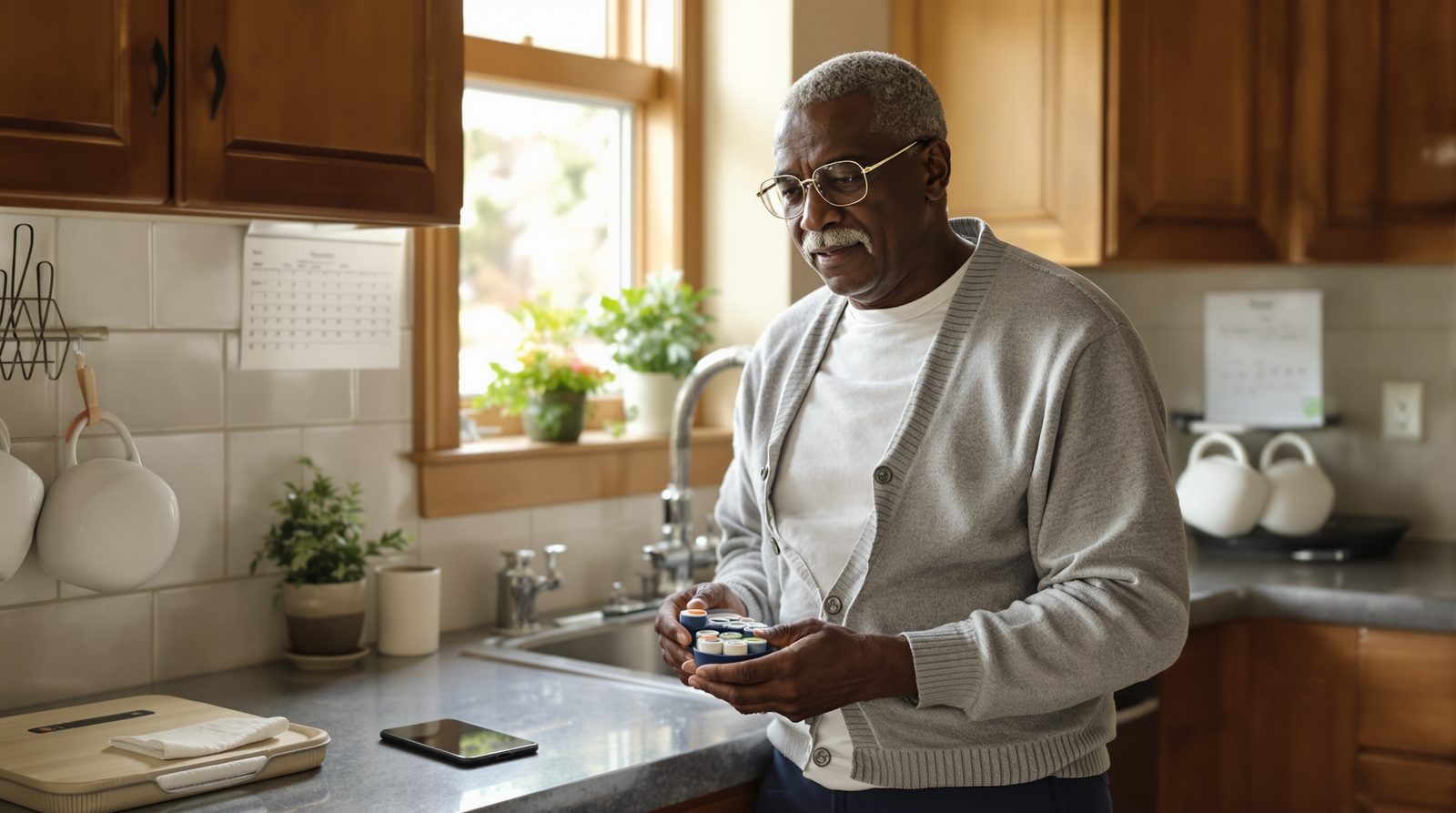
Medication Reminders for Seniors That Actually Work
Dad's 3 p.m. heart pill keeps getting missed. The pill organizer didn't fix it. Here is what did.
Thursday, 4:18 p.m. Sasha calls her dad on the way home from work. "Did you take the 3 o'clock?" she asks. Tyrone pauses. "I think so." Sasha hears the pause. The pause is the answer. She pulls into the gas station and stares at the dashboard. The afternoon pill is the carvedilol. Skipping the carvedilol is how people end up in the ER.
She has tried things. The plastic pillbox with the day labels — Tyrone filled it on Sunday and then forgot to look at it on Tuesday. The phone alarm — he turned off the sound because it scared him when it went off in the grocery store. The whiteboard on the fridge — he stopped seeing it after the second week. He is not careless. He is 78 and the pill is at 3 p.m. and he is in the recliner watching baseball.
Sasha gets back in traffic. She does the math on her own. There are 21 doses a week of carvedilol. He takes maybe 15. That is a six-pill-a-week deficit. The cardiologist will see it in his blood pressure at the next visit and they will both pretend they don't know why.
I think I took it. I'm pretty sure I took it.
He told Tiina, and Tiina remembered.
Tiina, a voice-first AI companion for older adults, gives your dad a warm 3 p.m. cue and a check-in five minutes later — not a beep he ignores. Medication reminders that actually work for an elderly parent combine three cues: a physical pillbox he can see, an audible voice reminder he can answer, and a quick check-in that closes the loop.
If your dad keeps missing the 3 p.m. pill, it is not because he doesn't care about his heart. He fills the pillbox every Sunday. He means to take it every day. The pillbox is a tool that requires him to look at it at 3 p.m. — and 3 p.m. is the worst time of the day for an older adult to remember to look at anything. Energy dips. Attention drifts. The pill loses.
Your job is not to call him every afternoon and become his alarm clock. Your job is to build a system where the cue finds him, the cue talks like a person, and the cue closes the loop. Three cues, not one. The pillbox is step one of three.
He is not forgetting on purpose. The system was missing two steps.
Why the pillbox alone keeps failing
Roughly 50% of medications for chronic conditions are not taken as prescribed, according to the CDC. Among older adults, that number is higher when the regimen has more than three pills or more than one time of day. The pillbox solves the question "is this Tuesday's dose?" — it does not solve "is it 3 p.m. and am I looking at the box?"
Phone alarms work for people who keep their phone in their pocket and have good hearing. Most older adults do neither. The phone sits on the counter, the volume is low because it scared them once, and the buzz is indistinguishable from a text. The alarm becomes background noise inside a week.
The third failure mode is the closed-loop problem. Even when the cue lands, there is no record of whether the pill was taken. "I think so" is the most dangerous sentence in medication management. Without a check-in, the family has to guess, and the doctor has to guess from the blood pressure reading at the next visit.
What works: three cues that stack into a real system
Cue one is the pillbox — keep it. Visible, on the kitchen counter, not in the cabinet. Sunday fill, seven days, two slots a day. The pillbox is the source of truth for what was supposed to happen. It is step one, and it is not optional.
Cue two is the voice reminder. At 2:58 p.m., Tyrone's iPhone says, in a warm voice, "Hey Tyrone, the afternoon pill — the small white one. Go grab it and let me know when you've taken it." Not a beep. A sentence. He opens Tiina, says "taking it now," and walks to the counter. The pill goes in. He says "got it." Tiina says "thank you." Forty seconds, start to finish.
Cue three is the check-in. At 3:08 p.m., if Tyrone didn't respond, Tiina asks once more — gently, not alarmed. "Did you grab the afternoon pill yet?" If he says yes, the loop closes. If he says he forgot, Tiina walks him to the kitchen counter and stays on the line until the pill is taken. The fifteen-minute gap is the thing that catches the miss before it becomes a habit.
What changes when the 3 p.m. cue finds Dad in the recliner
Tyrone is now taking 20 of 21 doses a week. The one miss was last Saturday — he was at his brother's and forgot the pillbox. He told Tiina about it that night, and Tiina reminded him the next morning to double up per the cardiologist's standing rule. He told Sasha on Sunday, in his own words, the way he tells her about anything else. The miss got named, not hidden.
The cardiologist saw the difference at the eight-week visit. Blood pressure was down. Heart rate was steadier. The dose stayed the same instead of getting bumped up to compensate for missed pills — which is the trap that often spirals into more side effects and more skipping.
Tyrone kept his autonomy through all of it. He takes the pill himself. He confirms it himself. Sasha is not his alarm clock and he is not being managed. The system runs in the background. He still watches the 3 p.m. inning. He just takes the pill in the seventh-inning stretch.
Tiina talks with your parent between your visits — gentle, repeatable, always patient — so the quiet stretches of the day aren't so quiet.
What you can do this weekend
Three steps. First: get the pillbox visible. Out of the cabinet, onto the kitchen counter where the coffee maker lives. He will see it ten times a day even when he isn't looking for it. If you don't already have one, the AARP-recommended weekly pillbox is under $10 at any pharmacy.
Second: set up the 3 p.m. voice cue with a real sentence, not a beep. The cue needs to use his name and name the specific pill — "the small white one" — not "medication reminder."
Third: set up the 15-minute check-in inside Tiina so the second cue catches the miss before it becomes a habit. If he forgets, the second cue walks him to the counter. If three days in a row are getting skipped — he'll know it because Tiina knows it — that is a conversation to have with the cardiologist about the regimen, not a conversation to have with him about willpower.
What this sounds like with Tiina in the room
Thursday, 2:58 p.m. Tiina says, "Hey Tyrone, the small white one — the carvedilol. Want to grab it and tell me when you've taken it?" Tyrone is in the recliner. He says, "On it." He pauses the game and walks to the counter. The Thursday slot is open. He takes the pill with the half-glass of water that's always there. He walks back, picks up the phone. "Got it." Tiina says, "Thank you. How are you feeling today?" Tyrone says, "Tired. Slept rough." Tiina says, "I'll make a note. Are you still planning to walk after dinner?" Tyrone says, "If the rain holds." Tiina says, "Got it. I'll check in around six." He sits back down. The seventh inning is just starting.
Friday afternoon, Sasha calls and asks how his week's going. He tells her about the game, the walk after dinner, and — only because she asks — that he hasn't missed a pill all week. He sounds like a man running his own life.
Dad takes the 3 p.m. pill. He doesn't guess and you don't have to ask.
The pillbox is on the counter. The 2:58 voice cue uses his name. The 3:08 check-in walks him to the kitchen if he forgot. Tyrone tells Sasha how the week went on Sunday — in his own words. Twenty doses out of twenty-one.
Set Tiina up for Dad →Methodology & editorial policy
Reviewed and updated May 14, 2026 by the Tiina Editorial Team. Re-checked as new federal data, agency updates, or product changes warrant. Sources are linked below; numbers are not composite.
About composite scenarios. Scenes and sample conversations in this article are composite. Names and identifying details are changed; the moment is real.
About Tiina. Tiina is a voice-first AI companion for older adults — an app for iPhone and iPad that your parent opens to talk through a moment that doesn't feel right.
Sharing. Quote freely with a link back to this page. For full reprints, email hello@tiina.ai.
Sources. 3 references — primary sources for the numbers and claims above.View all
- CDC: Medication Adherence — We cited the CDC's data on medication adherence in chronic disease, including the roughly 50% non-adherence rate.. cdc.gov/index.html
- NIA: Safe Use of Medicines for Older Adults — We referenced NIA guidance on building medication routines that fit existing daily anchors.. nia.nih.gov
- AARP: Medication Management for Caregivers — We used AARP's caregiver-facing guidance on pillboxes and reminder systems.. aarp.org/caregiving
Frequently Asked Questions
Stack three cues, not one. The pillbox alone fails because it requires looking at it at the right moment. Add a voice cue that uses your parent's name and names the pill specifically ("the small white one"), and add a check-in 10-15 minutes later that closes the loop. The CDC reports that roughly half of chronic-disease medications are not taken as prescribed; the gap is almost always between the reminder firing and confirming the pill was swallowed. Closing that loop is the thing that moves adherence. Tiina can do the voice cue and the check-in without your parent learning a new app. Anchor doses to existing routines — coffee, dinner, lights-out — so the timing isn't fighting them.
The 4 M's are Medication, Mentation, Mobility, and What Matters Most. They are the framework the Institute for Healthcare Improvement and the Calvin A. Hartford Foundation use to define Age-Friendly Health Systems. Medication asks whether each drug is necessary, safe, and not contributing to confusion or falls. Mentation covers mood, memory, and delirium. Mobility means keeping the person moving safely. What Matters Most means knowing the person's own health goals — comfort, independence, time with family. The 4 M's give the doctor a structured 90-second screen for the issues that actually drive quality of life in older adults. Ask whether your parent's clinic uses it.
Medisafe is the most popular standalone medication reminder app, with a free tier and a premium plan that adds unlimited medications and additional reminder sounds. It works for tech-comfortable older adults but has the same flaw as every alarm-based app: the alert fires, your parent silences it, and there's no confirmation the pill was swallowed. The CDC reports about half of chronic medications are not taken as prescribed, and most of the gap is at the confirmation step, not the reminder step. Voice-based systems that ask for a verbal response and notify the caregiver if there's no answer close that loop better than a beep on a screen.
The American Geriatrics Society Beers Criteria flags several drug classes as high-risk in older adults. Five of the most cited: long-acting benzodiazepines like diazepam (falls, confusion), first-generation antihistamines like diphenhydramine/Benadryl (delirium, urinary retention), muscle relaxants like cyclobenzaprine (sedation, anticholinergic effects), tricyclic antidepressants like amitriptyline (falls, cardiac effects), and certain sleep aids like zolpidem (falls, confusion). The list isn't an automatic ban — sometimes the benefit outweighs the risk — but every one of these warrants a conversation with the prescribing doctor and pharmacist. Ask specifically: "Is this drug on the Beers list, and is it still the right call?"