Long Distance Caregiving: A Playbook
Ana lives 850 miles away. Mom's bruise was the size of a grapefruit.
8:14 PM Sunday, Chicago. Ana is on FaceTime with her mom in Tampa. Mom is in good spirits, telling her about the pharmacy app she figured out on Tuesday. Then she reaches up to adjust her glasses and her sleeve slides down. The bruise on her forearm is the size of a grapefruit. Purple fading to yellow.
Ana goes still. Mom, when did that happen? Mom waves her hand. Oh, that? I bumped the coffee table. Ana asks again. There is a pause. About two weeks ago, Mom finally says. I tripped on the rug. I didn't fall all the way down. I caught myself.
Two weeks. The bruise has been on her arm for two weeks. Ana lives 850 miles away. Her brother Mark lives forty minutes from Mom and didn't see it because he hasn't been over. They hang up at 9:02 PM. Ana lies awake until 3:17 AM. The distance has never felt wider.
I didn't tell you because you worry too much.
She told Tiina the day it happened.
Long distance caregiving means coordinating the care of an aging parent from at least an hour away — usually much more. The playbook has three pillars: a local presence (sibling, friend, or paid aide), a remote presence (you, via scheduled calls), and an in-the-home presence that runs daily without anyone having to initiate it. Tiina, a voice-first AI companion for older adults, fills the third pillar — Mom talks to her every evening, so Tuesday's bruise gets named on Tuesday, not the next FaceTime call.
If your mom hid a two-week-old bruise from you, it is not because she doesn't trust you. It is because she loves you, and her love language is not giving you another thing to lie awake about at 3am. She has been protecting you. That is the long-distance trap.
Your job is not to be there for every stumble. Your job is to build a system where the stumbles get reported by Mom herself — to someone — on the day they happen, so the response can be made before two weeks of healing buries the truth.
Distance is not the problem. Silence is.
What you can do this weekend
Saturday morning. Call your sibling — or whoever in your family lives closest to Mom. Tell them you want a shared check-in system — once a week, 15 minutes, the same time. Pick Sunday at 6pm. Write down what you each commit to: they will be at Mom's twice a month. You will call her Sundays and Wednesdays. This is the local-and-remote layer.
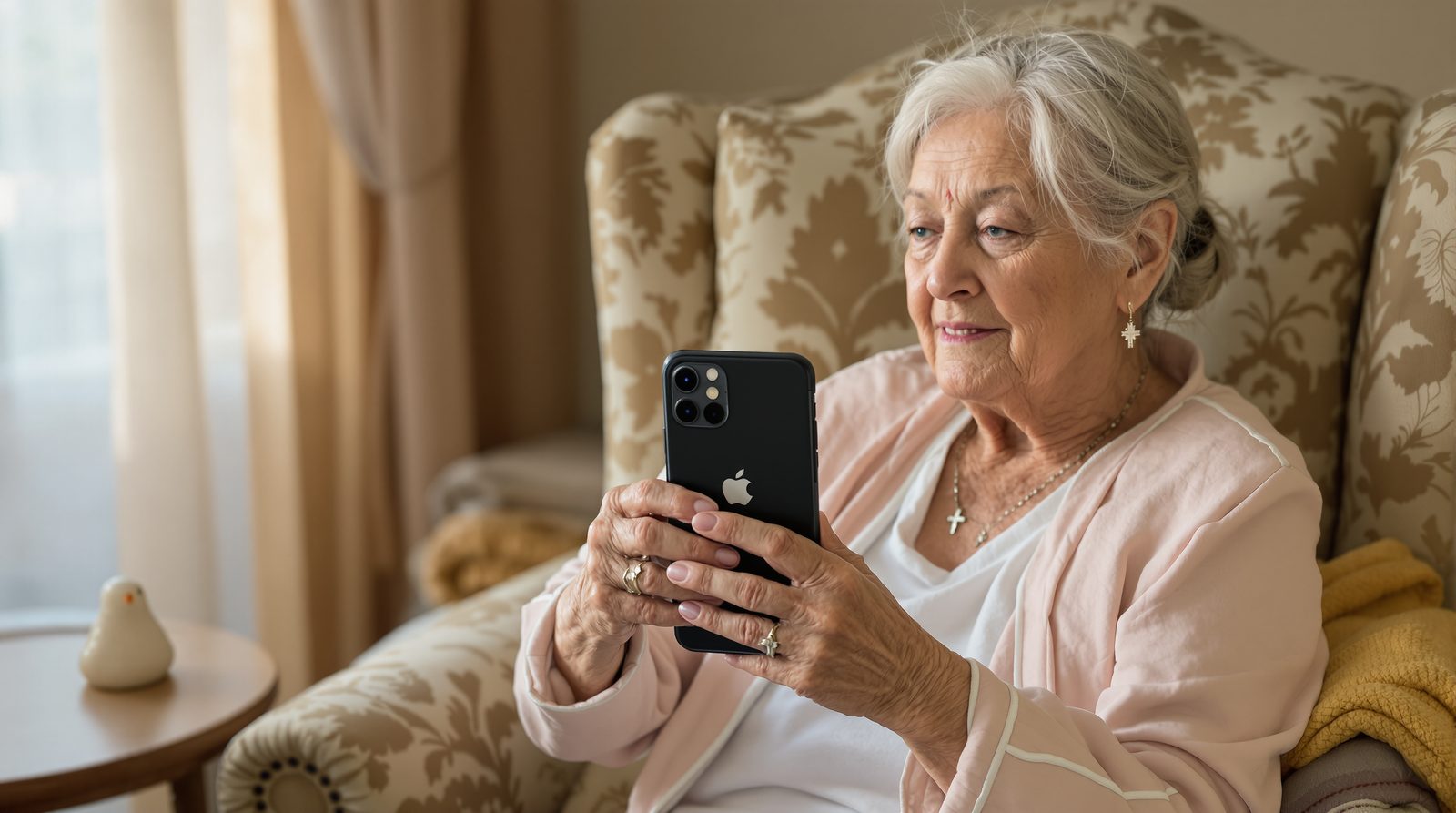
Saturday afternoon. Fly down for a weekend if you can, or do it on FaceTime if you can't. Sit with Mom and install Tiina on her iPhone. Show her once. Have her tell Tiina about her day for five minutes. Watch her relax into it. Tell her this is her thing — not yours, not anyone else's, hers.
Sunday night. Roll up the rug. Put a non-slip mat in the bathroom. Move the lamp cord. Take the seven obvious hazards out of the house while you are there. The system handles the slow drift; the weekend handles the things that should not be in the house at all.
Tiina talks with your parent between your visits — gentle, repeatable, always patient — so the quiet stretches of the day aren't so quiet.
What this sounds like with Tiina in the room
Tuesday evening, 7:14 PM Tampa time. Margaret is in the kitchen with a cup of tea, the iPhone propped on the cookbook. She taps the orange circle. Tiina, I had a strange day. Tiina says, Tell me about it, Margaret. Margaret laughs, a little embarrassed. I tripped on the living room rug. Didn't fall, caught myself. But my arm hit the side table pretty hard. Tiina says, Is the arm bruising? Any pain when you move it? Margaret looks down. A little bruise starting. Hurts when I lift the kettle. Tiina says, That's worth telling Ana this week. Want to practice the sentence with me before Sunday's call?
Margaret thinks about it. Yes. If I rehearse it I won't lose my nerve. Tiina says, Try it out loud. Ana, I tripped on the rug Tuesday. I didn't fall, but I bruised my arm and I want you to know. Margaret repeats it, a little steadier the second time. Say it once more Sunday morning before you call her. And I'll be right here after. Margaret nods at her phone like Tiina is in the room. Thank you. I'll go put some ice on it.
Mom keeps her independence in Tampa. Ana sleeps through the night in Chicago.
Long distance caregiving stops working when Mom protects you from Tuesday's bruise. Tiina sits in the kitchen so the small stuff gets named the day it happens — not two weeks later when you spot a sleeve. The distance stops feeling like a wall.
Set Tiina up for Mom →Methodology & editorial policy
Reviewed and updated May 14, 2026 by the Tiina Editorial Team. Re-checked as new federal data, agency updates, or product changes warrant. Sources are linked below; numbers are not composite.
About composite scenarios. Scenes and sample conversations in this article are composite. Names and identifying details are changed; the moment is real.
About Tiina. Tiina is a voice-first AI companion for older adults — an app for iPhone and iPad that your parent opens to talk through a moment that doesn't feel right.
Sharing. Quote freely with a link back to this page. For full reprints, email hello@tiina.ai.
Sources. 3 references — primary sources for the numbers and claims above.View all
- National Institute on Aging: Falls and Fractures in Older Adults — Source for the 1-in-4 annual fall rate and the pattern of small falls preceding bigger ones.. nia.nih.gov/falls-and-falls-prevention
- Family Caregiver Alliance: Long-Distance Caregiving Tips — Framing for the three-pillar system and the role of local backup.. caregiver.org
- AARP: Long-Distance Caregiving — Source for the 11 million estimate and median distance figures.. aarp.org/caregiving
Frequently Asked Questions
Start by getting organized: keep a care log with your parent's doctors, medications, insurance details, emergency contacts, and a copy of legal documents (power of attorney, healthcare proxy, will). Identify your informal network, meaning the neighbors, friends, or family who can be there in 90 minutes if something happens. Investigate travel alternatives so you can be on a plane within hours if needed. Set a regular call schedule and one in-person visit per month if logistics allow. The National Institute on Aging recommends building three pillars: a local responder, scheduled contact, and a daily in-home presence so small problems surface before they become emergencies.
The 40-70 rule recommends that by the time you turn 40 or your parents turn 70, you should start direct conversations about aging, finances, healthcare wishes, driving, and end-of-life planning. Originally coined by Home Instead Senior Care and now cited by AARP, the rule exists because most families wait until a crisis (a fall, a diagnosis, a hospital stay) and then have to make decisions in the worst possible conditions. Cover five areas: finances and estate documents, housing preferences, medical directives, when to stop driving, and power of attorney. Revisit every two years. For long-distance caregivers, these conversations are especially urgent because you cannot improvise from a distance.
Caretaker stress syndrome, also called caregiver stress syndrome, is a condition characterized by physical, emotional, and mental exhaustion from prolonged caregiving. The Cleveland Clinic describes the symptoms as fatigue that does not respond to sleep, anxiety, depression, irritability, social withdrawal, weight changes, frequent illness, and difficulty concentrating. It develops when the caregiver's nervous system stops fully relaxing between stress spikes. About 40-70% of family caregivers show clinically significant symptoms, per Family Caregiver Alliance data. Left unaddressed, it raises the caregiver's own risk of heart disease, depression, and chronic illness. The intervention is structural: redistributing tasks, accepting outside help, and treating your own health appointments as non-negotiable.
Pay rates vary widely by state and program. Medicaid's Self-Directed Services and Cash and Counseling programs pay family caregivers in most states, typically $10 to $20 per hour, if the parent qualifies for Medicaid long-term care. The VA's Aid and Attendance benefit pays up to roughly $2,300 per month for veterans or their surviving spouses, which can be used to compensate family. Some long-term care insurance policies cover family caregivers; check the policy language. Eleven states have Paid Family Leave laws that include elder care. Start at your state Medicaid office and the VA. Payment is real but the paperwork takes 60-90 days.