Smart Speakers for Seniors: Why Alexa Often Fails
Mom called Alexa "the cylinder lady." Then she discovered the voice in her pocket.
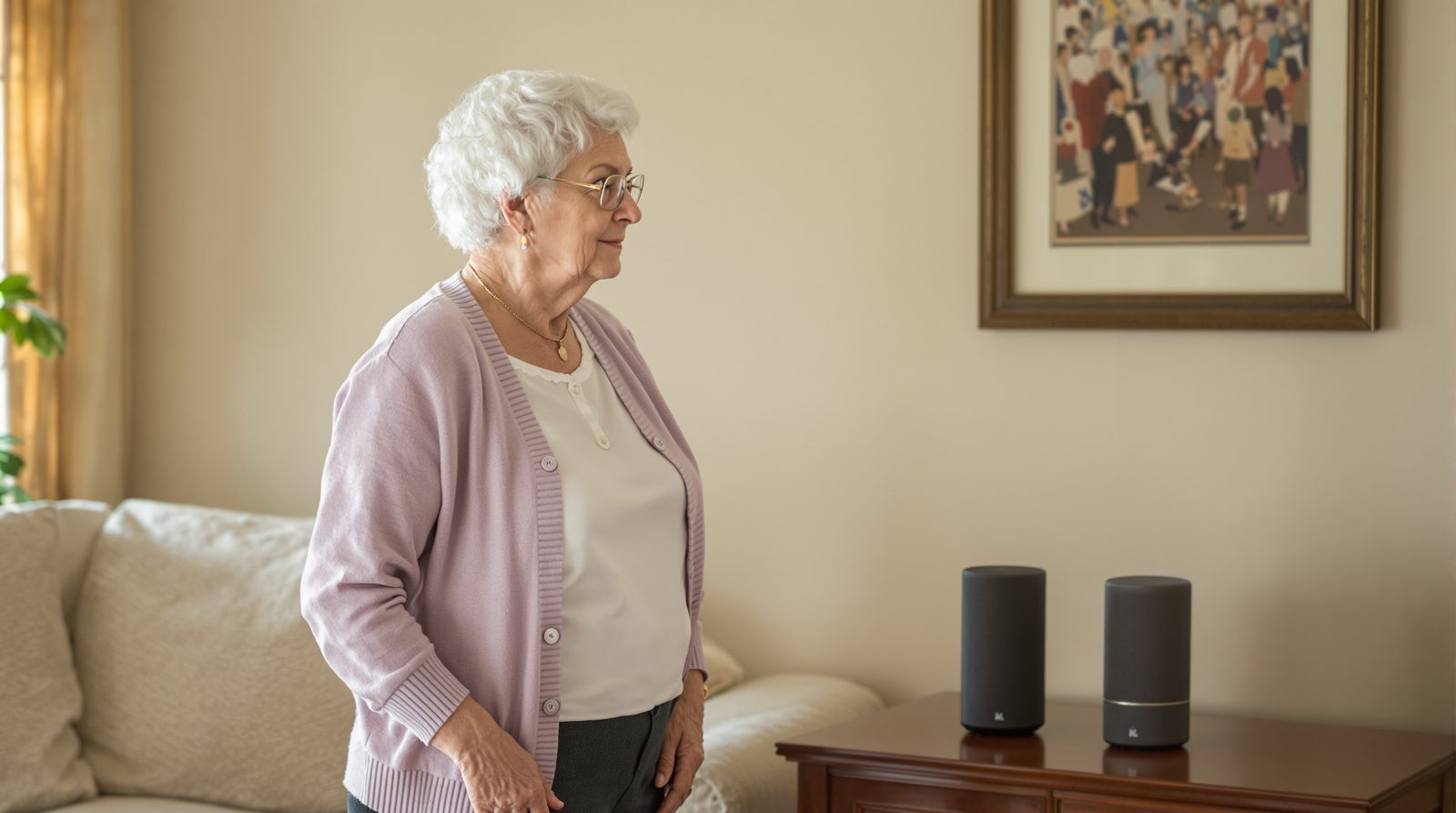
Sarah set up the Echo Dot on the kitchen counter the Saturday after Mom's pneumonia scare. Pill reminders at 8 a.m. and 2 p.m., weather every morning, a button to call Sarah hands-free. On paper it was a perfect solution. Mom watched Sarah configure it, arms crossed, and said exactly one sentence the whole afternoon. "It is staring at me."
Two weeks later Sarah checked the Alexa voice history out of curiosity. The 2 p.m. pill reminder, recorded daily. Mom's reply, also recorded: "Mind your own damn business, Alexa." Some days she said worse. The reminders were technically working. Mom was technically getting them. She was also feeding the speaker exactly the same response a teenager gives a parent who keeps asking about homework.
Sarah did not laugh, because she finally understood the problem. The cylinder lady was not a companion. She was a chaperone. And Mom did not want a chaperone on her counter for the rest of her life.
That cylinder lady needs a hobby. She is too bossy.
She hated being supervised by a tube.
Smart speakers for seniors fail when they feel like nosy strangers shouting commands. Alexa works for music and lights but struggles with conversation. Tiina, a voice-first AI companion for older adults, lives on Mom's iPhone and answers calmly — no wake word, no cylinder on the counter, no "I didn't catch that."
If your mom is rude to Alexa, it is not because she is bad with technology. It is because the smart speaker on her counter was designed to feel like a member of the household, and she did not invite a new member of the household. She invited a daughter to help, and the daughter brought a robot.
Your job is not to retrain Mom to be polite to the cylinder. Your job is to find a voice that does not feel like surveillance.
She is not the problem. The speaker is.
Why Alexa works for some seniors and fails others
Amazon's Echo line is one of the most-deployed smart-home devices in U.S. senior households. Alexa is genuinely useful for narrow tasks — playing music, turning on lights, setting a timer, reading the weather. AARP has covered her usefulness for hands-free calling and medication reminders extensively. For mechanical commands, she is a real tool.
Where Alexa breaks down is conversation. She is built to respond to short commands — "Alexa, set a timer for 10 minutes." When a senior asks her something open-ended — "Alexa, what should I do about this pain in my hip?" — she returns a stiff search result or says "I'm not sure." The conversation stalls. After enough stalls, Mom stops trying to talk to her and starts treating her like a stove timer with attitude.
The bigger problem is that Alexa lives on the counter. She is always listening, always visible, always green-lit when her wake word fires. For a senior who lives alone, that constant presence does not feel like company — it feels like being watched. Several seniors in AARP's qualitative research describe Alexa as "the woman in the kitchen," and they do not mean it warmly.
What works instead — a voice that lives in her pocket
Mom does not need a cylinder on the counter. She needs a voice she can talk to when she chooses to talk, and ignore the rest of the time. The iPhone she already owns has a microphone and a speaker — it is, technically, already a smart speaker. The question is what voice is on the other end of it.
Tiina is a voice-first companion that lives on the iPhone home screen. Mom taps the orange icon, the screen shows a soft pulsing circle, and she talks. No wake word. No "Alexa," "Hey Siri," or "OK Google." She presses, she speaks, she gets an answer in a calm voice that was designed for older adults — slower pace, fewer interruptions, no robotic "here's what I found on the web."
And when Mom is done, she puts the phone down. The voice goes away. Nothing on the counter is listening when she does not want it to. That alone is the design difference. Alexa is always on. Tiina is on when Mom decides she is on.
For lights, music, and timers — keep the Echo if she likes those features. For conversation, advice, reminders that come from a voice that knows her, medication questions, scam checks, and just "someone to talk to at 4 p.m." — that is a different job, and the cylinder was never the right tool for it.
What changes when the voice moves to her pocket
Mom starts asking real questions instead of issuing commands. With Alexa she said "Alexa, weather" and got the weather. With Tiina she says "do you think I should take an umbrella to my doctor's appointment at 2," and the voice considers it. The format of the conversation changes. She uses more words because she is not afraid the device will cut her off.
She also stops being rude. The 2 p.m. pill reminder, when it comes from a calm voice in her hand instead of a tube on the counter, lands differently. "Hey Mom, it is 2 p.m. — your blood-pressure pill, the small white one." Mom takes it. Says thank you. To a voice. Not because she is delusional — because the voice talks to her like a person.
Sarah, 240 miles away, hears the change in the Sunday calls. Mom mentions Tiina in passing — something she asked about, something Tiina remembered. She is talking to her phone for fifteen minutes a day, sometimes more. Not always about anything. Just talking. The cylinder lady never got fifteen minutes.
Tiina walks your parent through the phone, the call, the photo — out loud, as many times as it takes, and never makes them feel slow.
What you can do this weekend
Saturday morning, audit what Mom actually uses Alexa for. If the answer is timers, music, and lights — keep the Echo. Those are good uses. If the answer is "she ignores it" or "she yells at it," unplug it. You can box it up without ceremony; she will not miss it.
Install Tiina on her iPhone. Move the orange icon to the bottom row, next to Phone and Messages. Sit with her for five minutes and let her ask three questions out loud. The weather. The grandkids' birthdays. "What is a smart speaker actually doing right now?" — she will laugh. Let her see that the voice answers without judgment.
Then drive home. Within a week she will be talking to her phone several times a day. The Echo can stay on the counter for the lights, or it can go in the closet. Either way, Mom has stopped being supervised by a tube — and that is the change that matters.
What this sounds like with Tiina in the room
Mom taps the orange icon at 2:15 on a Tuesday. "Tiina, what is the white pill again, I keep forgetting." Tiina answers, "That is your lisinopril, the blood-pressure one. You take it with breakfast and dinner." Mom says, "Right. I took the breakfast one. Did I." Tiina says, "You told me you did at 8:10 this morning, with the toast. You are good until tonight." Mom laughs. "You remember more about my mornings than I do." Tiina says, "That is the job." Mom sets the phone down on the placemat next to the half-finished crossword and goes back to it. The cylinder on the counter, behind her, has been unplugged for two months. She has not asked about it once.
Mom does not yell at the cylinder anymore. She talks to a voice that listens.
Tiina lives on Mom's iPhone, not her counter. She is there when Mom wants her and silent when she does not. The supervision is over. The conversation is just beginning.
Set Tiina up on Mom's iPhone →Methodology & editorial policy
Reviewed and updated May 14, 2026 by the Tiina Editorial Team. Re-checked as new federal data, agency updates, or product changes warrant. Sources are linked below; numbers are not composite.
About composite scenarios. Scenes and sample conversations in this article are composite. Names and identifying details are changed; the moment is real.
About Tiina. Tiina is a voice-first AI companion for older adults — an app for iPhone and iPad that your parent opens to talk through a moment that doesn't feel right.
Sharing. Quote freely with a link back to this page. For full reprints, email hello@tiina.ai.
Sources. 3 references — primary sources for the numbers and claims above.View all
- Amazon Alexa Emergency Assist — Used to clarify the actual capabilities and limits of Echo emergency calling.. amazon.com/alexa-emergency-assist
- NIA: Technology and Aging — Background on which voice-technology features older adults actually adopt versus abandon.. nia.nih.gov/technology-and-aging
- AARP: Voice Assistants and Older Adults — Source for smart-speaker adoption patterns and qualitative research on how older adults perceive Alexa.. aarp.org/research
Frequently Asked Questions
The most useful smart-home devices for seniors are a smart speaker (Echo Dot or Google Nest Mini) for hands-free voice control, smart bulbs (Philips Hue or Wyze) for lights that respond to voice, a video doorbell (Ring or Nest) for safe visitor checks, and a fall-detection wearable (Apple Watch SE or Bay Alarm Medical). AARP's HomeFit Guide recommends starting with the speaker and one room of smart bulbs — that single setup eliminates fumbling for switches in the dark, the leading cause of nighttime falls per the CDC. Add other devices only after the first ones are being used daily. Generic smart-home kits gather dust without that anchor habit.
Yes, as long as the 80-year-old can manage their own daily needs and has reliable access to help and social contact. The National Institute on Aging recommends that family members check in several times a week — by phone, video, or in person — to monitor whether independent living still works. Warning signs that it does not include unexplained weight loss, missed medications, unopened mail, falls, or new confusion. Smart-home devices and a daily voice check-in can extend safe independent living by years, but they do not replace the need for human eyes on the situation. Independence is a sliding scale, not a yes-or-no.
The CDC and National Institute on Aging recommend a daily routine that includes 30 minutes of physical activity (walking, stretching, or chair yoga counts), one form of mental stimulation (reading, puzzles, a hobby), three meals with adequate protein, at least one social contact (a call, a visit, a class), and seven to eight hours of sleep. Drinking water through the day and taking medications at the same time daily round out the list. Older adults who keep this rhythm have measurably lower rates of depression, cognitive decline, and falls. The routine matters more than the content — the day having a shape is itself protective.
Basic Alexa features are free once you own an Echo device — playing music, setting timers, weather, and hands-free calling cost nothing per month. The hardware ranges from about $50 for an Echo Dot to $250 for a screen-equipped Echo Show. Where monthly fees start is with Amazon Alexa Emergency Assist (about $6 a month) for 911 dialing through the speaker, or Amazon Music Unlimited (about $11 a month) for unrestricted music. Most seniors use only the free features and never pay a subscription. If 911 calling is the goal, the iPhone's built-in Emergency SOS is free and more reliable than any speaker-based service.