Does Medicare Cover Dental? What Your Parent Can Do Instead
Original Medicare won't pay for cleanings, fillings or dentures. Here are the real ways to cover a parent's dental care, from plan benefits to free programs.
Some links below are affiliate links: if you buy through them, Tiina may earn a small commission at no extra cost to you. As an Amazon Associate I earn from qualifying purchases.
Original Medicare doesn't cover routine dental care: no cleanings, fillings, extractions or dentures. It pays only when dental work is tied to certain medical treatment, like an exam before a heart valve replacement or organ transplant. For everyday care, look at a Medicare Advantage plan with dental benefits, your state's Medicaid program, dental schools, community health centers and free care through Dental Lifeline Network.
We're not dentists or insurance advisers. Plan benefits can change from year to year, so confirm coverage with the plan before your parent books major work. A toothache that won't go away or a bump on the gums needs a dentist soon, and a swollen jaw is serious: untreated tooth infections can become dangerous. If swelling makes it hard to breathe or swallow, call 911.
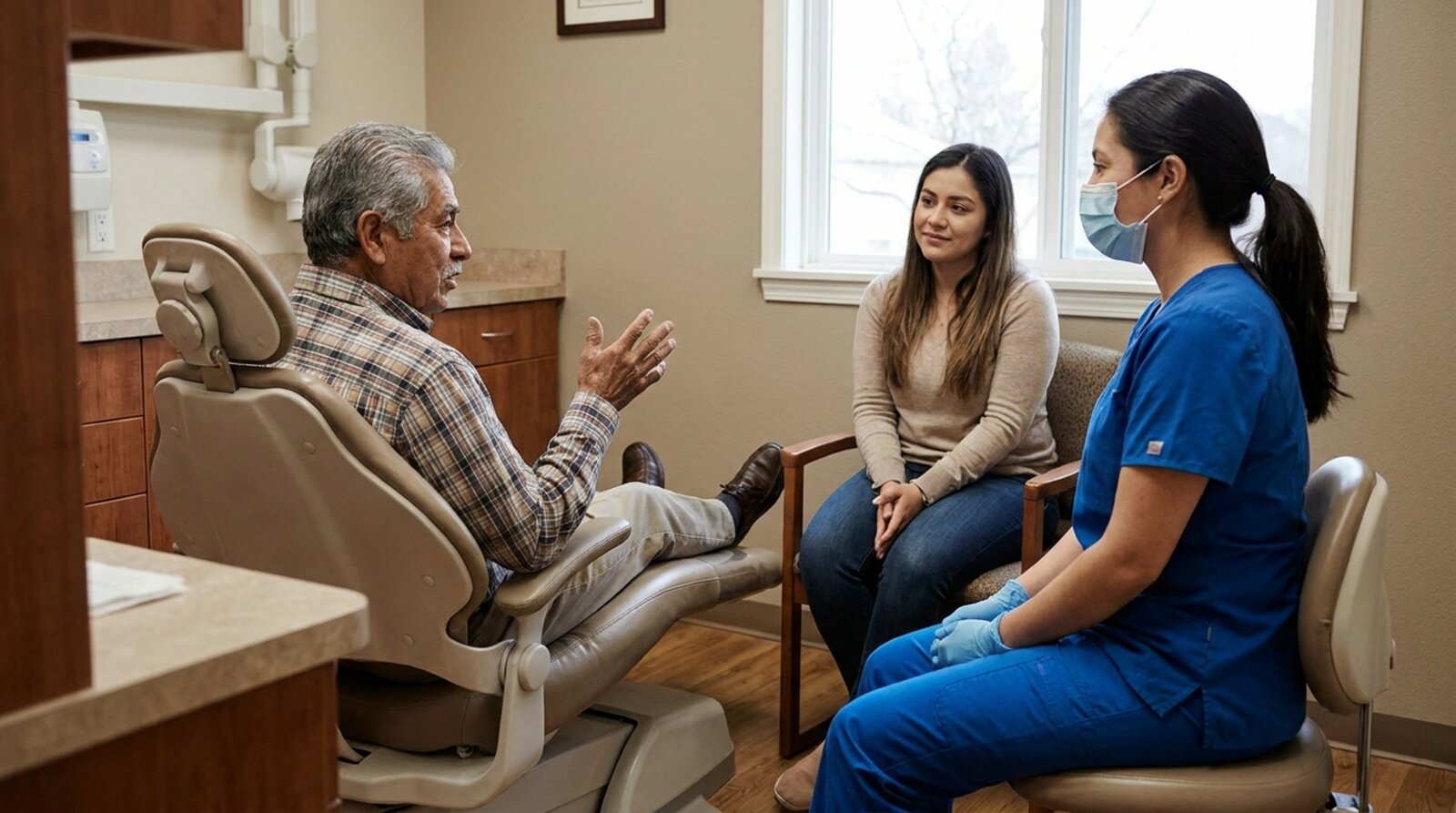
Your dad mentions, almost in passing, that he's been chewing on the left side for a few months. A back tooth hurts. He hasn't seen a dentist since he retired, because he assumed Medicare would take care of it when the time came, and then found out it doesn't. Now the tooth is worse and he's quietly worried about the bill. He's far from alone: nearly half of people on Medicare had no dental coverage at all as of 2019, according to KFF. The good news: there are more ways to pay for a parent's dental care than most people know, and some cost little or nothing.
What Medicare covers, and what it doesn't
According to Medicare.gov, Original Medicare (Parts A and B) generally doesn't cover routine cleanings, fillings, tooth extractions, dentures or implants. If your parent has only Original Medicare, they pay the full cost of everyday dental care.
Medicare may cover dental care when it's tied to a medical treatment. When it does, your parent usually pays 20% of the Medicare-approved amount after the Part B deductible, plus a facility copay if the work happens in a hospital outpatient setting. Ask the doctor's office to coordinate with the dentist so the claim is billed correctly. The covered situations are:
- An oral exam and dental treatment needed before a heart valve replacement or an organ, kidney or bone marrow transplant.
- Treating a mouth infection, such as pulling a tooth, before cancer treatment like chemotherapy.
- Treating complications that come up during head and neck cancer treatment.
- Dental exams and infection treatment before and during dialysis for kidney failure.
- Some dental services during a hospital stay, when the procedure or your parent's condition requires admission.
Medicare Advantage dental: read the fine print
Medicare Advantage plans, sold by private insurers, can add extra benefits that Original Medicare doesn't have, including some dental. But "includes dental" can mean a lot or very little.
Two numbers matter most. The first is the annual maximum, the most the plan will pay in a year. In KFF's analysis of 2021 plans, 78% of enrollees with fuller dental coverage were in plans with a yearly cap, averaging $1,300. The second is coinsurance for bigger work. KFF found 50% was the most common share for fillings, extractions and root canals.
Before your parent picks or keeps a plan, ask:
- What's the yearly maximum for dental, and does it cover dentures?
- Is my parent's current dentist in the network?
- What do cleanings cost, and what share do we pay for fillings, extractions and crowns?
- Is there a waiting period before major work is covered?
- Will the plan pay anything if my parent sees a dentist outside the network?

When to switch plans, and who can help for free
Your parent can switch Medicare Advantage plans, or move between Original Medicare and Medicare Advantage, during Open Enrollment from October 15 to December 7 each year. If they're already in a Medicare Advantage plan, they get a second chance from January 1 to March 31.
Plans can change their benefits from one year to the next, so a plan that covered your parent's cleanings this year may cap or drop dental next year. Before October 15, sit down with your parent and the plan's benefit summary for next year, and check three lines: the dental yearly maximum, whether dentures are covered, and whether their dentist is still in the network. If any of those changed, that's the year to compare.
Comparing plans is a slog, and it's easy to miss a cap or a network rule. Your parent's State Health Insurance Assistance Program, called SHIP, gives free one-on-one Medicare counseling and doesn't sell anything. Bring the plan's dental summary to the appointment. And if a plan letter or explanation of benefits makes no sense, here's what an EOB actually means.

The plan's dental summary, the yearly maximum, the coinsurance line: your parent can read it aloud to Tiina or share a photo, and she explains it in plain words and talks through what to ask the plan. They decide.
Medicaid and dental: it depends on the state
If your parent has Medicaid, alone or alongside Medicare, check their state's dental benefit. Medicaid.gov is blunt about it: states choose whether to provide dental benefits for adults, and there are no minimum requirements. So what's covered can look very different from one state to the next.
Call the state Medicaid office or the member services number on your parent's Medicaid card and ask exactly what's covered for adults. If you're not sure your parent qualifies for Medicaid or other help, the BenefitsCheckUp tool from the National Council on Aging shows which benefit programs your parent may qualify for.
Low-cost and free dental care
The National Institute of Dental and Craniofacial Research lists the places families find affordable care. These are the ones most useful for an older parent:
- Dental school clinics. Students treat patients under supervision, usually at lower cost. Find accredited programs with the American Dental Association's school search.
- Community health centers. Federally funded centers charge what you can afford based on income, and many have dental clinics. Search by address with HRSA's Find a Health Center.
- Dental Lifeline Network. Its Donated Dental Services program gives comprehensive treatment at no cost to people who are 65 or older, permanently disabled or medically fragile and can't afford care. Your parent must use any dental insurance or Medicaid first, it's a one-time service, and waitlists run from several months to a year or more. Some counties are closed to new applications.
- Your local health department, or a call to 2-1-1. Both can point you to free or reduced-cost dental programs nearby.
Helping a parent who hasn't seen a dentist in years
Cost is often only part of it. Some parents are embarrassed about the state of their teeth, or dread being lectured, or have dentures that stopped fitting long ago and just stopped wearing them. Go with them to the first visit if you can. It changes the whole tone.
If your parent lives in assisted living or a nursing home, ask the staff whether a dentist or hygienist visits on site. It can save a hard trip, especially for a parent who uses a wheelchair or gets anxious in new places.
Bring a current medication list. The dentist needs to know every medicine your parent takes before any treatment, and keeping a medication list for an elderly parent up to date makes every appointment easier. Ask for a written treatment plan with prices before any major work, ask what's urgent and what can wait, and ask for the cash price too. Sometimes it beats what you'd pay through the plan.
These appointment prep tips for aging parents work for the dentist just as well as the doctor.
- Find every card in your parent's wallet: Medicare, any Medicare Advantage or Medicaid card, any separate dental plan.
- Call the number on each card and ask whether it covers dental, the yearly maximum and the share for fillings and dentures.
- Ask for the list of in-network dentists near your parent.
- If there's no coverage, look up the nearest community health center and dental school clinic.
- If your parent is 65 or older and can't afford care, check whether Dental Lifeline Network is open in their county.
- Write the answers on one page and keep it with your parent's insurance papers.
Dad finally sees a dentist, and stops chewing on one side.
When the Medicare Advantage dental letter makes no sense, he can share a photo of it with Tiina and ask what it means, as many times as he needs. Then he calls the dentist himself.
Try Tiina with Dad →Frequently Asked Questions
Methodology & editorial policy
Reviewed and updated October 31, 2026 by the Tiina Editorial Team. Facts, programs and prices in this guide come from the sources listed below.
About composite scenarios. The opening scene is a composite drawn from common caregiver experiences, not one family's story.
About Tiina. Tiina is a voice-first AI companion for older adults: an app for iPhone and iPad that your parent opens whenever they want someone to talk to, day or night.
Sharing. Quote freely with a link back to this page. For full reprints, email hello@tiina.ai.
Sources. 9 references: Medicare.gov, KFF, Medicaid.gov, NIDCR, Dental Lifeline Network, SHIP National Technical Assistance Center, MedlinePlus.View all
- Medicare.gov. Dental services. medicare.gov
- Medicare.gov. Compare Original Medicare and Medicare Advantage. medicare.gov
- Medicare.gov. Joining a plan: enrollment periods. medicare.gov
- KFF. Medicare and Dental Coverage: A Closer Look. kff.org
- Medicaid.gov. Dental care. medicaid.gov
- NIDCR. Finding low-cost dental care. nidcr.nih.gov
- Dental Lifeline Network. Apply for help: Donated Dental Services. dentallifeline.org
- SHIP National Technical Assistance Center. Find your local SHIP. shiphelp.org
- MedlinePlus. Tooth abscess. medlineplus.gov