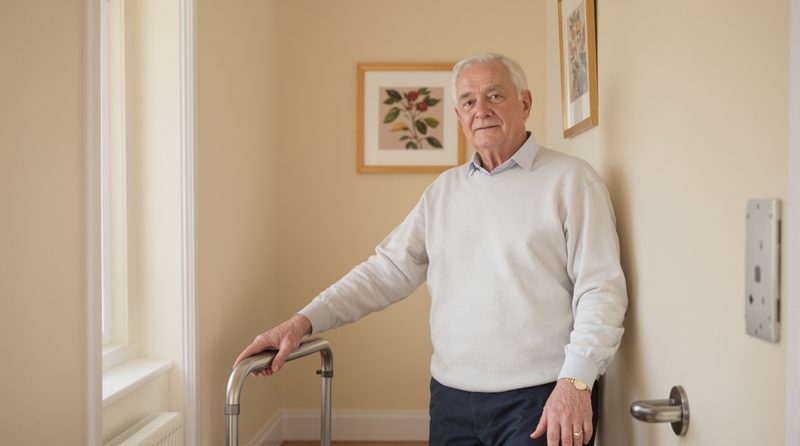
How to Take Care of Elderly Parents, Realistically
Ingrid's mother is 83 and "fine." The kitchen table says otherwise.
Saturday, 10:20 AM, Dayton. Ingrid, fifty-four, lets herself into her mother's kitchen with a bag of bagels and finds the table she did her homework on for twelve years buried under mail. Catalogs. Charity envelopes. A hospital bill flagged with a curling yellow note. Two letters from the insurance company that look exactly like the seventeen pieces of junk designed to look like letters from the insurance company.
Gladys is at the counter pouring coffee, narrating her week. She is eighty-three, sharp, funny, and entirely in charge of this room. Ingrid slides the pile toward herself anyway — just to straighten it — and her mother's hand comes down flat on the stack. I have a system. A beat. You're hovering, sweetheart.
Driving home, Ingrid runs the inventory she's been avoiding. The reading glasses on every flat surface. The bathtub with no grab bar. The pile. Nobody handed her a job description, but she has one now — and no idea which part matters first, or how to do any of it without becoming her mother's supervisor.
I ran this kitchen for fifty years. I don't need a manager in it.
The job is to keep her the author of her own life.
Start with an honest assessment of what your parent actually needs — then work in order of stakes: falls, money and mail, health logistics, and the quiet hours in between. Keep her the decision-maker at every step. Tiina, a voice-first AI companion for older adults, covers the hours you can't. Here's the realistic version of each step.
If you feel like you're failing at a job you never applied for, you're in the largest club in America. Roughly one in four U.S. adults with a parent 65 or older — 24% — says they're already helping care for them, per Pew Research Center's February 2026 report on family caregiving in an aging America. Almost none of them got training. All of them are improvising.
And the fastest way to lose your mother's cooperation is to treat her like a problem you're managing. She isn't a task list. She's a capable adult whose life is changing shape — and how you show up in the next six months decides whether she experiences you as backup or as a takeover.
Dignity first. Logistics second. In that order, both get easier.
Start with an honest assessment — of what she still owns
Before you fix anything, spend one ordinary day together. Not a holiday, not a visit with an agenda. Watch what is actually hard — not what you fear is hard. The gap between those two is where most adult children go wrong in the first month.
Ingrid assumed the problem was the stairs. It wasn't; Gladys takes them slowly and fine. The problem was paper — anything arriving in an envelope that required a decision. One afternoon of paying attention taught her more than a month of worried phone calls.
Then draw two columns. What she needs help with. What she still owns. Gladys still owns the cooking, the garden, her own checkbook, and every opinion she has ever held. That second column is not a nice-to-have — it is the whole point. Every task you take over without being asked is a room of her life you've walked into uninvited.
Ask her the question directly, once: What's the one thing that would actually make your week easier? Then do that thing first, even if it isn't the thing that worries you most. You're building the trust you'll spend on the harder conversations later.
Just as important: know what can wait. The driving conversation — if she's still driving safely in daylight, it can wait. The housing question — one hard visit does not mean the house has stopped working. The full legal-paperwork project can start with a single conversation about where the important documents live, not a binder by Friday. A crisis compresses all of these into one terrible week; the whole point of starting now, calmly, is that you get to take them one at a time.
Falls: fix the house before it proves a point
Falls come first because the stakes are the highest and the fixes are the cheapest. The CDC counts more than 14 million adults 65 and older reporting a fall each year — and the hallway rug, the dark stair, and the bathtub with nothing to hold are behind an outsized share of them (CDC falls data).
The afternoon version: take up the throw rugs, put a grab bar in the shower, light the path from bed to bathroom, and retire the step stool by moving what she reaches for down a shelf. Do it with her, not to her. Which of these rugs would you actually miss? lands very differently than a silent purge while she's at church.
The room-by-room version — nine fixes, one afternoon — is in our fall-prevention guide. It is the single highest-return errand on this entire page.
The money and the mail
The pile on Gladys's table holds the two money problems every adult child eventually meets: confusion and predators. The confusion is by design — insurers, hospitals, and half the junk-mail industry print envelopes engineered to look official. The predators are professionals, and they work this age group by phone, text, and mail, full time.
Start with a standing date: twenty minutes, once a week, coffee on. She opens, you translate, she decides. Move the boring, unchanging bills to autopay — with her approval, from her account, with her still the signer. The goal is fewer envelopes that demand a decision, not a daughter holding the checkbook.
Then have the scam conversation before there is a scam, the way you'd talk about a storm before it hits. Reported losses to romance scams alone hit record levels among older Americans last year, per AARP's fraud research — and romance scams are only one lane. Our guide to the seven phone scams targeting seniors gives you the exact sentence that stops each one. And if the bank statements already look strange — withdrawals she can't explain, a new "friend" helping with her finances — read the warning signs of elder financial abuse today, not this weekend.
Health logistics, without becoming her secretary
The medical file arrives in your life one appointment at a time. Two tools carry most of the weight.
First: one current medication list — every prescription, the dose, the prescribing doctor, the pharmacy's number — that lives in her purse and in your phone as a photo. Update it in the parking lot after every appointment, while the changes are still fresh. When anything goes wrong, this list is the first thing every professional will ask for.
Second: go to the big appointments, and walk in with three written questions. Not fifteen — three. Our doctor questions checklist is built for exactly this. In the exam room you are the recorder, not the patient: she talks to her doctor, you write the answers down.
Between appointments, the real risk isn't dramatic. It's the 8 AM and 8 PM pills with nobody there to notice a missed day. Medication reminders that actually work covers the systems that survive a week when you don't call — because there will be weeks when you don't call.
The hours in between
Here is the part nobody warns you about: most of taking care of an elderly parent is not appointments and paperwork. It's Tuesday at 2 PM. The house is safe, the bills are paid — and your mother is alone with a quiet phone while you're in a meeting until five.
Loneliness at this age isn't a mood; it's a current dragging on everything else — appetite, sleep, whether the pills seem worth taking. If your mother lives alone, especially after losing a spouse, the in-between hours are the actual job. And if you're doing all of this from another city, the long-distance playbook is its own discipline.
This is also where technology either earns its place or fails your parent. Be honest about the field: every leading AI tool is built for the tech-savvy. A keyboard. A typed prompt. An account, settings, updates. Impressive for people who grew up on them — a locked door for a lot of 83-year-olds who could use the help most.
Tiina was designed from the opposite direction: from the ground up for older adults and people who aren't tech-savvy. One button on the iPhone. A patient voice that never rushes and never talks down. Nothing to configure. Gladys asks about a word in the hospital letter, reads a suspicious text out loud before answering it, or talks through the afternoon with someone who remembers what she said yesterday. The answers, the scam backstop, the company — without asking her to become a different person first.
And the conversation belongs to her. Tiina doesn't report to anyone; what Gladys says stays hers, to pass along or keep. That's not a limitation — it's the reason she keeps using it. If you'd be the one setting it up, the families page shows what that looks like end to end.
Tiina talks with your mother between your visits — patient, unhurried, hers alone — so Tuesday at 2 PM isn't so quiet.
When she says no
Expect the no. It is not a verdict on you; it is a defense of the second column — the things she still owns. "Help" can sound like a status change she never agreed to, or like becoming a burden, which she would rather struggle than be.
Three reframes do most of the work. Make the help invisible — the grocery delivery was cheaper than gas. Make it a favor to you — I'd worry less. Do it for me. Make it reversible — one month, and if you hate it, we cancel. Most parents will accept a trial they'd refuse as a life sentence. When nothing works and she is still mentally sharp, respect the no while keeping the door open: capable adults get to make choices you wouldn't. The full playbook — including what changes when capacity genuinely starts to slip — is in when an elderly parent refuses help.
Take care of the caregiver, too
Six months in, Ingrid noticed she had started dreading her mother's name on caller ID. Not because of Gladys — because every call was one more brick in a bag she never set down. That is not a character flaw. That is arithmetic: hours going out, nothing coming back in.
The protections are unglamorous and non-negotiable. Keep one weekly thing that is yours — the choir, the run, the standing coffee — and treat it like a shift you cannot drop. Say yes when a sibling or a neighbor offers something specific. Keep your own doctor's appointments. And learn the signs of caregiver burnout before you're past the line, because the line moves quietly and almost everyone finds it late.
Your mother does not need a martyr. She needs you upright, for years — and she would be the first to say so.
What this sounds like with Tiina in the room
Wednesday, 4:40 PM, Gladys's kitchen. The mail came at noon; one envelope from the insurance company has been sitting by the fruit bowl ever since, radiating. Gladys taps the orange circle on her iPhone. Tiina, I got a letter that says my plan is changing and I can't tell if it's real. Tiina says, Read me the first few lines, Gladys — just as they're written. She does, glasses on. That's an annual renewal notice, Tiina says. It's real, and it isn't asking you for money or a phone call today. There's one date worth circling — the enrollment deadline. Do you see it?
Gladys finds it and circles it in pen. Ingrid's been asking about this pile all month, she says. Tiina says, Then tell her you handled this one. You caught it, you read it, you know the deadline. That's a good phone call to make. Gladys laughs — it is, isn't it — and sets the letter on the done pile. Saturday, when Ingrid asks about the mail, her mother slides one envelope across the table with the date circled. Not a problem to inherit. A decision already made.
Mom reads the letter to Tiina before it joins the pile.
You can't be at the kitchen table every afternoon. Tiina can — a patient voice that helps your mother sort the confusing from the dangerous and keeps her running her own house. She stays the author. You stop dreading the pile.
Try Tiina with Mom →Methodology & editorial policy
Reviewed and updated July 8, 2026 by the Tiina Editorial Team. Re-checked as new federal data, agency updates, or product changes warrant. Sources are linked below; numbers are not composite.
About composite scenarios. Ingrid and Gladys are composite characters. Scenes and sample conversations in this article are composite; names and identifying details are changed. The moments are real.
About Tiina. Tiina is a voice-first AI companion for older adults — an app for iPhone and iPad that your parent opens to talk through a moment that doesn't feel right.
Sharing. Quote freely with a link back to this page. For full reprints, email hello@tiina.ai.
Sources. 3 references — primary sources for the numbers and claims above.View all
- Pew Research Center: Family Caregiving in an Aging America (February 2026) — Source for the 24% of adults with a parent 65 or older who say they provide care. pewresearch.org/social-trends
- CDC: Older Adult Falls Data and Statistics — Source for the 14 million-plus adults 65 and older who report falling each year. cdc.gov/falls/data-research
- AARP: Romance Scam Losses Hit Record Levels (February 2026) — Source for the record reported romance-scam losses among older Americans. aarp.org/press/releases
Frequently Asked Questions
Start by watching, not fixing. Spend one ordinary day with your parent and write down only what you actually saw was hard — not what you fear. Then ask one question: "What would genuinely make your week easier?" and do that first, even if it isn't the thing that worries you most. Keep two lists: what they need help with, and what they still own — the cooking, the checkbook, the decisions. Take the smallest task that solves a real problem, leave the second list alone, and make every change reversible ("let's try it for a month"). Helping without taking over is mostly a matter of sequence: trust first, then the harder conversations.
Falls, then money, then health logistics. Falls first because the stakes are highest and the fixes are cheapest: the CDC reports that more than 14 million adults 65 and older fall each year, and one afternoon of removing throw rugs, adding a grab bar, and lighting the bed-to-bathroom path takes out the biggest hazards — our fall-prevention guide has the room-by-room list. Second, the mail and the money: a weekly twenty-minute sort together, autopay for the unchanging bills, and the scam conversation before there's a scam. Third, health logistics: one current medication list and three written questions per doctor visit. Everything else can usually wait until this base is in place.
Build three layers: a local responder, scheduled contact, and a daily in-home presence. The local responder is a sibling, neighbor, or paid aide who can be at the house within the hour — and has a key. Scheduled contact means calls at fixed times, so a missed call is a signal instead of a guess. The daily presence is whatever fills the hours in between: a senior-center routine, a companion who visits, or a voice companion your parent genuinely enjoys using. Keep one shared document with doctors, medications, and insurance details you can read from anywhere. Our long-distance caregiving playbook covers the full system, including the first weekend setup.
First, decode the no. It usually means fear of lost independence, fear of being a burden, honest denial, or an old family script — not stubbornness. Then reframe instead of re-arguing. Make the help invisible (a grocery delivery that "was cheaper than gas"). Make it a favor to you ("I'd worry less — do it for me"). Make it reversible ("one month, then we cancel if you hate it"). Most parents will accept a trial they would refuse as a permanent arrangement. If your parent is mentally competent and still says no, that is their right: stay close, and be ready with a specific offer when the window opens. Our guide to when an elderly parent refuses help has the full scripts.