The Grandparent Scam: AI Voice Clones and the Three Calls
The three calls, the family code word that stops them, and what to do when your dad hears your nephew's voice and writes a check before he calls anyone.
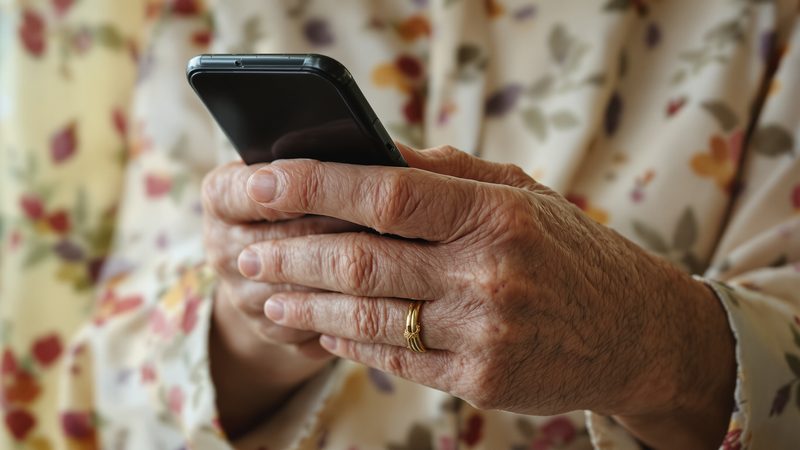
The grandparent scam is the call where someone pretending to be a grandchild — or, in 2026, an AI voice clone of an actual grandchild — says they're in trouble and need money fast. A few seconds of public audio (a TikTok, a voicemail, a school presentation) is enough to clone a voice convincingly. The fix isn't technical. It's a single agreed family code word, plus a calm voice on the other end of the call after — somebody like Tiina, a voice-first AI companion for older adults, who won't make Dad feel dumb for picking up.
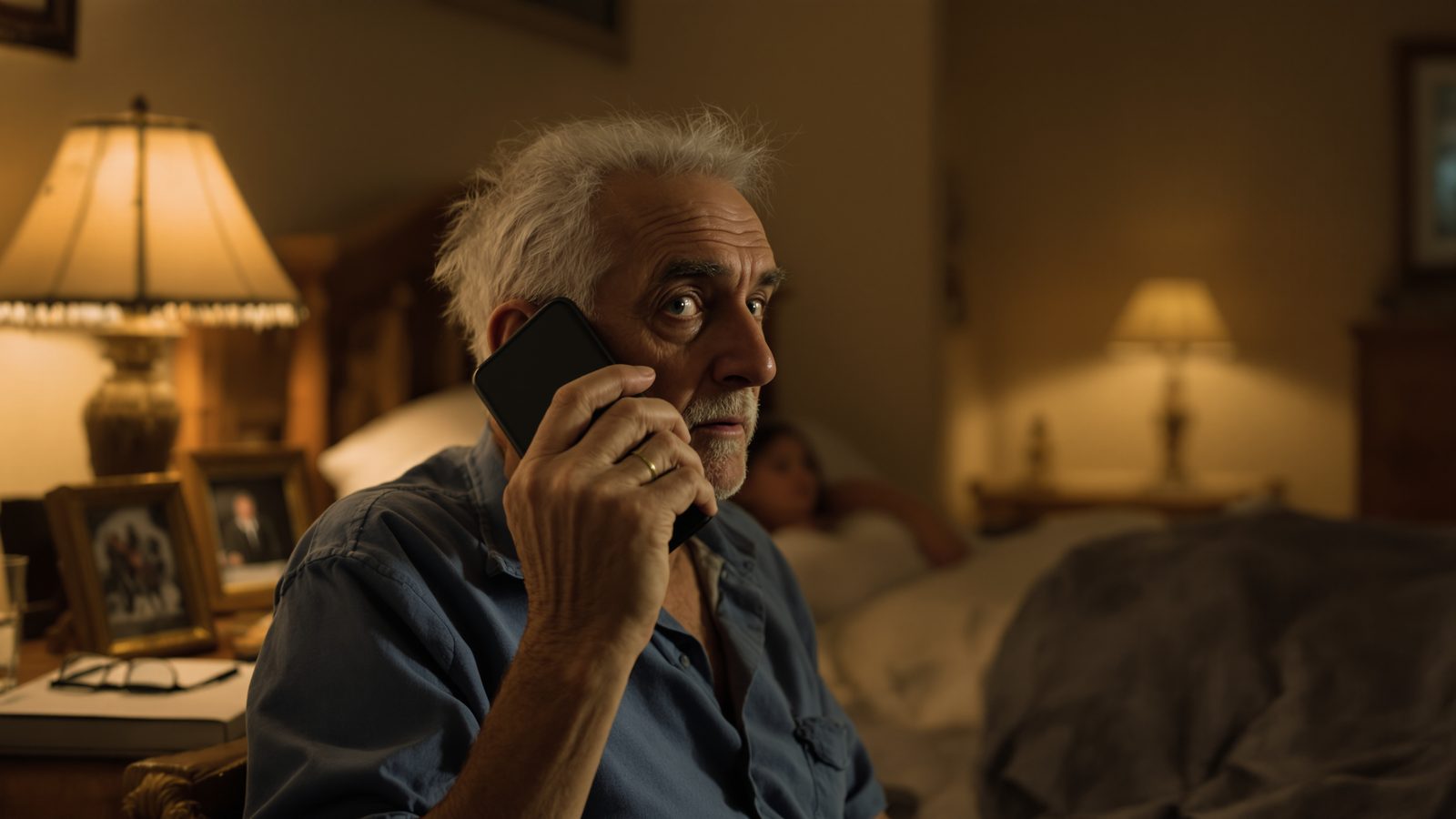
At 2:14 AM on a Wednesday, a 78-year-old retired postmaster named Earl in suburban Phoenix picked up his bedside phone on the second ring. The voice on the other end was crying.
"Grandpa? Grandpa, it's Tyler. I'm in jail. Please don't tell Mom."
Earl has one grandson named Tyler, age 19, a sophomore at the University of Arizona who is trying to be a mountain-bike YouTuber. The voice on the phone sounded exactly like him — same slight rasp from a sinus infection Tyler has had since he was twelve, same pause between sentences, same "Grandpa" the way only Tyler says it. The voice said he'd been in a car accident leaving a frat party, that there was alcohol in the car, that the bail was forty-eight hundred dollars in cash, that a bondsman named Reyes would arrive at Earl's house in forty minutes, that Tyler's mother — Earl's only daughter — absolutely could not be told because the family-court paperwork from her divorce was still active and this would tank it.
Tyler-the-real-grandson was asleep in his apartment in Tucson and had been since eleven. There was no party. There was no Reyes.
The call lasted six minutes and Earl was already in the kitchen pulling on his slippers when his wife, Mary, woke up and asked him what was wrong. He told her, and she said the four words that ended it: "Call Tracy right now." Tracy is their daughter. Tracy called Tyler. Tyler answered on the second ring, in his own apartment, with no idea what was happening.
A composite scenario, drawn from case patterns documented in FBI Internet Crime Complaint Center reporting. Names and details are invented.
But it was Tyler's voice.
Tyler has 1,400 subscribers on YouTube. He reviews trails near Tucson — Sweetwater, Fantasy Island, the Starr Pass loops. Twenty seconds of him narrating a switchback was all the cloning model needed. The scammer had pulled the audio three weeks earlier, run it through an inexpensive commercial voice-cloning tool, and uploaded a script. When Earl asked "Tyler, is that really you?" — the model improvised. It improvised in Tyler's voice. It cried in Tyler's voice. It said the word Grandpa in Tyler's voice, the way only Tyler says it.
How a fifteen-second clip becomes a phone call
The threshold for a convincing voice clone has collapsed. As far back as 2023, McAfee researchers found that widely available tools could produce a convincing clone from as little as three seconds of clean audio. By 2026, commercial tools — flagged in FTC consumer alerts — need nothing more than a short public clip to produce a voice good enough to fool a parent or grandparent who is half-asleep, scared, and listening through a landline at 2 AM.
The audio source is almost always public. A TikTok where your nephew narrates his lunch. A voicemail greeting on his old phone number that's still listed somewhere. A school video where he answers a question about Shakespeare. A Reddit comment in a niche subreddit recorded for a podcast clip. The scammer doesn't need to know your family. They need to find one teenager whose voice is online — most are — and cross-reference with a public record showing they have a grandparent.

The defense your generation grew up with — "I'd recognize my grandson's voice anywhere" — stopped working around 2024. By 2026, voice recognition is no longer a sufficient identity check. Something else has to do that work.
The three calls running right now
The script varies. The pattern is always the same: an emergency, a stranger about to arrive, a request for cash or wire or gift cards, and an instruction to keep one specific family member out of the loop.
1. The jail call
"Grandpa, I'm in jail. The bail is [amount]. The bondsman is coming to your house. Please don't tell Mom."
Most common variation. The "bondsman" is the scammer's accomplice, often using a different voice to call back five minutes later as Officer Reyes or Attorney Patterson. The address they have is your address. The fact that the grandchild's "real" voice is on the line makes the call feel verified before the scripted second voice arrives.
2. The accident call
"Grandma, I hit someone. There was alcohol in my car. The lawyer says if I pay restitution before charges are filed, it stays off my record."
Typically targets grandmothers. The narrative is engineered to maximize the urge to protect the grandchild from consequences — a "lawyer" calls back to "explain the restitution." Restitution payments are almost always demanded in cash via courier or wire transfer to a "law-firm trust account" that doesn't exist.
3. The kidnapping call (the worst one)
"Don't say anything. Don't hang up. They have me. They want $X by [time]." (Sometimes the grandchild's "voice" is replaced halfway through by a "kidnapper" giving instructions.)
This one is rare but it is the call that has driven seniors to drain retirement accounts in under an hour. The FBI's recommendation is unambiguous: hang up, call your real grandchild's parents on a known number, and call your local FBI field office. Real kidnappings of US adults from US homes are extraordinarily rare. Virtual kidnapping calls — calls where nobody is actually kidnapped, the entire scenario is theater — are common.
The family code word: the one defense that still works

The protocol is simple, and pre-AI families used it for the original (non-cloned) grandparent scam without thinking of it as a "protocol." Pick a single phrase your family will use to verify identity in any real emergency. AI cannot produce a code word the scammer doesn't know.
- Unguessable from public information. Not the dog's name. Not the hometown. Not the high-school mascot. Not the maiden name. Anything a stranger could find on Facebook in five minutes is disqualified.
- Easy for the oldest family member to remember. A short phrase that means something to your family — an old joke, a misheard song lyric, the punchline to a story everyone tells at Thanksgiving. "Purple shoelaces" works. "The chicken came from Sears" works. "Aunt Lorraine's pickles" works. The dumber the better — it's easier to remember and impossible to guess.
- Spoken, not written. Don't text it. Don't post it on a family group chat. Don't put it in a shared password manager. Tell every family member in person at the next holiday and write it on the index card by the kitchen phone, nowhere else.
- Updated when needed. If a phone is lost, hacked, or stolen, pick a new one. If a family member dies, pick a new one — old code words have a way of surviving in old voicemails and emails.
The other practical defense is the callback. Real emergencies survive a hang-up. If the person on the line is your grandchild and they are actually in trouble, you can hang up, call them on the number you already have, and call them back at the bondsman's number once you've verified. Anyone who refuses to let you do that — anyone who insists you stay on the line, or that the bondsman is "in transit," or that hanging up will get the grandchild hurt — is a scammer. That refusal is the tell.
A scammer counts on no one being there to ask. Tiina is — a companion on the phone who'll talk through any "urgent" call, calmly, before your parent does anything they can't undo.
If money was already given
For complete recovery steps, see our step-by-step recovery guide. The first hour matters most.
- Call the bank that wired the funds. Wire recall is sometimes possible if the recipient bank hasn't released funds. There's a roughly 24-48 hour window depending on the bank.
- File a complaint with the FBI's IC3 at ic3.gov. Same day. The complaint number is what banks ask for.
- File a local police report. Required for tax-loss documentation later, and for any insurance claim.
- Don't shame the parent. Shame is the reason these calls don't get reported. Shame is the reason the next call lands.
How to talk to your parent about this without making them feel watched
Don't lead with "Don't fall for the scam." That's a shame frame and it makes parents defensive. Lead with the practical: let's pick a family code word, because my friend's parent almost lost $4,000 last month. Make it about the family, not the parent.
The sentence we recommend: "I read that AI can clone a teenager's voice from a TikTok now. We should pick a code word so if anyone calls saying they're me or one of the kids, you'll know it's really us." The framing is: the scammers got smarter, not your parent got dumber. That's the truth, and it's the version of the truth your parent can act on.
Frequently asked
What this sounds like with Tiina in the room
2:23 AM. Your dad is sitting on the edge of the bed, the lamp on, his wife asleep behind him. The call ended four minutes ago. He didn't drive to the ATM. He opens Tiina and says, "It sounded exactly like Tyler. He cried. I almost — I almost got in the car." Tiina answers. Tells him what AI voice cloning is and how the call he got is documented in current FBI advisories. Tells him to call Tyler's mom in the morning, not now. Tells him to write down what the caller said while it's fresh, in case the FBI needs it. Doesn't say he was foolish. When he asks the same thing twice, she answers it twice. Your dad puts the phone down and waits for morning.
The next time "his grandson" calls crying, Grandpa hangs up and asks Tiina.
The AI voice on the line will sound exactly like Tyler. The voice in his pocket will sound like the one person telling him to breathe, hang up, and call Tyler's real number.
Get Tiina on Grandpa's phone →Methodology & editorial policy
Reviewed and updated May 9, 2026 by the Tiina Editorial Team. Updated when the FTC, FBI, or AARP issues new advisories on voice-cloning fraud (last federal update tracked in our research log: April 2026).
About composite scenarios. Earl, Tyler, Mary, Tracy — composite characters, drawn from case patterns documented in FBI IC3 reporting. The sample conversation is scripted. The scripts and call patterns are not composite; they are documented in the sources below.
About Tiina. Tiina is a voice-first AI companion for older adults — an app for iPhone and iPad that your parent opens to talk through what just happened. We are not a law-enforcement agency, a fraud-recovery service, or a phone-blocking app.
Sharing. Quote freely with a link back to this page. For full reprints, email hello@tiina.ai.
Sources. 9 references — FTC, FBI/IC3, AARP, FCC, McAfee, Microsoft Research.View all
- FTC Consumer Alert — Scammers use AI to enhance their family emergency schemes (Mar 2023, upd. 2024). consumer.ftc.gov
- FBI Internet Crime Complaint Center — 2024 Internet Crime Report, elder-fraud section. ic3.gov
- FBI Public Service Announcement — virtual kidnapping schemes (PSA I-082417-PSA, periodically reissued). fbi.gov/news/press-releases
- McAfee Labs — The Artificial Imposter consumer survey (May 2023).
- Microsoft Research — VALL-E: Neural Codec Language Models are Zero-Shot Text to Speech Synthesizers (Wang et al., 2023). arxiv.org/abs/2301.02111
- FCC Consumer Guide — Caller ID Spoofing & STIR/SHAKEN. fcc.gov/spoofing
- FTC Consumer Sentinel Network — Data Book 2024. ftc.gov
- FTC Data Spotlight — New twist to grandparent scam: mail cash (median family-emergency losses; cash payments by adults 70+). ftc.gov
- AARP Fraud Watch Network — Real-Time Voice Cloning Is the Newest Twist on the Grandparent Scam (upd. 2024-2025). aarp.org/money/scams-fraud