
How to Dispute a Medical Bill for Your Parent, Step by Step
A confusing medical bill isn't a reason to pay it. How to check it, what to say on the phone, and where to get help.
Some links below are affiliate links: if you buy through them, Tiina may earn a small commission at no extra cost to you. As an Amazon Associate I earn from qualifying purchases.
Don't pay a medical bill you don't understand. Ask for an itemized bill, compare it line by line with the insurance statement (the Medicare Summary Notice or the EOB), and call the billing office about anything that doesn't match. If the charges are right but unaffordable, ask about financial assistance. If insurance denied the claim, appeal by the deadline on the statement.
We're not lawyers or insurance advisers, and nothing here is legal advice. For free help with a Medicare bill or appeal, contact your parent's State Health Insurance Assistance Program. For problems with debt collectors or medical debt on a credit report, contact the Consumer Financial Protection Bureau.
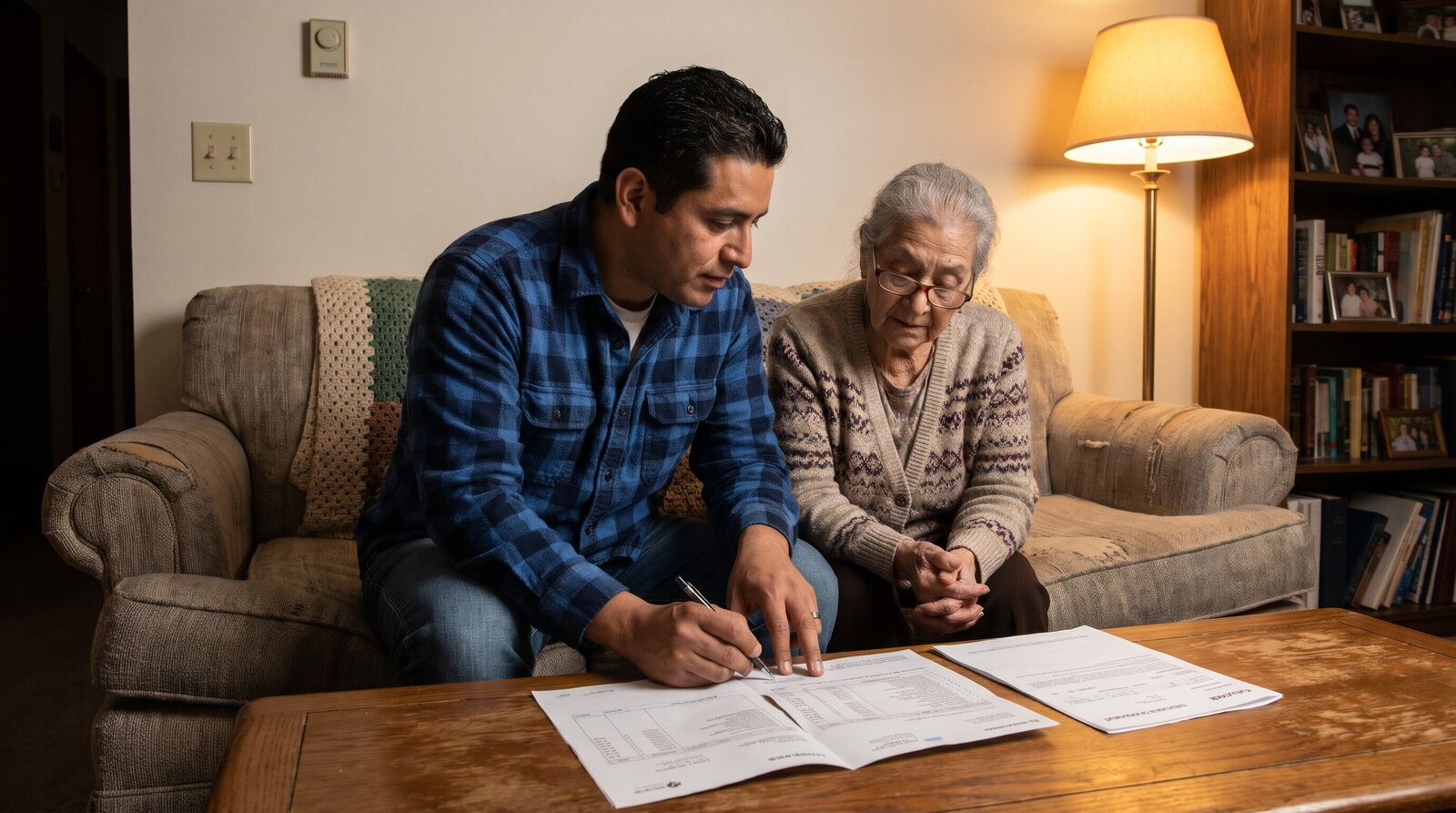
The envelope says FINAL NOTICE in red. Inside is a bill for your mom's emergency room visit back in June, the one you thought Medicare and her supplement had covered. There's no list of charges, just a total and a due date. Your mom is ready to write the check, because she's never paid a bill late in her life. Ask her to wait. Medical bills can be wrong, and checking one before paying is just good sense. You have more options here than that red stamp suggests.
Step 1: Get the itemized bill
The bill your parent got in the mail is usually a summary: a date, a total and a due date. If you're already keeping this month's bills on the bills sheet from the Caregiver's Survival Guide, note the one you want to question there, then call the billing office and ask for an itemized bill, a line-by-line list of every charge with the date, the service and the billing code. You can't check a bill you can't see.
On that same call, ask the office to put the account on hold while you look it over, so it doesn't move toward collections. The billing office may need your parent on the line, or a signed authorization, before they'll talk to you. Make the first call together if you can.
Step 2: Compare it with the insurance statement
Every bill should match a statement from your parent's insurance. With Original Medicare, that's the Medicare Summary Notice. With a Medicare Advantage plan or other insurance, it's the Explanation of Benefits, or EOB. If those papers confuse you, start with what an EOB actually means.
Can't find the statement? With Original Medicare, your parent can log into their secure account at Medicare.gov and usually see a claim within a day after Medicare processes it. The Medicare Summary Notice also shows the most your parent may owe each provider. With a Medicare Advantage plan, the plan mails an EOB in any month your parent sees a provider, and calling the plan gets you the most current claim status.
Lay the bill and the statement side by side and check that the date of service matches, the services listed match, and the amount the provider is asking for matches what the statement says your parent may owe. If the provider is asking for more than the statement shows, or there's no statement at all for that visit, the claim may not have gone to insurance correctly. That's your first phone call.
Step 3: Look for the common mistakes
Go down the itemized bill with a pen. These are the problems worth circling:
- A charge for something your parent didn't get, like a test that was ordered and then canceled.
- The same charge listed twice.
- Dates that don't match when your parent was actually there.
- A bill sent before insurance processed the claim, or sent to an old insurance plan.
- Your parent's name, birth date or Medicare number entered wrong.
- Out-of-network charges for emergency care. Federal surprise-billing rules limit those.

Your parent can share a photo of a bill or insurance letter, and Tiina explains it in plain words and talks through the next step. They decide what to do.
Step 4: Call the billing office, and what to say
Call with the itemized bill, the insurance statement and a notepad. Write down the date, the name of the person you speak with and what they promise. Then try something like this:
"Hi, I'm calling for my mother, [her name], date of birth [date], about the bill for her visit on [date]. I've compared the itemized bill with her Medicare statement, and line 6 is a charge for a test she didn't have. Can you remove it, or resubmit the claim? And can you put the account on hold while this is fixed?"
Stay calm and specific. Billing staff fix mistakes all day; vague anger slows them down. Ask for a reference number and when you'll hear back, and follow up in writing if the fix isn't on the next statement.
One warning: real billing offices don't demand payment by gift card, wire transfer or crypto. A call like that is a scam, and these Medicare scam calls are worth reviewing with your parent.

Step 5: If the bill is right but too much, ask for financial assistance
If every charge checks out and your parent still can't afford it, ask the hospital about financial assistance, sometimes called charity care. Under IRS rules for nonprofit hospitals, a nonprofit hospital must have a written financial assistance policy covering emergency and medically necessary care. It must post the policy, the application and a plain-language summary online for free, and mention it on billing statements.
If your parent qualifies, the hospital can't charge more than it generally bills insured patients for the same care, and some patients qualify for free care. Ask for the application, fill it out completely, and ask whether collection activity stops while it's reviewed. If your parent doesn't qualify, ask for a payment plan they can actually afford, ideally with no interest.
Step 6: If insurance said no, appeal
If the bill is high because insurance denied the claim, the fix is an appeal, not an argument with the hospital. For Original Medicare, the Medicare.gov appeals page explains the first step, called a redetermination. File by the date printed on the Medicare Summary Notice. Your parent can circle the denied item on the notice, explain in writing why they disagree, add their name and Medicare number, and mail it to the company listed on the last page, or use the Redetermination Request Form, CMS-20027. Medicare's contractor generally decides within 60 days.
For a Medicare Advantage plan, the plan must explain in writing how to appeal. Ask your parent's doctor for a letter supporting the care; it makes appeals stronger. The State Health Insurance Assistance Program gives free, unbiased Medicare help and can walk you through it.
Surprise bills, collections and credit reports
If your parent had no insurance or chose not to use it, the provider should have given a good faith estimate before scheduled care. Under the No Surprises Act, if the bill is at least $400 more than that estimate, your parent can file a federal dispute within 120 days of the bill date. There's a $25 fee, and while the dispute is open the provider can't send the bill to collections. CMS explains who qualifies and how to file.
Worried about your parent's credit? According to Experian, unpaid medical collections under $500 don't appear on credit reports, paid medical collections are removed, and a medical bill paid within a year of going delinquent won't affect credit. If a debt collector is calling about a bill you're disputing, the Consumer Financial Protection Bureau takes complaints at 1-855-411-2372.
Mom stops paying bills just to make the worry go away.
When the next envelope comes, she can read it to Tiina and ask what it means before she reaches for the checkbook. Then she knows what to ask the billing office, and whether to call you.
Try Tiina with Mom →Frequently Asked Questions
Methodology & editorial policy
Reviewed and updated October 31, 2026 by the Tiina Editorial Team. Facts, programs and prices in this guide come from the sources listed below.
About composite scenarios. The opening scene is a composite drawn from common caregiver experiences, not one family's story.
About Tiina. Tiina is a voice-first AI companion for older adults: an app for iPhone and iPad that your parent opens whenever they want someone to talk to, day or night.
Sharing. Quote freely with a link back to this page. For full reprints, email hello@tiina.ai.
Sources. 9 references: CMS, Medicare.gov, IRS, Experian, SHIP National Technical Assistance Center, Consumer Financial Protection Bureau, Consumer Finance Monitor.View all
- CMS. Dispute a medical bill. cms.gov
- Medicare.gov. Appeals in Original Medicare. medicare.gov
- Medicare.gov. How do I file an appeal. medicare.gov
- IRS. Financial assistance policy and emergency medical care policy, Section 501(r)(4). irs.gov
- Experian. How does medical debt affect your credit score. experian.com
- SHIP National Technical Assistance Center. Find your local SHIP. shiphelp.org
- Consumer Financial Protection Bureau. Consumer Financial Protection Bureau. consumerfinance.gov
- Medicare.gov. Checking the status of a claim. medicare.gov
- Consumer Finance Monitor. Federal judge vacates CFPB medical debt rule (July 15, 2025). consumerfinancemonitor.com