Get paid to care for a family member in Delaware
Find out who can be paid to help an older family member at home in Delaware, how payment works and where to apply.
The short answer
Does Delaware pay you to take care of a family member?
Yes, if your parent qualifies for Medicaid. Delaware can pay a family caregiver through DSHP Plus self-direction.
- In your favor: Can an adult child be paid?Yes.
- Condition: Can a spouse be paid?Only under certain conditions.
- Condition: Does your parent need Medicaid?For DSHP Plus self-direction, yes. Attendant Services does not.
- Check: Is there a waiting list?Not known. Ask on the first call.
Can you get paid in Delaware? Check your situation
Four questions about the person you care for. Then your answer, your steps, and your Delaware forms filled in.

Who can get paid as a family caregiver in Delaware?
Official name: Diamond State Health Plan Plus Self-Directed HCBS (formerly Self-Directed Attendant Care, SDAC)
DSHP Plus self-direction pays for approved help at home, such as bathing and dressing. The person receiving care can choose an eligible family member to provide that help and be paid.
The person receiving care
Your parent is 65 or older (or an adult with a physical disability), meets Delaware's nursing home level of care or is at risk of it, and qualifies for long-term care Medicaid (income up to 250% of the SSI rate, assets up to $2,000). They live at home, not in assisted living.
You, the family caregiver
- In your favor: Adult children: yes.The state contract lets your parent hire "a neighbor, friend, or family member". The person who directs your parent's care (the employer representative) cannot also be the paid worker.
- Condition: Spouses: with conditions.The state's managed care contract lets members hire "legally responsible family members", which includes a spouse, as long as the spouse is not also the employer representative. One plan's 2024 policy (Delaware First Health) still lists legally responsible persons as not allowed, so confirm with your parent's plan.
How much does Delaware pay family caregivers?
Pay is set by your parent's plan.
Ask DSHP Plus self-direction what wage and hours it would approve for your family before you plan on this income: call your parent's DSHP Plus plan case manager; new applicants start with the DMMA Central Intake Unit at 1-866-940-8963.
A draft 2024 state rate study assumed $15.92 to $18.13 an hour for self-directed attendants. Delaware minimum wage is $15.00.
- Who issues the payment
- A financial management service chosen through your parent's DSHP Plus plan (GT Independence, JEVS Human Services or Easterseals), from Medicaid funds. That company handles your timesheets, the payroll taxes and your pay. It does not decide who qualifies.
- What hours or care the payment covers
- Set by the plan's case manager in your parent's plan of care; no published cap for adults. Overtime at 1.5 times pay after 40 hours a week, except for a worker who lives in the same home (Delaware First Health policy).

How to apply in Delaware
Is there a waiting list? Unknown. No waiting list is published for DSHP Plus home care. Ask the Central Intake Unit when you apply.
1 Apply for Medicaid if your parent does not have it
Already on Medicaid? Skip to step 2.
Start with Delaware Medicaid: call 1-866-940-8963, or see how to apply at assist.dhss.delaware.gov. Even if you think your parent has too much income or savings, apply anyway: care at home has its own Medicaid rules.
Not sure if they already have it? They can look it up.
What to say on the call:
I want to apply for long-term care Medicaid for my parent, who needs help at home with daily tasks. What do you need from us?Write down the date, who you spoke to, and any case number.
2 Ask the care program to start an application
Call your parent's DSHP Plus plan case manager; new applicants start with the DMMA Central Intake Unit at 1-866-940-8963. Ask if the assessment can start while Medicaid is pending.
What to say on the call:
My parent has Medicaid, or is applying, and needs help at home with daily tasks. I want to be their paid caregiver through DSHP Plus self-direction. Can we start now?3 Arrange a review of the help your parent needs
A nurse or caseworker reviews the help your parent needs through DSHP Plus self-direction, at home or by phone. Before it, list everything you do for your parent in a day: bathing, dressing, the toilet, meals, medicines, rides. The help they approve comes from that list.
4 Get the decision and enroll as the paid worker
Medicaid must decide within 45 days, or 90 if it must also decide a disability. No answer by then? Call back with your case number.
Once approved, you sign up as the worker with the agency that pays you; the forms come with the free checklist below.
5 Help if you get stuck
- Turned down? Ask why, in writing.
- Too much income or savings? Ask Delaware Medicaid about a spend-down or a Qualified Income Trust; an elder law attorney can help.
- Too few hours approved? Ask DSHP Plus self-direction for a new assessment, with a note from the doctor.
- Still stuck? Call Delaware Aging and Disability Resource Center (ADRC) at 1-800-223-9074. It is free.
Official application instructions and contacts
Applying for Medicaid in Delaware: Long-term care Medicaid starts with the Central Intake Unit (1-866-940-8963), which mails its own application packet. Form 100 is the general paper application; its Appendix C (page 19) names an authorized representative. General help: 1-800-372-2022.
- If your parent is not on long-term care Medicaid yet, call the DMMA Central Intake Unit at 1-866-940-8963. They mail an application packet and set up an interview. You can also apply online in ASSIST.
- A nurse checks that your parent meets the nursing home level of care and DMMA checks income and assets. Once approved, your parent is enrolled in a DSHP Plus plan (Highmark Health Options, AmeriHealth Caritas Delaware or Delaware First Health).
- Tell the plan's case manager that your parent wants to self-direct attendant care. Your parent signs a statement choosing self-direction and completes a self-assessment. If they need help, they name an employer representative, who cannot be the paid worker.
- The plan's financial management service (GT Independence, JEVS Human Services or Easterseals) enrolls your parent as the employer and you as the worker: tax forms, a criminal background check, registry checks and training.
- You and your parent (or the representative) sign an employment agreement. The plan cannot pay you until it is signed and your training is done.
- You record your hours with electronic visit verification, your parent approves the timesheet, and the financial management service pays you.
Your Delaware application checklist and forms
We fill in your Delaware paperwork for you: one free PDF with your next steps, a call script, a document checklist and the official forms, with your names and addresses already typed in. Answer the four questions above, and the form to fill it in comes with your answer.
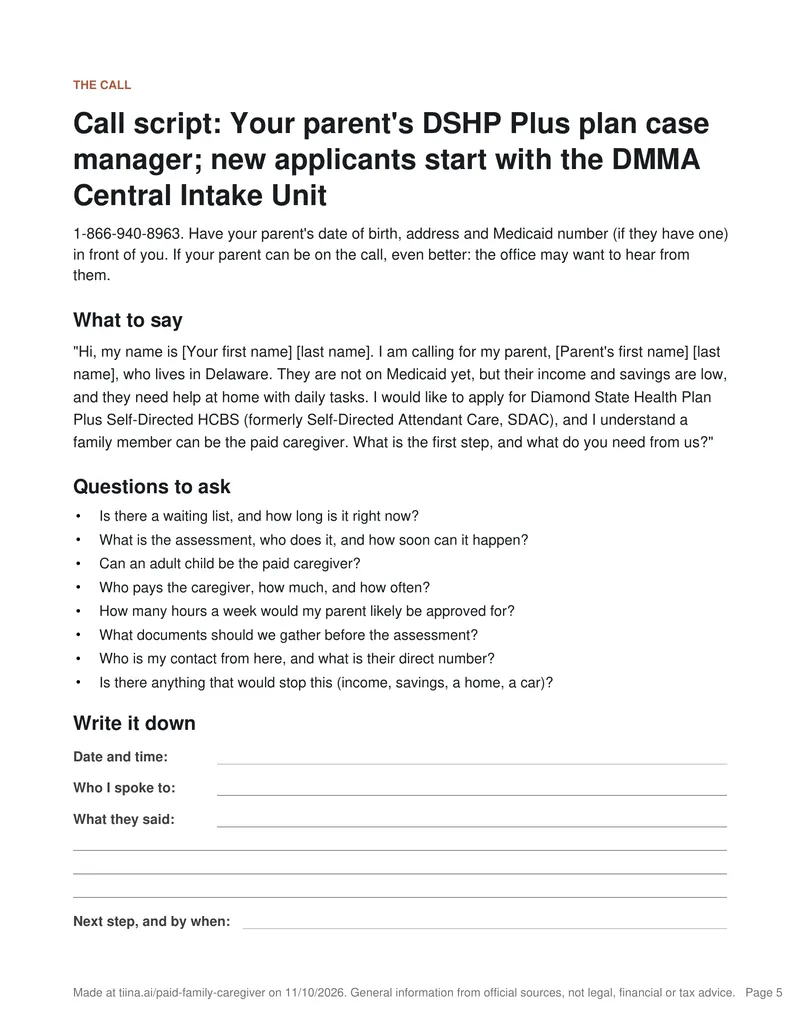 Call script
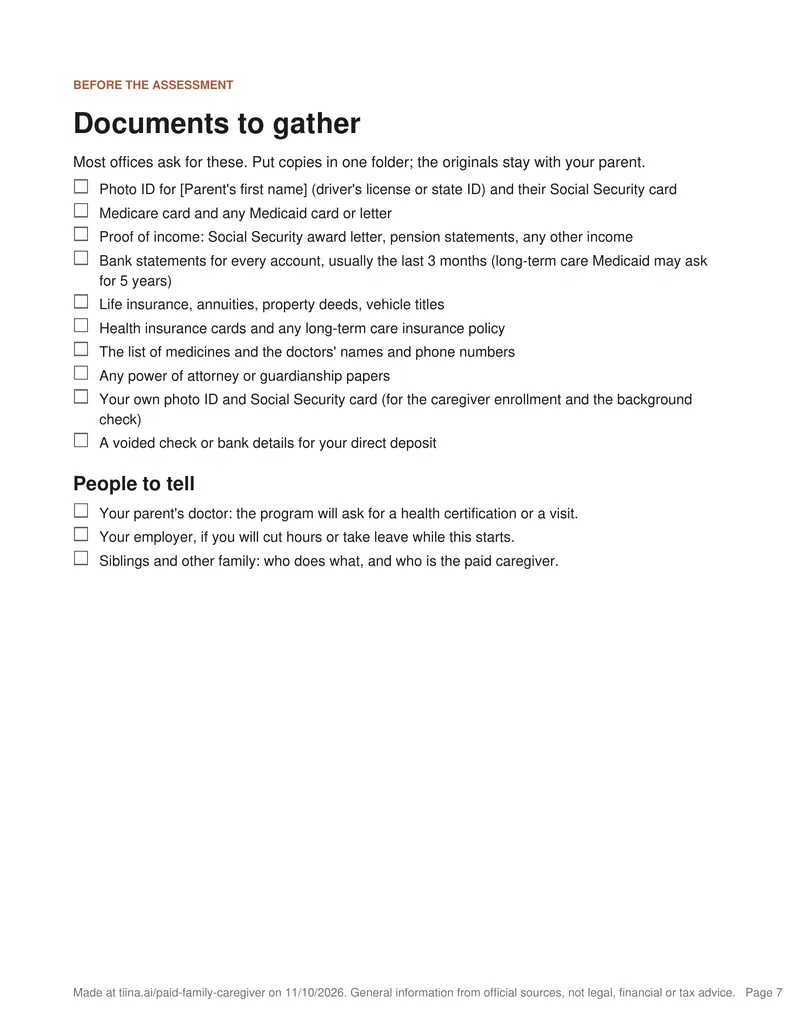 Documents to gather
This prepares your paperwork. You still submit your DSHP Plus self-direction application to the office or website listed in the instructions.
The official Delaware forms
- Apply for Medicaid for the person receiving care
Application for Food Benefits, Cash, Medical, and Child Care Assistance (Form 100)From Delaware Health and Social Services. The packet gives you a sheet with your answers to copy over. Follow the form’s instructions for where to send it.
- Enroll as the paid caregiver
GT Independence portal (worker and employer enrollment for DSHP Plus self-direction)From GT Independence (financial management service). Online only. The packet gives you a sheet with your answers to type in. Follow the form’s instructions for where to send it.
What other financial help is there for caregivers in Delaware?
Another program that can pay for care
Attendant Services Program (DSAAPD, self-directed)
This state program helps pay for care at home. The eligibility and payment rules below explain when a family member can be paid.
- Who this is for
- Your parent is 18 or older with a physical disability and meets DSAAPD's financial and functional rules. It serves people who are not on Medicaid; they may pay a small share of the cost.
- Payment
- Not published. DSAAPD authorizes the hours and the support provider pays the attendant.
Eligibility details and how to apply
Can a spouse be paid? Unclear. DSAAPD's published text does not say whether a spouse can be paid.
Is there a waiting list? Unknown. No waiting list information is published. Ask on the first call.
- Call the Delaware Aging and Disability Resource Center (ADRC) at 1-800-223-9074 and ask about the Attendant Services Program.
- A DSAAPD case manager reviews your parent's disability, needs and income and authorizes attendant hours.
- DSAAPD refers your parent to a support provider (such as JEVS Human Services), which writes a service plan with your parent that names you as the attendant.
- You sign an agreement with the support provider and complete the background check and training.
- You keep timesheets for the authorized hours; the support provider invoices DSAAPD and pays you.
Paid time off from work
Delaware Paid Leave (Family Caregiver Leave)
This replaces part of your own wages while you take time off work to care for a family member. It is a temporary leave benefit, not an ongoing job as a paid caregiver.
- Who this is for
- You, the working child: you have worked for your employer at least 12 months and 1,250 hours, and your employer has 25 or more employees (smaller employers do not have to cover family caregiver leave). A health care provider certifies your parent's serious health condition. Your parent does not need Medicaid.
- Pay during leave
- Up to 6 weeks every 24 months at 80% of your own wages, up to $900 a week (2026).
Eligibility details and how to apply
Caring for a spouse with a serious health condition is covered.
- Check that your employer has 25 or more employees and that you have worked there at least 12 months and 1,250 hours.
- Tell your employer you need family caregiver leave and agree on the dates.
- File a claim in Delaware Labor First, the Department of Labor's online system, using your Social Security number.
- Delaware Labor First sends a certification form to your parent's health care provider, who completes it online (they have up to 90 days).
- If approved, the state pays 80% of your wages, up to $900 a week, for up to 6 weeks. Keep your leave dates current in Delaware Labor First.
Benefits for veterans and surviving spouses
Some Department of Veterans Affairs (VA) benefits pay a caregiver; others help the veteran or surviving spouse with care costs. Answer the questions above to see the VA options for your family in Delaware.
Questions families ask in Delaware
These answers cover every family in Delaware. Your own answer is above.
Can I get paid if I live with my parent in Delaware?
Usually, yes. The DSHP Plus self-direction rules we found do not shut out a caregiver who lives with your parent. Overtime at 1.5 times pay after 40 hours a week, except for a worker who lives in the same home (Delaware First Health policy). Ask on the first call whether living together changes the hours or the pay.
What if my parent is not on Medicaid in Delaware?
DSHP Plus self-direction needs Medicaid. Care at home has its own Medicaid limits on income and savings, so check with Delaware Medicaid before you rule it out. Attendant Services does not need Medicaid. For Delaware help that is not Medicaid, such as respite and caregiver support grants, call Delaware Aging and Disability Resource Center (ADRC) at 1-800-223-9074. If you work in Delaware, Delaware Paid Leave can pay part of your wages while you take time off to care for your parent. If your parent is a veteran or the surviving spouse of one, some VA benefits pay a family caregiver or add money for care, without Medicaid.
How long does it take to start getting paid in Delaware?
No waiting list is published for DSHP Plus home care. Ask the Central Intake Unit when you apply. If your parent is not on Medicaid yet, Delaware Medicaid must decide within 45 days, or 90 if it must also decide a disability. Then DSHP Plus self-direction reviews the help your parent needs, and you sign up as the paid worker with the agency that pays you.
What forms do I need to get paid as a caregiver in Delaware?
For DSHP Plus self-direction: To apply for Medicaid: Application for Food Benefits, Cash, Medical, and Child Care Assistance (Form 100). To sign up as the paid caregiver: GT Independence portal (worker and employer enrollment for DSHP Plus self-direction) (online). The free PDF on this page gives you an answers sheet to copy from for each one. Answer the questions above to make it.

Tiina is an AI companion your parent talks to on an iPhone or iPad, like a phone call.
Please note. Tiina is a private company (Dignable LLC, doing business as Tiina). We are not a law firm and not a government agency, and we are not affiliated with Medicaid, the VA or any state program. This guide and its packet are free general information, not legal, financial or benefits advice, and not a promise that anyone qualifies or will be paid: only the agency decides. The official forms are free from the agencies named. Use the packet only with the knowledge and agreement of the person the forms are about, or as their legal representative. Read the full disclaimer.
Sources
Checked against official Delaware and federal sources on November 4, 2026. How we check every state.
- DMMA and Mercer, Delaware Rate Study for HCBS, provider town hall slides (draft), archived copy (October 30, 2024)
- Delaware Code Title 19, Chapter 9, section 902 (minimum wage $15.00 from January 1, 2025)
- DMMA, 2023 MCO Master Services Agreement, section 3.8.8 Self-Directed HCBS for DSHP Plus LTSS Members, archived copy (November 28, 2022)
- CMS, Delaware Diamond State Health Plan 1115 extension approval and STCs, STC 41 (participant direction) (May 17, 2024)
- CMS, Delaware DSHP 1115 STCs, eligibility table (DSHP Plus HCBS income and resource limits) (May 17, 2024)
- Delaware First Health, Payment Policy DE.PP.003 Self-Directed Attendant Care: LTSS (May 10, 2024)
- DMMA, 2023 MCO Master Services Agreement, section 3.8.8 (self-assessment, FMS, employment agreement) (November 28, 2022)
- DMMA, Long Term Care Medicaid Programs (Central Intake Unit)
- DMMA, Diamond State Health Plan Plus
- DSAAPD, In-Home Support to Help You Live Independently (Attendant Services, self-directed)
- DSAAPD FAQ, Can I get paid for being a caregiver for a family member or friend? (archived copy)
- DSAAPD, Support for Participant Direction service specifications (sections 7.12, 7.14, 7.21) (December 16, 2021)
- JEVS Human Services, Financial Management Services (Delaware)
- DSAAPD, Delaware Aging and Disability Resource Center
- Delaware Department of Labor, Delaware Paid Leave
- Delaware Department of Labor, Delaware Paid Leave employee webinar slides (November 13, 2025)
- Delaware Department of Labor, Delaware Paid Leave (eligibility and employer size)
- Delaware Department of Labor, Delaware Paid Leave employee webinar slides (leave types and weeks) (November 13, 2025)
The pay figure. Source: DMMA and Mercer, Delaware Rate Study for HCBS, provider town hall (draft rates), archived copy, October 30, 2024. What this number means.
For DSHP Plus self-direction: Pay is set by your parent's plan.
Not caregiver pay: the same draft 2024 rate study proposed $4.98 to $5.66 per 15 minutes ($19.92 to $22.64 an hour) as the Medicaid rate for self-directed attendant care. Adoption not confirmed.
Sharing. Quote this Delaware guide freely, with a link back to this page.