Family Caregiver Pay Index 2026
How much family caregivers get paid in every state in 2026: pay rates, spouse rules and waiting lists, each with its source.
Family caregiver pay depends on the state and the program. For each of the 50 states and DC, the index gives the main program that can pay an adult child to care for an older parent, the pay figure that program publishes and what kind of figure it is. Every number is free to quote with credit.
Key family caregiver pay statistics for 2026
- All 50 states and DC have a program that can pay an adult son or daughter to care for a parent at home in 2026: 41 without special conditions and 10 only under certain conditions.
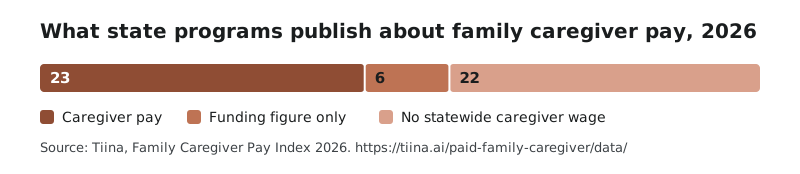
- The main program publishes what a family caregiver is paid in 23 of the 50 states and DC in 2026: a minimum wage in 16, a state-set rate in 4, a minimum caregiver payment in 2 and a state average in 1.
- In 22 states the main program publishes no statewide caregiver wage in 2026. The plan, the agency or the family sets the pay.
- In 6 states (Indiana, Iowa, Maine, South Carolina, Texas and Wyoming) the main program publishes a funding figure only in 2026: the wage its payment rates assume, or an hourly rate that employer payroll taxes come out of. It is not the caregiver’s wage: the family or the agency sets actual pay, or it is the state rate less employer payroll taxes.
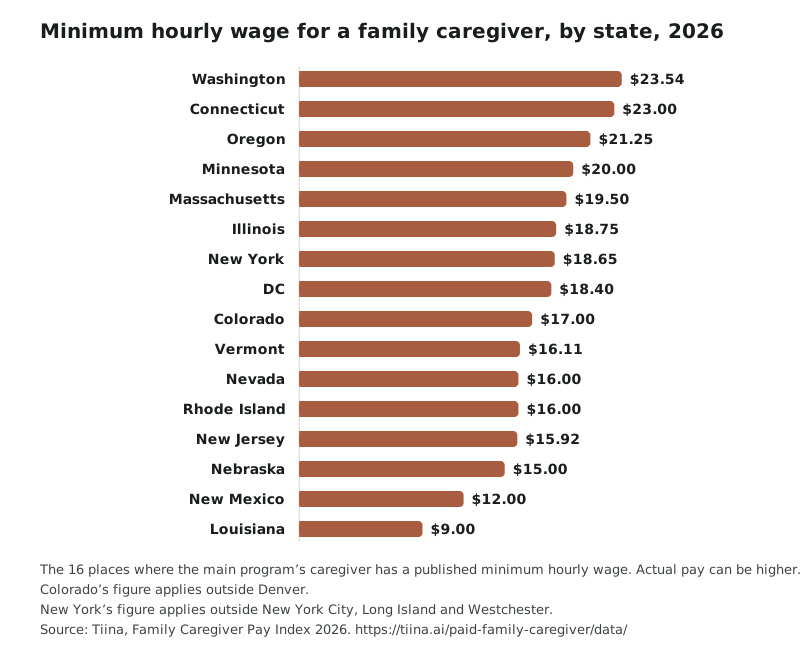
- Among the 15 states and DC where the main program’s caregiver has a published minimum hourly wage, the minimum runs from $9 in Louisiana to $23.54 in Washington (set by union contract) in 2026.
- California publishes a statewide average of what its main program’s caregivers are paid: $19.51 an hour (state weighted average, January 2026).
- In 2026 a spouse can be the paid caregiver without special conditions in 2 states (New Jersey and North Carolina), only under certain conditions in 25, and only through a second program in 6. In 13 states and DC the answer is no, and in 4 the rule is not published.
- The main program has a waiting list in 12 states in 2026. 21 states report none, and 17 states and DC publish nothing either way.
- 15 states have a live-in caregiver stipend program in 2026, which pays by the day or the month instead of by the hour.
- 12 states and DC have paid family leave in 2026. It replaces part of a worker’s own wages while they care for a family member, up to a weekly maximum of $900 (Delaware) to $1,765 (California).
One main program for each of the 50 states and DC.
- Caregiver pay
- Funding figure only
- No statewide caregiver wage
Caregiver pay means an average, a minimum wage, a state-set rate or a minimum payment. Source: Tiina, Family Caregiver Pay Index 2026. Free to reuse with credit. Download this chart (SVG)
Family caregiver pay rates by state
Read the label beside the amount. An average wage, a minimum wage and a funding assumption mean different things. “Not published” means the program does not publish a standard caregiver wage; it does not mean caregivers are unpaid. Open a state’s name for eligibility, application steps and other programs.
Monthly figures are examples: hourly pay assumes 40 approved hours a week; daily payments assume 30.4 days a month. Actual approved hours and pay can differ.
| State | Main program | Pay | Spouse paid? | Waiting list |
|---|---|---|---|---|
| Alabama | Personal Choices (self-directed option of the Elderly and Disabled Waiver) | Not published | Conditions | Unknown |
| Alaska | Personal Care Services (PCS), Consumer-Directed PCS Program (CDPCA) | Not published | No | None |
| Arizona | Arizona Long Term Care System (ALTCS) attendant care, with a family member as the paid caregiver | Not published | Conditions | None |
| Arkansas | ARChoices in Homecare waiver, attendant care self-directed through IndependentChoices | Not published | No | Unknown |
| California | In-Home Supportive Services (IHSS) | $19.51/hrabout $3,380/mostate average | Conditions | None |
| Colorado | Consumer-Directed Attendant Support Services (CDASS), under Community First Choice | $17/hrabout $2,950/mominimum wage | Conditions | None |
| Connecticut | Community First Choice (CFC) | $23/hrabout $3,990/mominimum wage | No | None |
| Delaware | Diamond State Health Plan Plus Self-Directed HCBS (formerly Self-Directed Attendant Care, SDAC) | Not published | Conditions | Unknown |
| District of Columbia | Elderly and Persons with Physical Disabilities (EPD) Waiver, Services My Way (participant-directed) | $18.40/hrabout $3,190/mominimum wage | No | Unknown |
| Florida | Statewide Medicaid Managed Care Long-Term Care, Participant Direction Option (PDO) | Not published | Unknown | Yes |
| Georgia | Structured Family Caregiving (Elderly and Disabled Waiver) | $66.23/dayabout $2,010/mominimum caregiver payment | No | Yes |
| Hawaii | QUEST Integration home and community based services, self-directed personal assistance (Med-QUEST) | Not published | Conditions | Unknown |
| Idaho | Aged and Disabled (A&D) Waiver attendant care, agency or self-directed through a fiscal intermediary | Not published | No | Unknown |
| Illinois | Community Care Program (CCP), In-Home Service (Illinois Department on Aging) | $18.75/hrabout $3,250/mominimum wage | Conditions | None |
| Indiana | Indiana PathWays for Aging Waiver, Attendant Care (ATTC), agency or participant-directed | $20.62/hrabout $3,570/mofunding assumption | No | Yes |
| Iowa | HCBS Elderly Waiver, Consumer Choices Option (CCO) | $16.12/hrabout $2,790/mofunding assumption | Conditions | None |
| Kansas | HCBS Frail Elderly (FE) Waiver, Self-Directed Personal Care Services (PCS) | Not published | Conditions | Yes |
| Kentucky | Home and Community Based (HCB) Waiver, Participant Directed Services (PDS) | Not published | Conditions | Yes |
| Louisiana | Community Choices Waiver (CCW), Personal Assistance Services, Self-Direction Option | $9/hrabout $1,560/mominimum wage | Conditions | Yes |
| Maine | MaineCare Section 19, Home and Community Benefits for the Elderly and Adults with Disabilities, Participant-Directed Option | $18.88/hrabout $3,270/mofunding assumption | Conditions | Unknown |
| Maryland | Community First Choice (CFC), Personal Assistance Services | Not published | Unknown | None |
| Massachusetts | MassHealth Personal Care Attendant (PCA) Program | $19.50/hrabout $3,380/mominimum wage | No | None |
| Michigan | Home Help Program (Medicaid personal care) | $17.13/hrabout $2,970/mostate-set rate | No | None |
| Minnesota | Community First Services and Supports (CFSS) | $20/hrabout $3,470/mominimum wage | Conditions | None |
| Mississippi | Elderly and Disabled (E&D) Waiver, personal care services by a relative | Not published | No | Unknown |
| Missouri | Consumer Directed Services (CDS), Personal Care Assistance | Not published | No | None |
| Montana | Community First Choice Services (CFCS) and Personal Care Services (PCS), self-directed option | Not published | Conditions | None |
| Nebraska | Aged and Disabled (AD) Waiver, Personal Care by an independent provider | $15/hrabout $2,600/mominimum wage | Conditions | Unknown |
| Nevada | Self-Directed Personal Care Services (SD PCS) through an Intermediary Service Organization (ISO) | $16/hrabout $2,770/mominimum wage | No | None |
| New Hampshire | Choices for Independence (CFI) waiver, Participant Directed and Managed Services (PDMS) | Not published | Conditions | Unknown |
| New Jersey | Personal Preference Program (PPP), NJ FamilyCare self-directed personal care | $15.92/hrabout $2,760/mominimum wage | Yes | None |
| New Mexico | Self-Directed Community Benefit (SDCB), Turquoise Care | $12/hrabout $2,080/mominimum wage | Conditions | Unknown |
| New York | Consumer Directed Personal Assistance Program (CDPAP) | $18.65/hrabout $3,230/mominimum wage | No | None |
| North Carolina | Community Alternatives Program for Disabled Adults (CAP/DA), consumer-led option (Personal Assistance) | Not published | Yes | Yes |
| North Dakota | Medicaid State Plan Personal Care (MSP-PC) and Waiver Personal Care, by an individual Qualified Service Provider (QSP) | $27.92/hrabout $4,840/mostate-set rate | No | None |
| Ohio | MyCare Ohio Waiver self-direction (Next Generation MyCare), with PPL as the financial management service | Not published | Conditions | Unknown |
| Oklahoma | ADvantage Waiver, Consumer-Directed Personal Assistance Services and Supports (CD-PASS) | Not published | Conditions | Unknown |
| Oregon | Medicaid In-Home Services, Consumer Employer Program: Homecare Workers (HCWs) | $21.25/hrabout $3,680/mominimum wage | Conditions | Unknown |
| Pennsylvania | Community HealthChoices (CHC) Waiver, participant-directed Personal Assistance Services (common law employer model; Services My Way for budget authority) | Not published | No | Unknown |
| Rhode Island | Personal Choice Program (self-directed Medicaid long-term services and supports) | $16/hrabout $2,770/mominimum wage | No | Unknown |
| South Carolina | Community Choices Waiver, Attendant Care (Self-Directed) | $16.20/hrabout $2,810/mofunding assumption | No | Yes |
| South Dakota | HOPE Waiver Structured Family Caregiving (SFC), the state's Paid Family Caregiver option | $41/dayabout $1,250/mominimum caregiver payment | Unknown | Unknown |
| Tennessee | TennCare CHOICES Consumer Direction (personal care visits and in-home respite) | $18.31/hrabout $3,170/mostate-set rate | No | Unknown |
| Texas | STAR+PLUS personal attendant services, Consumer Directed Services (CDS) option | $13/hrabout $2,250/mofunding assumption | No | Yes |
| Utah | Aging Waiver (Waiver for Individuals Age 65 or Older), Personal Attendant Services, participant employed | Not published | Conditions | Yes |
| Vermont | Choices for Care, consumer-directed or surrogate-directed personal care (Home-Based) | $16.11/hrabout $2,790/mominimum wage | Conditions | Yes |
| Virginia | Commonwealth Coordinated Care Plus (CCC Plus) Waiver, consumer-directed personal care | $13.88/hrabout $2,410/mostate-set rate | Conditions | None |
| Washington | Medicaid in-home personal care (Community First Choice, COPES and Medicaid Personal Care) with an Individual Provider (IP) | $23.54/hrabout $4,080/mominimum wage | No | None |
| West Virginia | Aged and Disabled Waiver (ADW), Personal Options self-direction | Not published | No | Yes |
| Wisconsin | IRIS (Include, Respect, I Self-Direct), with participant-hired workers | Not published | Conditions | None |
| Wyoming | Community Choices Waiver (CCW), participant-directed personal support services | $15.20/hrabout $2,630/mofunding assumption | Conditions | None |
Pay per month = hourly figure x 173.3 hours (40 hours a week), or daily stipend x 30.4 days, rounded to the nearest $10. Each state's page has its sources.
How to read the pay figures
Some states publish what caregivers are paid, some publish only a legal minimum or a stipend, and some publish nothing. Every row carries its kind, so unlike numbers are never compared as if they were alike. The Medicaid rate paid to an agency or payroll company is never shown as caregiver pay; it covers taxes, benefits and administration.
| Kind | Meaning | States |
|---|---|---|
| state average | An official statewide average (or weighted average) of what caregivers are paid. | 1 |
| minimum wage | A legal minimum. The program must pay at least this; actual pay can be higher. | 16 |
| state-set rate | One rate the state itself pays an individual provider. It does not vary by person. | 4 |
| minimum caregiver payment | The minimum daily or monthly stipend the program must pass to the caregiver. | 2 |
| funding assumption | The state publishes no caregiver pay. This is the wage its payment rates assume; actual pay can differ. | 6 |
| weekly maximum | A weekly maximum: the benefit is a share of your own wages up to this cap. | 0 |
| no published wage | Nothing is published. Pay is set per person by the plan, the payroll agency or the family. | 22 |
Which states pay family caregivers?
All of them, through at least one program, when the person receiving care qualifies. The main program is a Medicaid program in every state and DC. 11 states also have a program that can pay a family caregiver without Medicaid: Delaware, Florida, Iowa, Kentucky, Maine, Massachusetts, New Jersey, New Mexico, North Dakota, Tennessee and Washington.
Which states pay family caregivers the most?
No single ranking is fair, because states publish different kinds of figure. The chart ranks the one kind most of them share: the minimum hourly wage the main program’s caregiver must be paid. The other published figures follow, each in the state record’s own words. A funding figure is not caregiver pay, so it is never ranked.
The 15 states and DC where the main program’s caregiver has a published minimum hourly wage.
Each figure is the least the main program’s caregiver must be paid; actual pay can be higher. A union contract sets it in Connecticut, Massachusetts, Oregon, Vermont and Washington; law or the program sets the others. Colorado’s figure applies outside Denver. New York’s figure applies outside New York City, Long Island and Westchester. Source: Tiina, Family Caregiver Pay Index 2026. Free to reuse with credit. Download this chart (SVG)
The other published figures
- North Dakota: $27.92 an hour state-set rate State rate for an individual QSP's personal care, from July 1, 2026.
- Tennessee: $18.31 an hour state-set rate TennCare-set average wage for personal care visits; up to $19.16 (July 2025).
- Michigan: $17.13 an hour state-set rate State rate for every individual Home Help caregiver, from January 1, 2026.
- Virginia: $13.88 an hour state-set rate State-set attendant wage outside Northern Virginia, rates effective July 1, 2026.
- California: $19.51 an hour state average State weighted average, January 2026.
- Georgia: $66.23 a day minimum caregiver payment At least 60% of the $110.39 agency per diem, for a live-in caregiver (October 2026 manual).
- South Dakota: $41 a day minimum caregiver payment At least 50% of the $82.00 base daily rate, for a live-in caregiver (July 1, 2026).
Can a spouse be paid as a caregiver?
It depends on the state. The main program alone says no in 20 states and DC; in 6 of those a second program can pay a spouse, and in 1 (Missouri) the second program’s rule is not published. In the other 13 states and DC no caregiver program in the index pays one. Paid family leave, where a state has it, is separate: it replaces part of a working spouse’s own wages for a few weeks.
- Yes 2
- New Jersey and North Carolina
- Only under certain conditions 25
- Alabama, Arizona, California, Colorado, Delaware, Hawaii, Illinois, Iowa, Kansas, Kentucky, Louisiana, Maine, Minnesota, Montana, Nebraska, New Hampshire, New Mexico, Ohio, Oklahoma, Oregon, Utah, Vermont, Virginia, Wisconsin and Wyoming
- Only through a second program 6
- Alaska, Indiana, Nevada, North Dakota, Tennessee and Washington
- No 14
- Arkansas, Connecticut, DC, Georgia, Idaho, Massachusetts, Michigan, Mississippi, New York, Pennsylvania, Rhode Island, South Carolina, Texas and West Virginia
- Rule not published 4
- Florida, Maryland, Missouri and South Dakota
Which states have a waiting list?
The main program keeps a waiting list for new people in 12 states: Florida, Georgia, Indiana, Kansas, Kentucky, Louisiana, North Carolina, South Carolina, Texas, Utah, Vermont and West Virginia. 21 states report none. In 17 states and DC the state publishes nothing either way, so ask on the first call.
Family caregiver statistics for the United States
For context beside the index. These figures are other organizations’ research, not ours.
- 63 million Americans are family caregivers, a nearly 50% increase since 2015. AARP and the National Alliance for Caregiving, 2025
- That count includes 11 million caregivers who receive some compensation through Medicaid, the VA or other state programs. AARP and the National Alliance for Caregiving, 2025
- Paid home health and personal care aides earned a median of $17.21 an hour ($35,800 a year) in May 2025. U.S. Bureau of Labor Statistics
- More than 600,000 people were on waiting or interest lists for Medicaid care at home in 2025, in 41 states. Older adults and adults with physical disabilities were 23% of them. KFF, 2025
- People on those lists waited 32 months on average before services started in 2025. KFF, 2025
Sources
Read on each source’s own page on November 10, 2026.
- AARP and National Alliance for Caregiving, Caregiving in the US 2025 (July 24, 2025)
- U.S. Bureau of Labor Statistics, Occupational Outlook Handbook: Home Health and Personal Care Aides (August 27, 2026)
- KFF, A Look at Waiting Lists for Medicaid Home- and Community-Based Services from 2016 to 2025 (November 20, 2025)
For reporters and researchers
https://tiina.ai/paid-family-caregiver/data/ License: Creative Commons Attribution 4.0 (CC BY 4.0).Use it. Every figure, table and chart on this page is free to quote and republish. Credit “Tiina, Family Caregiver Pay Index 2026” and give this page’s address.
Ask us. For a state’s figure explained, a number checked or a comment, email press@tiina.ai. We answer within one business day.
How current it is. Last checked November 4, 2026. An automatic check reads every source and form behind the index each month and just after the dates rates usually change (January 1, July 1, September 1 and September 30). When a source changes we research that state again, and its page records the change.
How we chose each number. For each of the 50 states and DC we read the state Medicaid and aging agency pages, the program handbooks, rate tables and waiver documents, and the payroll agency's state pages, in 2026. The index row is the main program an adult child caring for an older parent would use. The number is, in order of preference: an official statewide average of caregiver pay; a legal floor the caregiver must be paid; a state-set rate paid directly to the caregiver; the minimum stipend a live-in program must pass through; the wage the state's rates assume; or "set by the plan" when nothing is published. Each number carries its source document and that document's date, and the date we checked it. Spouse and adult-child rules come from state text, never from an agency's marketing page.
Every state's full record is a JSON file with its programs, rules, steps, contacts, forms, sources and change log: for example TX.json (any two-letter state code works), plus va.json for the VA programs.
Columns: state, program, amount, unit, monthly_40h, number_type, label, range_note, spouse_paid, adult_child_paid, live_in_required, waitlist, payer, who_to_call, phone, source_title, source_url, source_date, as_of, confidence, page.
Corrections: hello@tiina.ai. A state office that sends us a current rate table gets the row updated within a week, with credit.

Tiina is an app your parent talks to on an iPhone or iPad, like a phone call. The index is free because the families who need it are the families we build for.
Please note. Tiina is a private company (Dignable LLC, doing business as Tiina). We are not a law firm and not a government agency, and we are not affiliated with Medicaid, the VA or any state program. This guide and its packet are free general information, not legal, financial or benefits advice, and not a promise that anyone qualifies or will be paid: only the agency decides. The official forms are free from the agencies named. Use the packet only with the knowledge and agreement of the person the forms are about, or as their legal representative. Read the full disclaimer.