Get paid to care for a family member in Georgia
Find out who can be paid to help an older family member at home in Georgia, how payment works and where to apply.
The short answer
Does Georgia pay you to take care of a family member?
Yes, if your parent qualifies for Medicaid. Georgia can pay a family caregiver through Structured Family Caregiving. You must live with your parent.
- In your favor: Can an adult child be paid?Yes.
- Not eligible: Can a spouse be paid?No.
- Condition: Does your parent need Medicaid?Yes.
- Condition: Must you live with your parent?Yes.
- Condition: Is there a waiting list?Yes.
Can you get paid in Georgia? Check your situation
Four questions about the person you care for. Then your answer, your steps, and your Georgia forms filled in.

Who can get paid as a family caregiver in Georgia?
Official name: Structured Family Caregiving (Elderly and Disabled Waiver)
This supports a caregiver who shares a home with the person receiving care. Payment is for ongoing care in that home, rather than a wage for each hour worked.
The person receiving care
Your parent is on Georgia Medicaid, is approved for the Elderly and Disabled Waiver (CCSP or SOURCE), lives with you full time, and needs hands-on help every day. Admission depends on funding and the assessment score.
You, the family caregiver
- In your favor: Adult children: yes.Adult biological, adoptive or step-relatives are eligible and must live in the same home.
- Not eligible: Spouses: no.Georgia Medicaid will not reimburse legally responsible relatives, which includes spouses (DCH manual, section 905.1).
- Condition: Living together: required.You must live with your parent.
How much does Georgia pay family caregivers?
These figures apply to Structured Family Caregiving.
Minimum payment to the live-in caregiver
At least 60% of the $110.39 agency per diem, for a live-in caregiver (October 2026 manual).
A daily stipend, not hourly pay. The full per diem ($110.39, about $3,360 a month) is the ceiling, not the typical stipend.
- Who issues the payment
- A Structured Family Caregiving agency (for example Careforth), from the Medicaid per diem it bills.
- What hours or care the payment covers
- Not hourly: a daily stipend for live-in care that does not change with hours. Agencies screen for at least about 5 hours of care a day.

How to apply in Georgia
Is there a waiting list? Yes. Admission to the Elderly and Disabled Waiver depends on funding and a DON-R score. No official count published. Get on it the day you call, and get the date in writing.
1 Apply for Medicaid if your parent does not have it
Already on Medicaid? Skip to step 2.
Start with Georgia Medicaid: call 1-877-423-4746, or see how to apply at gateway.ga.gov. Even if you think your parent has too much income or savings, apply anyway: care at home has its own Medicaid rules.
Not sure if they already have it? They can look it up.
What to say on the call:
I want to apply for long-term care Medicaid for my parent, who needs help at home with daily tasks. What do you need from us?Write down the date, who you spoke to, and any case number.
2 Ask the care program to start an application
Call Georgia Aging and Disability Resource Connection (ADRC) at 1-866-552-4464. Ask if the assessment can start while Medicaid is pending.
What to say on the call:
My parent has Medicaid, or is applying, and needs help at home with daily tasks. I want to be their paid caregiver through Structured Family Caregiving. Can we start now?3 Arrange a review of the help your parent needs
A nurse or caseworker reviews the help your parent needs through Structured Family Caregiving, at home or by phone. Before it, list everything you do for your parent in a day: bathing, dressing, the toilet, meals, medicines, rides. The help they approve comes from that list.
4 Get the decision and enroll as the paid worker
Medicaid must decide within 45 days, or 90 if it must also decide a disability. No answer by then? Call back with your case number.
Once approved, you sign up as the worker with the agency that pays you; the forms come with the free checklist below.
5 Help if you get stuck
- Turned down? Ask why, in writing.
- Too much income or savings? Ask Georgia Medicaid about a spend-down or a Qualified Income Trust; an elder law attorney can help.
- Too few hours approved? Ask Structured Family Caregiving for a new assessment, with a note from the doctor.
- Still stuck? Call Georgia Aging and Disability Resource Connection (ADRC) at 1-866-552-4464. It is free.
Official application instructions and contacts
Applying for Medicaid in Georgia: Form 94A (streamlined) or Form 297 (full application) for aged, blind and disabled Medicaid. An authorized representative can also be named verbally or on the application itself (policy 2050).
- If your parent is not on Medicaid, apply at Georgia Gateway (gateway.ga.gov) or with the paper application (Form 94A or Form 297) at the county DFCS office.
- Call the Georgia Aging and Disability Resource Connection (ADRC) at 1-866-552-4464 and ask for an Elderly and Disabled Waiver screening (CCSP or SOURCE).
- A nurse or care coordinator assesses your parent (the DON-R). If your parent is approved for the waiver, ask the case manager for Structured Family Caregiving.
- Choose a Structured Family Caregiving agency from the waiver's provider list. It checks your background and trains you.
- The agency pays you a daily stipend (at least 60% of what Medicaid pays it) and a coach checks in regularly. You keep short daily notes in the agency's app.
Your Georgia application checklist and forms
We fill in your Georgia paperwork for you: one free PDF with your next steps, a call script, a document checklist and the official forms, with your names and addresses already typed in. Answer the four questions above, and the form to fill it in comes with your answer.
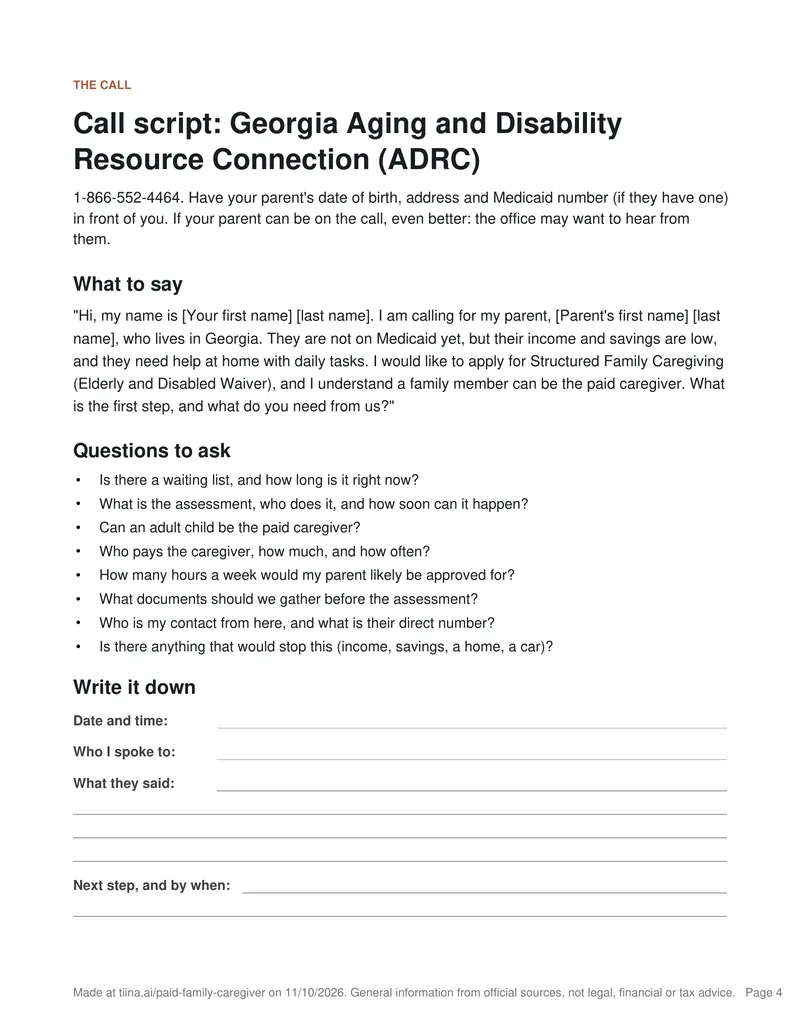 Call script
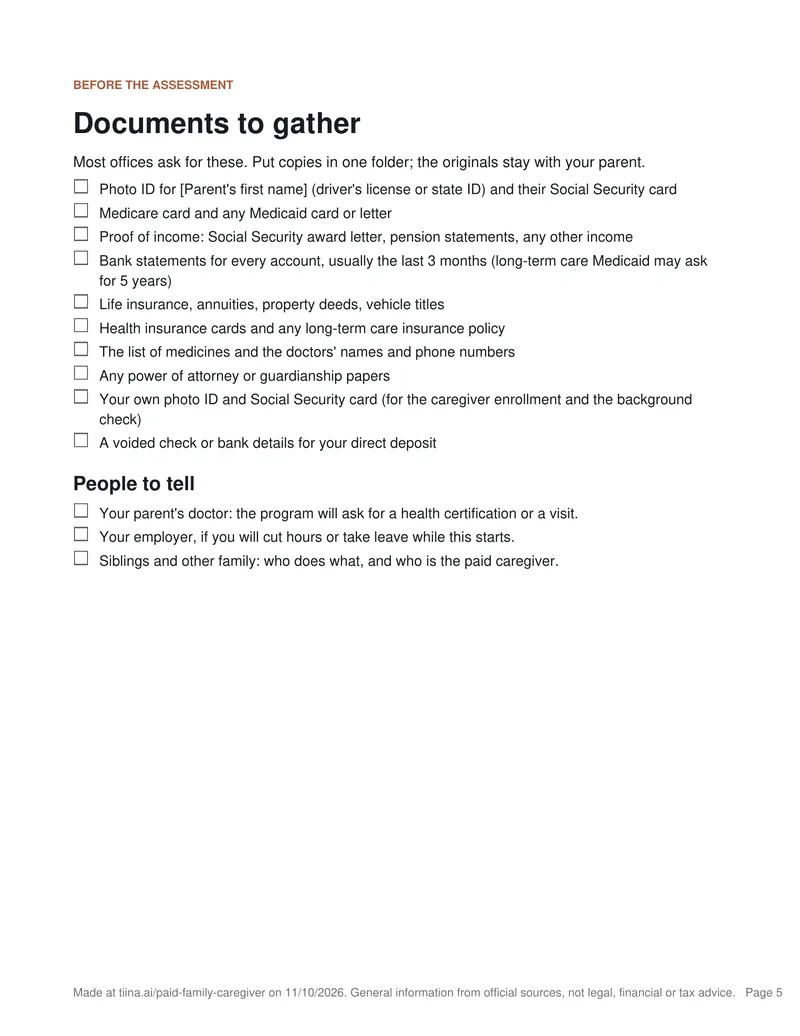 Documents to gather
This prepares your paperwork. You still submit your Structured Family Caregiving application to the office or website listed in the instructions.
The official Georgia forms
- Apply for Medicaid for the person receiving care
Medicaid Streamlined Application (Form 94A)From Georgia Division of Family and Children Services. The packet gives you a sheet with your answers to copy over. Follow the form’s instructions for where to send it.
- Apply for Medicaid for the person receiving care
Application for Benefits (Form 297)From Georgia Division of Family and Children Services. The packet gives you a sheet with your answers to copy over. Follow the form’s instructions for where to send it.
- Choose someone to help handle the application
Medicaid Application Attachment C: Authorized Representative (Form 94A Appendix C)From Georgia Division of Family and Children Services. Filled in for you in the packet. Follow the form’s instructions for where to send it.
What other financial help is there for caregivers in Georgia?
Another program that can pay for care
Elderly and Disabled Waiver personal support services (CCSP and SOURCE)
This pays for approved help at home, such as bathing and dressing. The person receiving care can choose an eligible family member to provide that help and be paid.
- Who this is for
- Your parent is on Medicaid, meets the level of daily care a nursing facility would provide and is approved for the Elderly and Disabled Waiver. Services are delivered by agencies; Georgia has no general self-direction option for older adults.
- Payment
- Delivered by home care agencies at the agency's wage. Some agencies hire a family member as the aide.
Eligibility details and how to apply
Can a spouse be paid? No. Legally responsible relatives are not reimbursed.
Is there a waiting list? Yes. Same waiver waitlist as Structured Family Caregiving. Get on it the day you call, and get the date in writing.
- Get your parent screened for the Elderly and Disabled Waiver through the ADRC (1-866-552-4464).
- Once approved, ask the care coordinator which personal support agencies hire family members as aides.
- Apply to the agency as an aide: background check, training and the agency's own hiring rules.
- The agency schedules you on your parent's care plan hours and pays you its hourly wage.
Benefits for veterans and surviving spouses
Some Department of Veterans Affairs (VA) benefits pay a caregiver; others help the veteran or surviving spouse with care costs. Answer the questions above to see the VA options for your family in Georgia.
Questions families ask in Georgia
These answers cover every family in Georgia. Your own answer is above.
Can I get paid if I live with my parent in Georgia?
Yes. Structured Family Caregiving pays only a caregiver who lives with your parent. Not hourly: a daily stipend for live-in care that does not change with hours.
What if my parent is not on Medicaid in Georgia?
Structured Family Caregiving needs Medicaid. Care at home has its own Medicaid limits on income and savings, so check with Georgia Medicaid before you rule it out. For Georgia help that is not Medicaid, such as respite and caregiver support grants, call Georgia Aging and Disability Resource Connection (ADRC) at 1-866-552-4464. If your parent is a veteran or the surviving spouse of one, some VA benefits pay a family caregiver or add money for care, without Medicaid.
How long does it take to start getting paid in Georgia?
Structured Family Caregiving has a waiting list. Admission to the Elderly and Disabled Waiver depends on funding and a DON-R score. No official count published. Get on it the day you call. If your parent is not on Medicaid yet, Georgia Medicaid must decide within 45 days, or 90 if it must also decide a disability. Then Structured Family Caregiving reviews the help your parent needs, and you sign up as the paid worker with the agency that pays you.
What forms do I need to get paid as a caregiver in Georgia?
For Structured Family Caregiving: To apply for Medicaid: Medicaid Streamlined Application (Form 94A); Application for Benefits (Form 297). To name someone who can help with the application: Medicaid Application Attachment C: Authorized Representative (Form 94A Appendix C). The free PDF on this page can fill in one of them with your names and addresses, depending on your answers, and gives you an answers sheet for the rest. Answer the questions above to make it.

Tiina is an AI companion your parent talks to on an iPhone or iPad, like a phone call.
Please note. Tiina is a private company (Dignable LLC, doing business as Tiina). We are not a law firm and not a government agency, and we are not affiliated with Medicaid, the VA or any state program. This guide and its packet are free general information, not legal, financial or benefits advice, and not a promise that anyone qualifies or will be paid: only the agency decides. The official forms are free from the agencies named. Use the packet only with the knowledge and agreement of the person the forms are about, or as their legal representative. Read the full disclaimer.
Sources
Checked against official Georgia and federal sources on November 4, 2026. How we check every state.
- Georgia DCH, Part II Policies and Procedures for EDWP (CCSP and SOURCE) General Services, Q4 October 2026 (rate table and the 60% stipend rule) (October 1, 2026)
- Georgia DCH, Part II Policies and Procedures for EDWP General Services, section 905.1 (legally responsible relatives) (October 1, 2026)
- Georgia Council on Developmental Disabilities, Ask GCDD Anything: Structured Family Caregiving (June 30, 2026)
- georgia.gov, Apply for the Elderly and Disabled Waiver Program
- georgia.gov, Apply for the Elderly and Disabled Waiver Program (steps)
- Georgia Division of Aging Services, ADRC
- Careforth, Structured Family Caregiving in Georgia (hours screened for) (January 24, 2024)
- Georgia DCH, Part II Policies and Procedures for EDWP General Services, Q4 October 2026 (October 1, 2026)
The pay figure. Source: Georgia Department of Community Health, Part II Policies and Procedures for EDWP (CCSP and SOURCE) General Services, Q4 October 2026, rate table, October 1, 2026. What this number means.
For Structured Family Caregiving: The minimum daily or monthly stipend the program must pass to the caregiver.
The agency per diem is $110.39 a day (since July 1, 2024). It is what Medicaid pays the agency, not the caregiver's stipend.
Sharing. Quote this Georgia guide freely, with a link back to this page.