Get paid to care for a family member in Hawaii
Find out who can be paid to help an older family member at home in Hawaii, how payment works and where to apply.
The short answer
Does Hawaii pay you to take care of a family member?
Only in some cases. Hawaii can pay a family caregiver through QUEST Integration self-direction. Your parent must qualify for Medicaid. Conditions apply: see the rules.
- Condition: Can an adult child be paid?Only under certain conditions.
- Condition: Can a spouse be paid?Only under certain conditions.
- Condition: Does your parent need Medicaid?Yes.
- Check: Is there a waiting list?Not known. Ask on the first call.
Can you get paid in Hawaii? Check your situation
Four questions about the person you care for. Then your answer, your steps, and your Hawaii forms filled in.

Who can get paid as a family caregiver in Hawaii?
Official name: QUEST Integration home and community based services, self-directed personal assistance (Med-QUEST)
QUEST Integration self-direction pays for approved help at home, such as bathing and dressing. The person receiving care can choose an eligible family member to provide that help and be paid.
The person receiving care
Your parent is on Med-QUEST, enrolled in a QUEST Integration health plan, and an assessment shows they need a nursing home level of care (a smaller set of services is open to people found 'at risk'). They live at home.
You, the family caregiver
- Condition: Adult children: with conditions.Family caregivers can be paid only in "extraordinary circumstances", such as being unable to find and keep another suitable caregiver, when the plan decides it is in your parent's best interest. Up to 40 hours in a 7-day period.
- Condition: Spouses: with conditions.The same rule covers legally responsible individuals, which the state defines to include "the spouse of a member": extraordinary circumstances only, no more than 40 hours in a 7-day period, and not for chores a spouse would normally do.
How much does Hawaii pay family caregivers?
Pay is set by your parent's health plan.
Ask QUEST Integration self-direction what wage and hours it would approve for your family before you plan on this income: call Med-QUEST Division customer service, then your parent's health plan service coordinator at 1-800-316-8005.
Hawaii minimum wage is $16.00 an hour from January 1, 2026. Family pay is capped at 40 hours a week.
- Who issues the payment
- Your parent's QUEST Integration health plan (AlohaCare, HMSA, Kaiser Permanente, 'Ohana Health Plan or UnitedHealthcare Community Plan), through its self-direction payroll.
- What hours or care the payment covers
- A paid family caregiver or spouse can provide no more than 40 hours of services in a 7-day period, based on the authorized personal care hours (STC 10.5(d)). The plan reviews family-provided hours every month.

How to apply in Hawaii
Is there a waiting list? Unknown. We could not confirm whether there is a waiting list; ask when you call.
1 Apply for Medicaid if your parent does not have it
Already on Medicaid? Skip to step 2.
Start with Hawaii Medicaid: call 1-800-316-8005, or see how to apply at mybenefits.hawaii.gov. Even if you think your parent has too much income or savings, apply anyway: care at home has its own Medicaid rules.
Not sure if they already have it? They can look it up.
What to say on the call:
I want to apply for long-term care Medicaid for my parent, who needs help at home with daily tasks. What do you need from us?Write down the date, who you spoke to, and any case number.
2 Ask the care program to start an application
Call Med-QUEST Division customer service, then your parent's health plan service coordinator at 1-800-316-8005. Ask if the assessment can start while Medicaid is pending.
What to say on the call:
My parent has Medicaid, or is applying, and needs help at home with daily tasks. I want to be their paid caregiver through QUEST Integration self-direction. Can we start now?3 Arrange a review of the help your parent needs
A nurse or caseworker reviews the help your parent needs through QUEST Integration self-direction, at home or by phone. Before it, list everything you do for your parent in a day: bathing, dressing, the toilet, meals, medicines, rides. The help they approve comes from that list.
4 Get the decision and enroll as the paid worker
Medicaid must decide within 45 days, or 90 if it must also decide a disability. No answer by then? Call back with your case number.
Once approved, you sign up as the worker through the plan’s payroll agency; the forms come with the free checklist below.
5 Help if you get stuck
- Turned down? Ask why, in writing.
- Too much income or savings? Ask Hawaii Medicaid about a spend-down or a Qualified Income Trust; an elder law attorney can help.
- Too few hours approved? Ask QUEST Integration self-direction for a new assessment, with a note from the doctor.
- Still stuck? Call Hawaii Aging and Disability Resource Center (ADRC) at 1-808-643-2372. It is free.
Official application instructions and contacts
Applying for Medicaid in Hawaii: Older adults applying for long-term care add the DHS 1100B supplement. A representative files DHS 1121 (designation) and, for a person who cannot act, DHS 1121A.
- If your parent is not on Med-QUEST yet, apply at mybenefits.hawaii.gov or mail form DHS 1100 with the DHS 1100B long-term care supplement. Call 1-800-316-8005 for help. To act for your parent, file DHS 1121.
- Your parent is enrolled in a QUEST Integration health plan: AlohaCare, HMSA, Kaiser Permanente, 'Ohana Health Plan or UnitedHealthcare Community Plan.
- Ask the plan's service coordinator for a home and community based services assessment. Personal assistance needs a nursing home level of care, or the 'at risk' level for some services.
- Ask to self-direct personal assistance and to hire you. The plan must find extraordinary circumstances (no other suitable caregiver) and that paying you is in your parent's best interest.
- The plan checks that you meet Hawaii's employment and training standards and certifies you by watching you give care. Your hours go into the care plan, up to 40 a week.
- You record every visit with electronic visit verification, and the health plan's payroll pays you.
Your Hawaii application checklist and forms
We fill in your Hawaii paperwork for you: one free PDF with your next steps, a call script, a document checklist and the official forms, with your names and addresses already typed in. Answer the four questions above, and the form to fill it in comes with your answer.
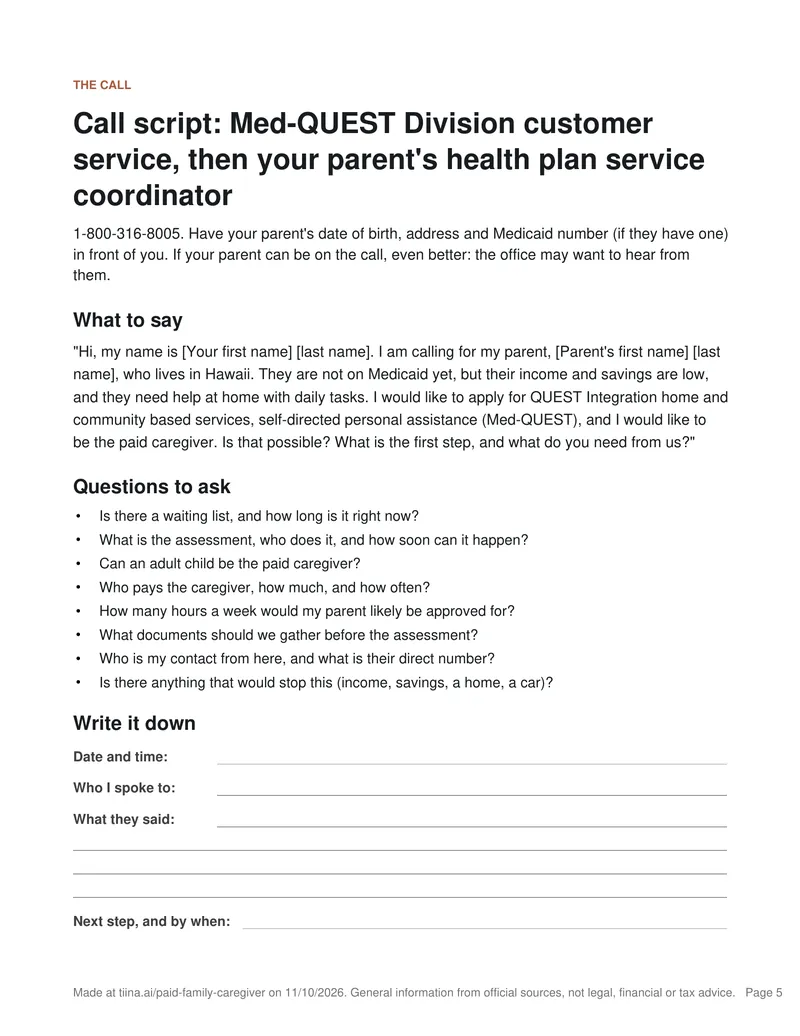 Call script
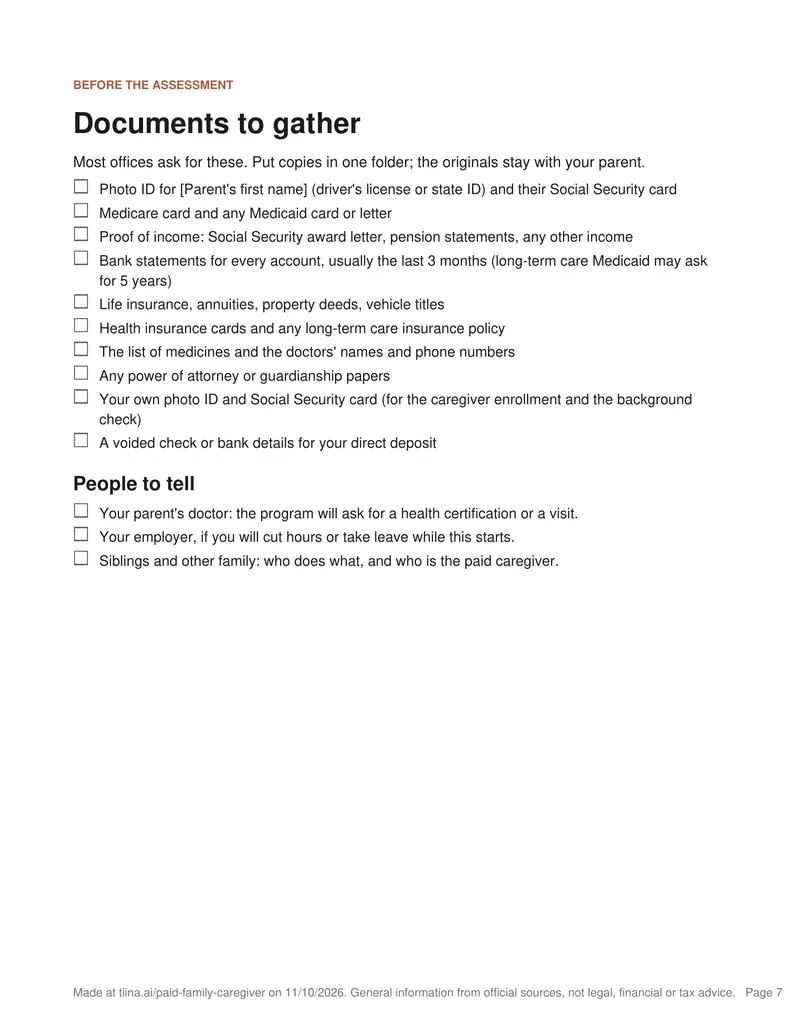 Documents to gather
This prepares your paperwork. You still submit your QUEST Integration self-direction application to the office or website listed in the instructions.
The official Hawaii forms
- Apply for Medicaid for the person receiving care
Application for Health Coverage & Help Paying Costs (DHS 1100)From Hawaii Department of Human Services, Med-QUEST Division. Filled in for you in the packet. Follow the form’s instructions for where to send it.
- Apply to the care or benefit program
Supplemental Form for Individuals Applying for Coverage on the basis of Age, Blindness or Disability and/or Requests for Long-Term Care Services (DHS 1100B)From Hawaii Department of Human Services, Med-QUEST Division. The packet gives you a sheet with your answers to copy over. Follow the form’s instructions for where to send it.
- Choose someone to help handle the application
Designation or Revocation of an Authorized Representative (DHS 1121)From Hawaii Department of Human Services, Med-QUEST Division. Filled in for you in the packet. Follow the form’s instructions for where to send it.
What other financial help is there for caregivers in Hawaii?
Help with care, without a caregiver wage
Kupuna Care, including the former Kupuna Caregivers Program (Executive Office on Aging)
This helps arrange or pay for care. It does not pay you a caregiver wage.
- Who this is for
- Your parent is 60 or older, a U.S. citizen or permanent resident, lives at home (not in a care facility), has no comparable home care from Medicaid or another program, and needs help with two daily activities (or two household tasks, or one of each), or needs close supervision because of memory loss. A working caregiver (employed 20 or more hours a week) can also get support.
- Payment
- No cash to the family. Funds go straight to the service provider or financial management service.
Eligibility details and how to apply
Not addressed in the statute.
Is there a waiting list? Yes. Not an entitlement: funding is limited and the law requires the state to report the number of people on the program waitlist. Get on it the day you call, and get the date in writing.
- Call the Aging and Disability Resource Center at 1-808-643-2372 and ask for Kupuna Care, and tell them if you work 20 or more hours a week.
- The county Area Agency on Aging does an intake and an in-home assessment of your parent, and a caregiver assessment if needed.
- Together you write a person-centered support plan that lists the services your parent needs, such as adult day care, respite, homemaker help or personal care.
- Choose traditional services from contracted providers, or participant-directed services where your parent manages a budget through a financial management service.
- The Area Agency on Aging authorizes the services and pays the provider or financial management service directly.
Benefits for veterans and surviving spouses
Some Department of Veterans Affairs (VA) benefits pay a caregiver; others help the veteran or surviving spouse with care costs. Answer the questions above to see the VA options for your family in Hawaii.
Questions families ask in Hawaii
These answers cover every family in Hawaii. Your own answer is above.
Can I get paid if I live with my parent in Hawaii?
Usually, yes. The QUEST Integration self-direction rules we found do not shut out a caregiver who lives with your parent. Ask on the first call whether living together changes the hours or the pay.
What if my parent is not on Medicaid in Hawaii?
QUEST Integration self-direction needs Medicaid. Care at home has its own Medicaid limits on income and savings, so check with Hawaii Medicaid before you rule it out. For Hawaii help that is not Medicaid, such as respite and caregiver support grants, call Hawaii Aging and Disability Resource Center (ADRC) at 1-808-643-2372. If your parent is a veteran or the surviving spouse of one, some VA benefits pay a family caregiver or add money for care, without Medicaid.
How long does it take to start getting paid in Hawaii?
We could not confirm whether there is a waiting list; ask when you call. If your parent is not on Medicaid yet, Hawaii Medicaid must decide within 45 days, or 90 if it must also decide a disability. Then QUEST Integration self-direction reviews the help your parent needs, and you sign up as the paid worker through the plan’s payroll agency.
What forms do I need to get paid as a caregiver in Hawaii?
For QUEST Integration self-direction: To apply for Medicaid: Application for Health Coverage & Help Paying Costs (DHS 1100). To name someone who can help with the application: Designation or Revocation of an Authorized Representative (DHS 1121). To apply for the program: Supplemental Form for Individuals Applying for Coverage on the basis of Age, Blindness or Disability and/or Requests for Long-Term Care Services (DHS 1100B). The free PDF on this page fills in up to two of them with your names and addresses, depending on your answers, and gives you an answers sheet for the rest. Answer the questions above to make it.

Tiina is an AI companion your parent talks to on an iPhone or iPad, like a phone call.
Please note. Tiina is a private company (Dignable LLC, doing business as Tiina). We are not a law firm and not a government agency, and we are not affiliated with Medicaid, the VA or any state program. This guide and its packet are free general information, not legal, financial or benefits advice, and not a promise that anyone qualifies or will be paid: only the agency decides. The official forms are free from the agencies named. Use the packet only with the knowledge and agreement of the person the forms are about, or as their legal representative. Read the full disclaimer.
Sources
Checked against official Hawaii and federal sources on November 4, 2026. How we check every state.
- CMS, Hawaii QUEST Integration 1115 approval and STCs, STC 10.5(d) family caregivers and legally responsible individuals (January 8, 2025)
- CMS, Hawaii QUEST Integration STCs, STC 10.5(d)(e) 40 hours in a seven-day period (January 8, 2025)
- CMS, Hawaii QUEST Integration STCs, HCBS service definitions (personal assistance Level I and II, self-direction) (January 8, 2025)
- CMS, Hawaii QUEST Integration STCs, STC 10.5(d) EVV and plan reviews (January 8, 2025)
- Hawaii DLIR, Minimum wage ($16.00 from January 1, 2026)
- Med-QUEST, How to apply (customer service 1-800-316-8005, also printed on DHS 1100)
- Hawaii Revised Statutes section 349-17, Kupuna care program
- Hawaii Revised Statutes section 349-16, Definitions (care recipient, employed caregiver, financial management service provider)
- Hawaii Revised Statutes section 349-18 (Kupuna caregivers program) repealed, L 2022, c 160
- Hawaii Revised Statutes section 349-17(d), (f), (l) (assessment, service options, payment to providers)
- Hawaii Revised Statutes section 349-17(l), (n) (subject to funding; waitlist reporting)
- Hawaii Aging and Disability Resource Center
The pay figure. Source: CMS, Hawaii QUEST Integration 1115 demonstration approval and STCs, STC 10.5(d), January 8, 2025. What this number means.
For QUEST Integration self-direction: Pay is set by your parent's health plan.
Sharing. Quote this Hawaii guide freely, with a link back to this page.