Get paid to care for a family member in South Dakota
Find out who can be paid to help an older family member at home in South Dakota, how payment works and where to apply.
The short answer
Does South Dakota pay you to take care of a family member?
Yes, if your parent qualifies for Medicaid. South Dakota can pay a family caregiver through Structured Family Caregiving. You must live with your parent.
- In your favor: Can an adult child be paid?Yes.
- Check: Can a spouse be paid?Unclear. Ask before applying.
- Condition: Does your parent need Medicaid?Yes.
- Condition: Must you live with your parent?Yes.
- Check: Is there a waiting list?Not known. Ask on the first call.
Can you get paid in South Dakota? Check your situation
Four questions about the person you care for. Then your answer, your steps, and your South Dakota forms filled in.

Who can get paid as a family caregiver in South Dakota?
Official name: HOPE Waiver Structured Family Caregiving (SFC), the state's Paid Family Caregiver option
This supports a caregiver who shares a home with the person receiving care. Payment is for ongoing care in that home, rather than a wage for each hour worked.
The person receiving care
Your parent is 65 or older (or 18 or older with a qualifying disability), meets the level of daily care a nursing facility would provide, qualifies for Medicaid through DSS, is on or eligible for the HOPE waiver, and wants to live with a principal caregiver.
You, the family caregiver
- In your favor: Adult children: yes.The principal caregiver may be a related family member or a close friend who is like family. You must live with your parent, in your parent's home or yours. Regular Medicaid personal care cannot be given by a family member, so SFC is the main paid path.
- Check: Spouses: unclear.The state manual says the principal caregiver may be a related family member; it does not say whether a spouse qualifies. Medicaid personal care names a spouse as a legally responsible person who cannot be paid.
- Condition: Living together: required.You must live with your parent.
How much does South Dakota pay family caregivers?
These figures apply to Structured Family Caregiving.
Minimum payment to the live-in caregiver
At least 50% of the $82.00 base daily rate, for a live-in caregiver (July 1, 2026).
A daily stipend, not hourly pay. Higher-need tiers: at least $51.26 (Tier 1) or $57.41 (Tier 2) a day. The agency sets the actual stipend.
- Who issues the payment
- The Medicaid-enrolled Structured Family Caregiving agency your parent chooses, which receives the daily Medicaid rate and pays you a stipend.
- What hours or care the payment covers
- Paid per day, not per hour. A principal caregiver may support no more than two participants. Meals, homemaker and chore services are part of SFC and are not paid separately.

How to apply in South Dakota
Is there a waiting list? Unknown. DHS publishes no waiting list for the HOPE waiver. Ask on the first call.
1 Apply for Medicaid if your parent does not have it
Already on Medicaid? Skip to step 2.
Start with South Dakota Medicaid: call 1-605-773-4678, or see how to apply at eaportal.sd.gov. Even if you think your parent has too much income or savings, apply anyway: care at home has its own Medicaid rules.
Not sure if they already have it? They can look it up.
What to say on the call:
I want to apply for long-term care Medicaid for my parent, who needs help at home with daily tasks. What do you need from us?Write down the date, who you spoke to, and any case number.
2 Ask the care program to start an application
Call Dakota at Home (DHS Division of Long Term Services and Supports) at 1-833-663-9673. Ask if the assessment can start while Medicaid is pending.
What to say on the call:
My parent has Medicaid, or is applying, and needs help at home with daily tasks. I want to be their paid caregiver through Structured Family Caregiving. Can we start now?3 Arrange a review of the help your parent needs
A nurse or caseworker reviews the help your parent needs through Structured Family Caregiving, at home or by phone. Before it, list everything you do for your parent in a day: bathing, dressing, the toilet, meals, medicines, rides. The help they approve comes from that list.
4 Get the decision and enroll as the paid worker
Medicaid must decide within 45 days, or 90 if it must also decide a disability. No answer by then? Call back with your case number.
Once approved, you sign up as the worker with the agency that pays you; the forms come with the free checklist below.
5 Help if you get stuck
- Turned down? Ask why, in writing.
- Too much income or savings? Ask South Dakota Medicaid about a spend-down or a Qualified Income Trust; an elder law attorney can help.
- Too few hours approved? Ask Structured Family Caregiving for a new assessment, with a note from the doctor.
- Still stuck? Call Dakota at Home (South Dakota's aging and disability resource line) at 1-833-663-9673. It is free.
Official application instructions and contacts
Applying for Medicaid in South Dakota: Long-term care Medicaid uses form DSS-EA-240, sent to the local DSS office, or the online portal. DSS publishes no separate authorized representative form: it asks for a power of attorney or guardianship copy, and the forms have authorized representative signature lines. The HOPE waiver itself starts with Dakota at Home (DHS).
- Call Dakota at Home at 1-833-663-9673 (or email DakotaAtHome@state.sd.us) and ask for a HOPE waiver assessment for Structured Family Caregiving. The DHS online referral form also works.
- A DHS Long Term Services and Supports case manager meets with your parent to check the level of daily care a nursing facility would provide and needs, and sets the SFC tier: base, Tier 1 or Tier 2.
- If your parent is not on Medicaid yet, apply with DSS Economic Assistance at eaportal.sd.gov or on form DSS-EA-240 sent to the local DSS office (1-605-773-4678). If your parent already has Medicaid, form DSS-EA-265 asks for waiver help.
- Pick a Medicaid-enrolled SFC agency from the Dakota at Home Resource Directory. The agency checks that the home is safe and that you can meet your parent's needs, then credentials you as the principal caregiver.
- You live with your parent and give the daily care in the care plan, with coaching, check-ins and home visits from the agency.
- The agency pays you a daily stipend of at least half of your parent's SFC daily rate.
Your South Dakota application checklist and forms
We fill in your South Dakota paperwork for you: one free PDF with your next steps, a call script, a document checklist and the official forms, with your names and addresses already typed in. Answer the four questions above, and the form to fill it in comes with your answer.
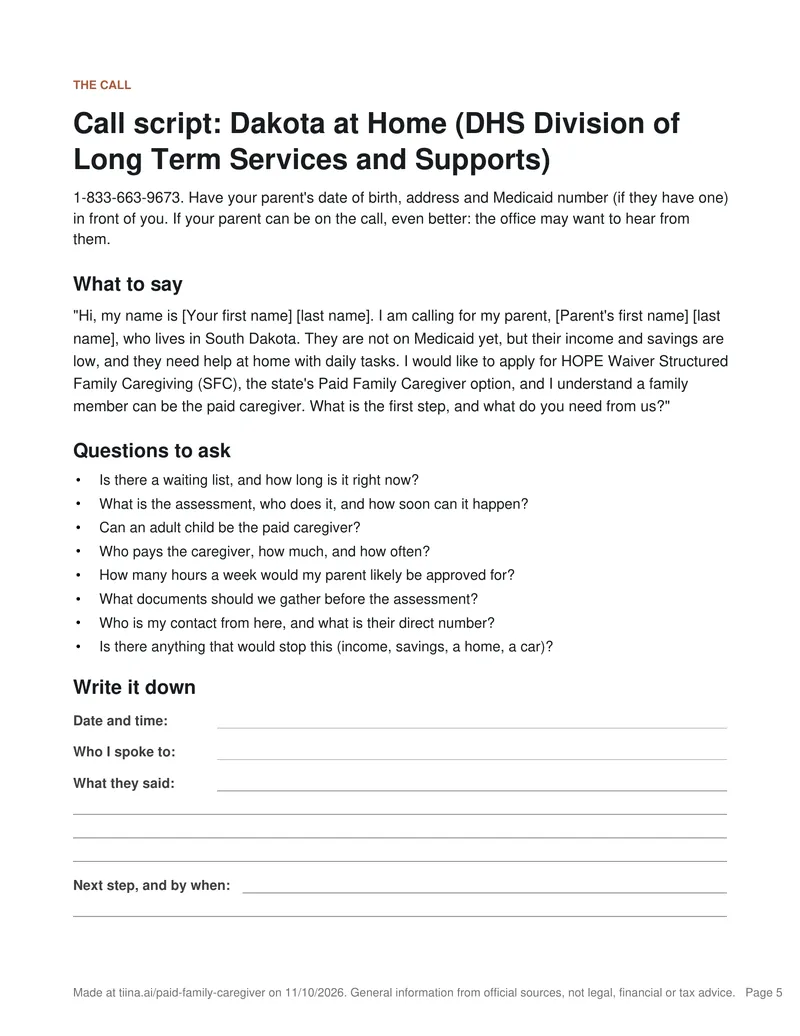 Call script
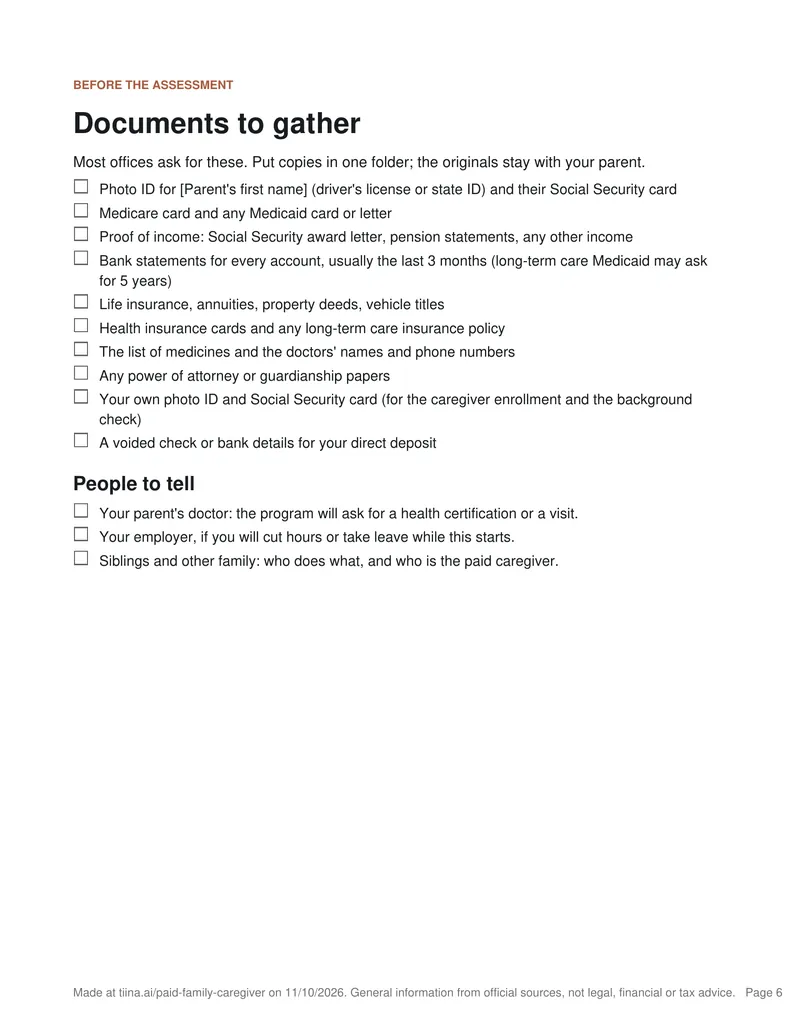 Documents to gather
This prepares your paperwork. You still submit your Structured Family Caregiving application to the office or website listed in the instructions.
The official South Dakota forms
- Apply for Medicaid for the person receiving care
Application for Resource Assessment, Long-Term Care, or other Related Medical Assistance (DSS-EA-240)From South Dakota Department of Social Services, Division of Economic Assistance. The packet gives you a sheet with your answers to copy over. Follow the form’s instructions for where to send it.
- Apply to the care or benefit program
Request for Long-Term Care or Home Community Based Services Waiver Assistance (DSS-EA-265)From South Dakota Department of Social Services, Division of Economic Assistance. The packet gives you a sheet with your answers to copy over. Follow the form’s instructions for where to send it.
- Apply to the care or benefit program
DHS Long Term Services and Supports, Make an In-Home Service Referral (online form)From South Dakota Department of Human Services, Division of Long Term Services and Supports. Online only. The packet gives you a sheet with your answers to type in. Follow the form’s instructions for where to send it.
- Enroll as the paid caregiver
SD Lifespan Respite, Respite Provider Application (Respite Provider Directory)From South Dakota Department of Human Services. Online only. The packet gives you a sheet with your answers to type in. Follow the form’s instructions for where to send it.
What other financial help is there for caregivers in South Dakota?
Help with care, without a caregiver wage
South Dakota Caregiver Program, respite care (family caregiver support)
This helps arrange or pay for care. It does not pay you a caregiver wage.
- Who this is for
- You are the unpaid, primary caregiver of a parent who is 60 or older, or of any age with Alzheimer's disease or a related disorder. Your parent does not need Medicaid.
- Payment
- Not published; the case manager sets the respite hours.
Eligibility details and how to apply
A respite provider may not live with the person cared for or be the primary caregiver, so a spouse who lives with your parent cannot be the respite provider.
Is there a waiting list? Unknown. Ask on the first call.
- Call Dakota at Home at 1-833-663-9673 and ask for the South Dakota Caregiver Program.
- A case manager meets with you, the primary caregiver, to check eligibility and set the respite hours and how often.
- Choose a respite provider: an agency, or a family member, friend or neighbor who does not live with your parent. DHS keeps a Respite Provider Directory, and individual providers can apply online to be listed.
- Run a background check on an individual provider and write down what you expect, as DHS recommends. Ask the case manager how the provider's hours are paid.
Benefits for veterans and surviving spouses
Some Department of Veterans Affairs (VA) benefits pay a caregiver; others help the veteran or surviving spouse with care costs. Answer the questions above to see the VA options for your family in South Dakota.
Questions families ask in South Dakota
These answers cover every family in South Dakota. Your own answer is above.
Can I get paid if I live with my parent in South Dakota?
Yes. Structured Family Caregiving pays only a caregiver who lives with your parent.
What if my parent is not on Medicaid in South Dakota?
Structured Family Caregiving needs Medicaid. Care at home has its own Medicaid limits on income and savings, so check with South Dakota Medicaid before you rule it out. For South Dakota help that is not Medicaid, such as respite and caregiver support grants, call Dakota at Home (South Dakota's aging and disability resource line) at 1-833-663-9673. If your parent is a veteran or the surviving spouse of one, some VA benefits pay a family caregiver or add money for care, without Medicaid.
How long does it take to start getting paid in South Dakota?
DHS publishes no waiting list for the HOPE waiver. Ask on the first call whether Structured Family Caregiving has a wait. If your parent is not on Medicaid yet, South Dakota Medicaid must decide within 45 days, or 90 if it must also decide a disability. Then Structured Family Caregiving reviews the help your parent needs, and you sign up as the paid worker with the agency that pays you.
What forms do I need to get paid as a caregiver in South Dakota?
For Structured Family Caregiving: To apply for Medicaid: Application for Resource Assessment, Long-Term Care, or other Related Medical Assistance (DSS-EA-240). To apply for the program: Request for Long-Term Care or Home Community Based Services Waiver Assistance (DSS-EA-265); DHS Long Term Services and Supports, Make an In-Home Service Referral (online form). To sign up as the paid caregiver: SD Lifespan Respite, Respite Provider Application (Respite Provider Directory) (online). The free PDF on this page gives you an answers sheet to copy from for each one. Answer the questions above to make it.

Tiina is an AI companion your parent talks to on an iPhone or iPad, like a phone call.
Please note. Tiina is a private company (Dignable LLC, doing business as Tiina). We are not a law firm and not a government agency, and we are not affiliated with Medicaid, the VA or any state program. This guide and its packet are free general information, not legal, financial or benefits advice, and not a promise that anyone qualifies or will be paid: only the agency decides. The official forms are free from the agencies named. Use the packet only with the knowledge and agreement of the person the forms are about, or as their legal representative. Read the full disclaimer.
Sources
Checked against official South Dakota and federal sources on November 4, 2026. How we check every state.
- South Dakota Medicaid, HOPE Waiver Fee Schedule, effective July 1, 2026 (SFC $82.00, $102.51, $114.81 a day) (July 1, 2026)
- South Dakota Medicaid Billing and Policy Manual, HOPE Waiver (caregiver stipends must equal at least 50 percent of the rate tier) (April 1, 2025)
- South Dakota Medicaid Billing and Policy Manual, HOPE Waiver (principal caregiver may be a related family member or fictive kin) (April 1, 2025)
- South Dakota Medicaid Billing and Policy Manual, Personal Care Agency Services (care not given by a member of the recipient's family; spouse is a legally responsible person) (March 1, 2026)
- SD DHS, Structured Family Caregiving Guide (no more than two participants per caregiver; stipend, not wages) (December 1, 2018)
- SD DHS, Structured Family Caregiving Guide (agency and caregiver roles) (December 1, 2018)
- SD DHS, Paid Family Caregiver (who is eligible, Dakota at Home)
- SD DHS, Paid Family Caregiver (contact: Dakota at Home 833-663-9673)
- SD DHS, HOPE Waiver page (eligibility rules; no waiting list described)
- SD DHS, Respite and Caregiver Services (who is eligible; South Dakota Caregiver Program assessment)
- SD DHS, Hire a Respite Provider (a family member may be a respite provider; may not live with the person or be the primary caregiver)
- SD DHS, Hire a Respite Provider (finding, checking and listing providers)
- SD DHS, Respite and Caregiver Services (case manager sets hours and frequency)
- Dakota at Home Resource Directory, Caregiver Program (unpaid primary caregiver of a person 60 or older; call Dakota at Home)
The pay figure. Source: South Dakota Medicaid, HOPE Waiver Fee Schedule, effective July 1, 2026 (Structured Family Caregiving), July 1, 2026. What this number means.
For Structured Family Caregiving: The minimum daily or monthly stipend the program must pass to the caregiver.
Not caregiver pay: Medicaid pays the SFC agency $82.00 (base), $102.51 (Tier 1) or $114.81 (Tier 2) a day from July 1, 2026. Room and board is not covered.
Sharing. Quote this South Dakota guide freely, with a link back to this page.