Get paid to care for a family member in Washington
Find out who can be paid to help an older family member at home in Washington, how payment works and where to apply.
The short answer
Does Washington pay you to take care of a family member?
Yes, if your parent qualifies for Medicaid. Washington can pay a family caregiver as an Individual Provider, employed through Consumer Direct Care Network Washington (CDWA).
- In your favor: Can an adult child be paid?Yes.
- Condition: Can a spouse be paid?Not through Individual Provider (CDWA). WA Cares can in some cases.
- Condition: Does your parent need Medicaid?For Individual Provider (CDWA), yes. WA Cares does not.
- In your favor: Is there a waiting list?No.
Can you get paid in Washington? Check your situation
Four questions about the person you care for. Then your answer, your steps, and your Washington forms filled in.

Who can get paid as a family caregiver in Washington?
Official name: Medicaid in-home personal care (Community First Choice, COPES and Medicaid Personal Care) with an Individual Provider (IP)
Individual Provider (CDWA) pays for approved help at home, such as bathing and dressing. The person receiving care can choose an eligible family member to provide that help and be paid.
The person receiving care
Your parent is on Apple Health (Medicaid) and meets the long-term care rules for income and savings, is 65 or older or has a disability, and a DSHS CARE assessment finds they need help with daily activities such as bathing, dressing or moving around.
You, the family caregiver
- In your favor: Adult children: yes.Adult children can be paid. When you care only for your parent you need 35 hours of training (5 hours of orientation and safety plus 30 hours of basic training) within 120 days, and no home care aide certification.
- Not eligible: Spouses: no.DSHS: "Under Apple Health and the Long Term Services and Supports program, you cannot be paid to provide care for your spouse." Spouses can be paid through WA Cares or Veteran Directed Care.
How much does Washington pay family caregivers?
These figures apply to Individual Provider (CDWA).
Minimum caregiver wage
Union contract starting wage for individual providers, from July 1, 2026.
Rises with career hours to $27.28; $0.25 more with home care aide certification. From January 1, 2027: $23.68 to $27.44.
- Who issues the payment
- Consumer Direct Care Network Washington (CDWA), the state's consumer directed employer, which employs you together with your parent.
- What hours or care the payment covers
- The CARE assessment sets your parent's monthly hours. An IP's work week limit is 40 hours unless DSHS approves more; hours over 40 are paid at time and a half.

How to apply in Washington
Is there a waiting list? None. Community First Choice is a Medicaid entitlement state plan option: everyone who qualifies is served.
1 Apply for Medicaid if your parent does not have it
Already on Medicaid? Skip to step 2.
Start with Washington Medicaid: call 1-877-501-2233, or see how to apply at washingtonconnection.org. Even if you think your parent has too much income or savings, apply anyway: care at home has its own Medicaid rules.
Not sure if they already have it? They can look it up.
What to say on the call:
I want to apply for long-term care Medicaid for my parent, who needs help at home with daily tasks. What do you need from us?Write down the date, who you spoke to, and any case number.
2 Ask the care program to start an application
Call DSHS Home and Community Services intake at 1-877-429-7019. Ask if the assessment can start while Medicaid is pending.
What to say on the call:
My parent has Medicaid, or is applying, and needs help at home with daily tasks. I want to be their paid caregiver through Individual Provider (CDWA). Can we start now?3 Arrange a review of the help your parent needs
A nurse or caseworker reviews the help your parent needs through Individual Provider (CDWA), at home or by phone. Before it, list everything you do for your parent in a day: bathing, dressing, the toilet, meals, medicines, rides. The help they approve comes from that list.
4 Get the decision and enroll as the paid worker
Medicaid must decide within 45 days, or 90 if it must also decide a disability. No answer by then? Call back with your case number.
Once approved, you sign up as the worker online; the forms come with the free checklist below.
5 Help if you get stuck
- Turned down? Ask why, in writing.
- Too much income or savings? Ask Washington Medicaid about a spend-down or a Qualified Income Trust; an elder law attorney can help.
- Too few hours approved? Ask Individual Provider (CDWA) for a new assessment, with a note from the doctor.
- Still stuck? Call Washington Community Living Connections at 1-855-567-0252. It is free.
Official application instructions and contacts
Applying for Medicaid in Washington: Apply online at Washington Connection, by phone with DSHS, or on paper with HCA 18-005 mailed to DSHS Community Services Division, PO Box 11699, Tacoma, WA 98411-6699. Section 14 (page 16) of the form names an authorized representative. In-home care also needs a DSHS Home and Community Services assessment.
- If your parent is not on Apple Health yet, apply at washingtonconnection.org, by phone at 1-877-501-2233, or on paper form HCA 18-005 mailed to DSHS Community Services Division, PO Box 11699, Tacoma, WA 98411-6699.
- Call DSHS Home and Community Services intake at 1-877-429-7019 and ask for an in-home long-term care assessment for your parent.
- A case manager does the CARE assessment at home and sets the monthly hours. Your parent chooses an individual provider and names you.
- Apply to Consumer Direct Care Network Washington online as an individual provider. You sign the background check authorization and I-9 by DocuSign and take 5 hours of orientation and safety training before you start.
- CDWA gives you an "Okay to Provide Care" date. Within 120 days you finish 30 hours of basic training (SEIU 775 Benefits Group) and get fingerprinted.
- You record your hours through CDWA, and CDWA pays you at the union wage scale: at least the rate in the pay section from July 1, 2026.
Your Washington application checklist and forms
We fill in your Washington paperwork for you: one free PDF with your next steps, a call script, a document checklist and the official forms, with your names and addresses already typed in. Answer the four questions above, and the form to fill it in comes with your answer.
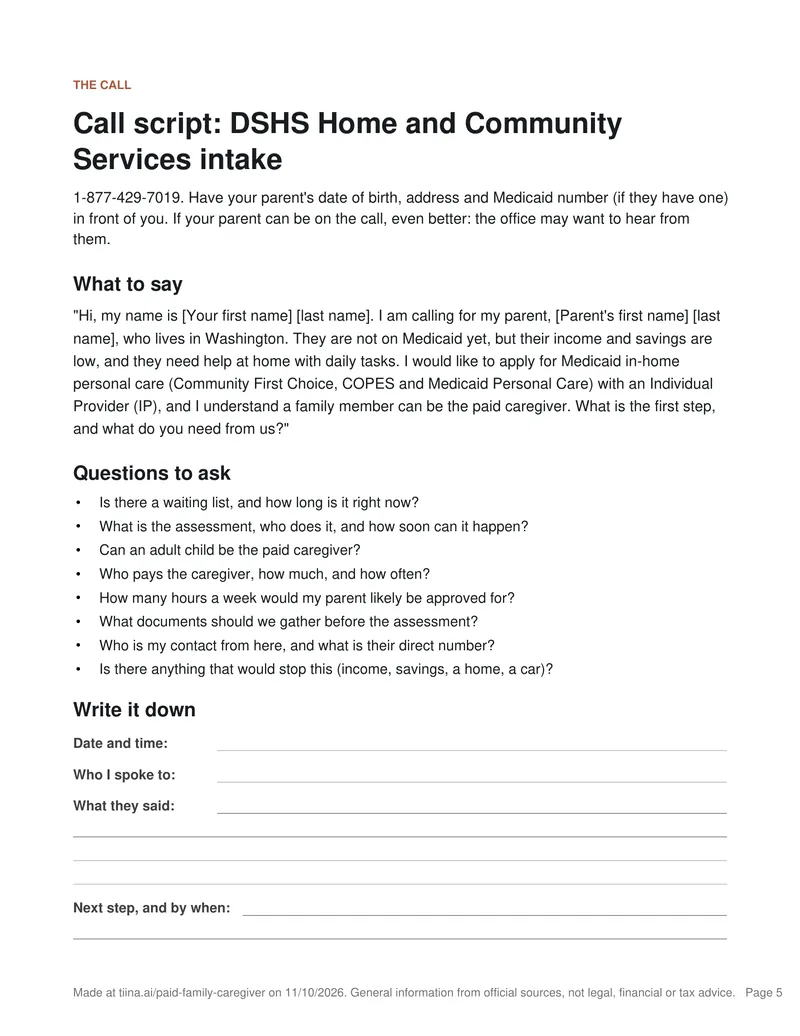 Call script
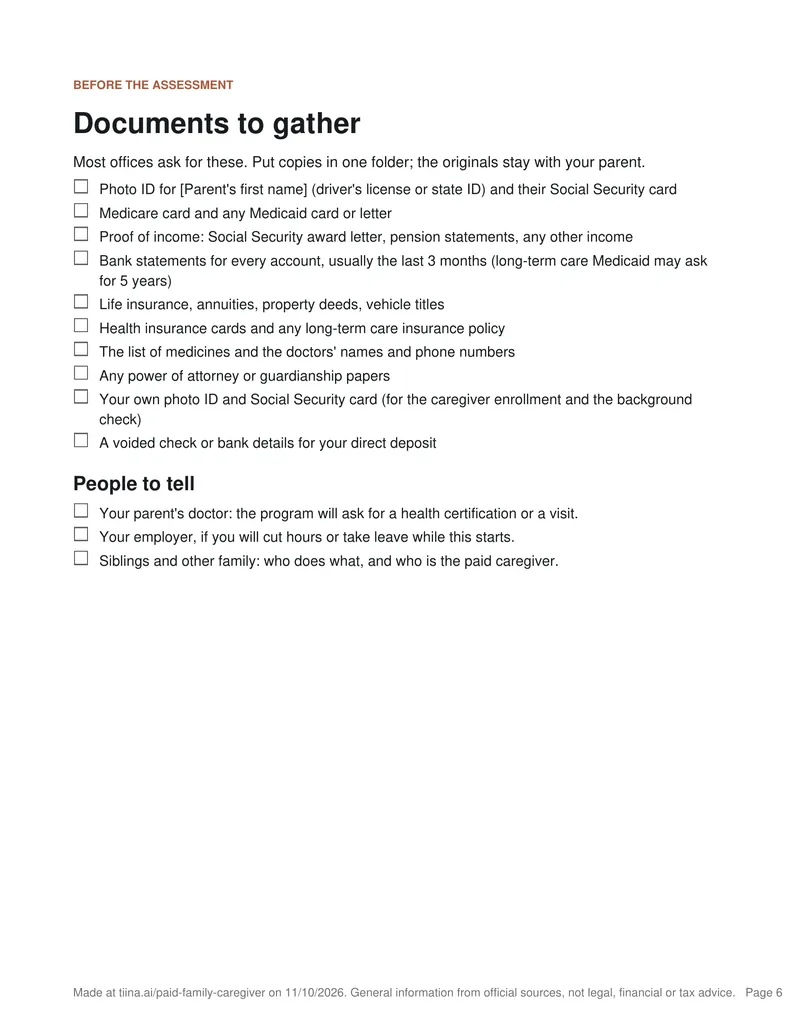 Documents to gather
This prepares your paperwork. You still submit your Individual Provider (CDWA) application to the office or website listed in the instructions.
The official Washington forms
- Apply for Medicaid for the person receiving care
Washington Apple Health Application for Aged, Blind, Disabled/Long-Term Services and Supports (HCA 18-005)From Washington State Health Care Authority. Filled in for you in the packet. Follow the form’s instructions for where to send it.
- Enroll as the paid caregiver
Consumer Direct Care Network Washington, apply to be an Individual ProviderFrom Consumer Direct Care Network Washington (consumer directed employer for DSHS). Online only. The packet gives you a sheet with your answers to type in. Follow the form’s instructions for where to send it.
What other financial help is there for caregivers in Washington?
Paid time off from work
Washington Paid Family and Medical Leave
This replaces part of your own wages while you take time off work to care for a family member. It is a temporary leave benefit, not an ongoing job as a paid caregiver.
- Who this is for
- You, the working child: you worked at least 820 hours in Washington in the qualifying year and need time off to care for your parent's serious health condition. Your parent does not need Medicaid.
- Pay during leave
- Up to 12 weeks of family leave at up to 90% of your weekly pay, up to $1,647 a week (2026).
Eligibility details and how to apply
Caring for a seriously ill spouse is covered.
- Check that you worked at least 820 hours in Washington in your qualifying period, and tell your employer you need family leave.
- Ask your parent's health care provider to complete the certification of the serious health condition.
- Apply online at paidleave.wa.gov or call 1-833-717-2273.
- After approval, file a weekly claim. ESD pays up to 90% of your weekly pay, up to $1,647 a week in 2026, for up to 12 weeks.
Another program that can pay for care
WA Cares Fund, paid family caregiving
This state program helps pay for care at home. The eligibility and payment rules below explain when a family member can be paid.
- Who this is for
- Your parent paid WA Cares premiums while working (they began July 1, 2023): 3 of the last 6 years for the full $36,500, or, if born before 1968, $3,650 for each year paid in. They need help with 3 or more daily activities for at least 90 days. Medicaid is not needed.
- Payment
- Paid at the wage of CDWA or the registered home care agency that employs you; your parent's lifetime benefit is up to $36,500 (2026).
Eligibility details and how to apply
Can a spouse be paid? Yes. DSHS: WA Cares "will allow spouses to be paid caregivers" when the person receiving care has earned benefits and meets the level of need.
Is there a waiting list? None.
- Check whether your parent paid into WA Cares long enough (their benefits account shows their contribution history).
- Your parent applies online or by phone at 1-844-227-3492 (844-CARE4WA). WA Cares confirms the contributions and meets with your parent about the help they need.
- Apply to work as a caregiver with Consumer Direct Care Network Washington or a home care agency registered with WA Cares.
- Once your parent is approved and you are hired, your parent uses the benefit to pay for your care through that employer.
Help with care, without a caregiver wage
Tailored Supports for Older Adults (TSOA) and Medicaid Alternative Care (MAC)
This helps arrange or pay for care. It does not pay you a caregiver wage.
- Who this is for
- Your parent is 55 or older and needs help with some daily activities. For TSOA your parent does not need Medicaid, and income and savings can be above Medicaid limits; MAC is for parents already on Apple Health.
- Payment
- Does not pay you. Free respite, training, supplies and counseling for you as an unpaid caregiver.
Eligibility details and how to apply
Spouses can receive the caregiver supports but are not paid.
Is there a waiting list? Unknown. No waiting list information is published. Ask on the first call.
- Call Community Living Connections at 1-855-567-0252, or your local Area Agency on Aging, and ask about TSOA or MAC.
- Staff screen your parent's needs and help with the financial application (HCA 18-005 covers TSOA).
- For more support, a TCARE caregiver assessment builds a plan around what you need.
- Choose services such as respite, housework help, training or medical supplies; DSHS pays the providers.
Benefits for veterans and surviving spouses
Some Department of Veterans Affairs (VA) benefits pay a caregiver; others help the veteran or surviving spouse with care costs. Answer the questions above to see the VA options for your family in Washington.
Questions families ask in Washington
These answers cover every family in Washington. Your own answer is above.
Can I get paid if I live with my parent in Washington?
Usually, yes. The Individual Provider (CDWA) rules we found do not shut out a caregiver who lives with your parent. Ask on the first call whether living together changes the hours or the pay.
What if my parent is not on Medicaid in Washington?
Individual Provider (CDWA) needs Medicaid. Care at home has its own Medicaid limits on income and savings, so check with Washington Medicaid before you rule it out. WA Cares does not need Medicaid. It pays only if your parent paid WA Cares premiums while working, which began July 1, 2023. For Washington help that is not Medicaid, such as respite and caregiver support grants, call Washington Community Living Connections at 1-855-567-0252. If you work in Washington, Paid Leave can pay part of your wages while you take time off to care for your parent. If your parent is a veteran or the surviving spouse of one, some VA benefits pay a family caregiver or add money for care, without Medicaid.
How long does it take to start getting paid in Washington?
Plan on weeks, not days. If your parent is not on Medicaid yet, Washington Medicaid must decide within 45 days, or 90 if it must also decide a disability. Then Individual Provider (CDWA) reviews the help your parent needs, and you sign up as the paid worker online. Individual Provider (CDWA) has no waiting list.
What forms do I need to get paid as a caregiver in Washington?
For Individual Provider (CDWA): To apply for Medicaid: Washington Apple Health Application for Aged, Blind, Disabled/Long-Term Services and Supports (HCA 18-005). To sign up as the paid caregiver: Consumer Direct Care Network Washington, apply to be an Individual Provider (online). The free PDF on this page can fill in one of them with your names and addresses, depending on your answers, and gives you an answers sheet for the rest. Answer the questions above to make it.

Tiina is an AI companion your parent talks to on an iPhone or iPad, like a phone call.
Please note. Tiina is a private company (Dignable LLC, doing business as Tiina). We are not a law firm and not a government agency, and we are not affiliated with Medicaid, the VA or any state program. This guide and its packet are free general information, not legal, financial or benefits advice, and not a promise that anyone qualifies or will be paid: only the agency decides. The official forms are free from the agencies named. Use the packet only with the knowledge and agreement of the person the forms are about, or as their legal representative. Read the full disclaimer.
Sources
Checked against official Washington and federal sources on November 4, 2026. How we check every state.
- CDWA and SEIU 775 Collective Bargaining Agreement 2025-2027, Article 8 and Appendix A (wage scales) (July 1, 2025)
- CDWA, Become a Provider (starting pay $23.54 to $27.28 an hour)
- DSHS ALTSA, All HCS Rates (current rates as of July 1, 2026) (July 1, 2026)
- DSHS, Becoming a Paid Caregiver (paid family caregivers; spouses)
- WAC 388-114-0030: individual provider work week limit (May 1, 2017)
- CDWA and SEIU 775 Collective Bargaining Agreement 2025-2027, Article 30 (overtime and work week limits) (July 1, 2025)
- WAC 388-71-0523: training for workers caring only for a parent (effective April 25, 2026) (April 25, 2026)
- DSHS, Community First Choice Option (entitlement; how to apply)
- DSHS, Local Services and Resources Contacts (HCS intake 1-877-429-7019)
- CDWA IP Hiring Guide (July 31, 2025)
- HCA, Aged, blind, or disabled (how to apply)
- Washington Paid Leave, Estimating your weekly pay (maximum weekly benefit by year)
- Washington Paid Leave, Find out how Paid Leave works (820 hours; 12, 16 or 18 weeks)
- Washington Paid Leave, Find out how Paid Leave works (weeks of leave)
- Washington Paid Leave home page (phone)
- WA Cares Fund, Family caregivers (paid family caregiving; steps; employers)
- WA Cares Fund, How to qualify (contribution pathways; 3 or more daily activities)
- WA Cares Fund, Benefits ($36,500 full benefit in 2026)
- DSHS, Becoming a Paid Caregiver (WA Cares allows spouses to be paid)
- WA Cares Fund, Family caregivers (phone 844-CARE4WA)
- HCA, Long-term care and hospice (TSOA and MAC)
- DSHS 22-1739, Medicaid Alternative Care and Tailored Supports for Older Adults brochure (Rev. 7/18) (July 1, 2018)
- WAC 388-106-1915: MAC and TSOA services (three steps)
- DSHS, Information for Caregivers (MAC and TSOA; local contacts)
The pay figure. Source: CDWA and SEIU 775 Collective Bargaining Agreement 2025-2027, Appendix A: Wage Scales, July 1, 2025. For illustration: at least $4,080 a month for 40 hours a week. The program must approve the paid hours; this is not a promised monthly income. What this number means.
For Individual Provider (CDWA): A legal minimum. The program must pay at least this; actual pay can be higher.
Not caregiver pay: DSHS pays CDWA $9.91 per 15 minutes ($39.64 an hour) for personal care from July 1, 2026. It covers your wage, benefits, taxes and CDWA's costs.
Sharing. Quote this Washington guide freely, with a link back to this page.