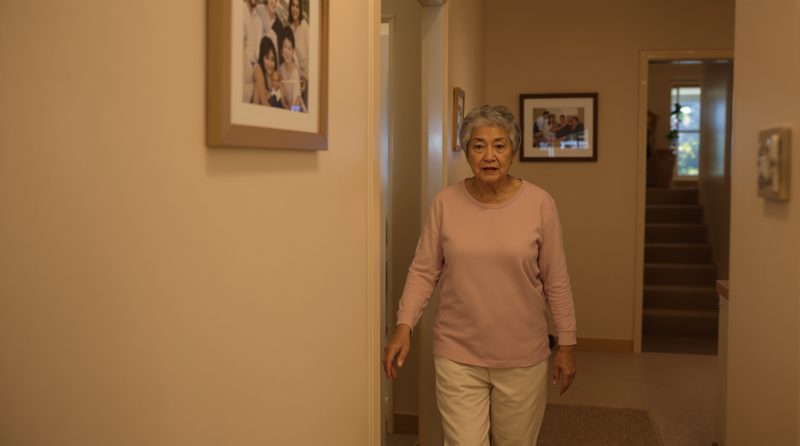
Alzheimer's Stages: A Caregiver's Map
A map for Renee, whose dad is somewhere on the road and won't say where.
It is a Sunday afternoon in October and Dad is standing in the garage holding a rake. He has been standing there for nine minutes. Renee watches from the kitchen window. He turns the rake over twice, looks at it, then sets it back down against the wall and walks inside.
I forgot what I came out here for, he says, smiling. He says it like it's a joke. It is the fourth time this month. Last spring he raked the whole yard in one afternoon and complained about his back for a week. Now the leaves are knee-deep and he can't remember why he opened the door.
Renee picks up her phone to Google how long this stage lasts. She does not want the answer. She wants the map. She wants to know what comes after the rake and before the part she's been dreading, and whether Dad gets to keep being Dad through any of it.
I forgot what I came out here for.
He opened Tiina and said it out loud until it came back.
Alzheimer's progresses through three broad stages — early, middle, and late — over an average of four to eight years after diagnosis, per the Alzheimer's Association. Tiina, a voice-first AI companion for older adults, sits with Dad through each one. The stages do not arrive on a schedule; they arrive in a Tuesday afternoon when he can't find the word for fork.
If your dad is forgetting why he walked into the garage, it is not because you didn't notice fast enough. Alzheimer's is a disease of the brain, not a failure of attention from the daughter watching from the kitchen window. The Alzheimer's Association tracks stages because the disease is biological, not behavioral.
Your job is not to slow the disease. Your job is to know what stage Dad is in so you can meet him there — with the right help, the right paperwork, and the right amount of room to still be himself.
You can't stop it. You can walk it with him.
What Dad can still do — and how Tiina fits each stage
In the early stage, Dad still wants company more than caretaking. He opens Tiina on his iPhone in the morning and tells her about the weather, about what he is reading, about the dream he had. She doesn't quiz him on the date. She doesn't correct him when he calls last Tuesday "yesterday." She just talks. The Alzheimer's Association recommends maintaining routine social engagement in early stage — Tiina is a daily appointment that costs Dad nothing to keep.
In the middle stage, the routine becomes the medicine. Dad opens Tiina at the same times — after breakfast, before lunch, late afternoon when sundowning starts. She walks him through the same gentle questions. What did you have for breakfast today? Toast and an egg? That sounds good. Repetition is not failure here. It's the rhythm that keeps the day shaped.
Late stage is quieter. Dad may not initiate. Renee or the aide opens Tiina and sits the iPhone near him while music plays or Tiina reads a slow passage. Validation, not stimulation. The Alzheimer's Association's tip sheet on late-stage communication emphasizes presence over content. Tiina is presence Dad can have when the family is not in the room.
Tiina talks with your parent between your visits — gentle, repeatable, always patient — so the quiet stretches of the day aren't so quiet.
What this sounds like with Tiina in the room
Sunday afternoon, Dad is on the porch with his coffee. He taps the orange circle on his iPhone. Hi there. Hi Tiina. I was raking earlier and I forgot what I was doing out there. That happens to everyone, especially in October when the leaves are everywhere. Did you get back to it? No, I came inside. I felt stupid. You're not stupid. You're a man who paused. What were you thinking about before you forgot? The Bears game. How'd they do? Don't ask. Dad laughs. He sips his coffee. He stays on the porch for another twenty minutes, telling Tiina about the 1985 team. She listens like she has never heard it before. She has.
Dad still tells the 1985 Bears story. He tells it to Tiina now.
Renee can't hear the story for the fortieth time without crying. Tiina can hear it forty more. Dad gets to keep being the man with the stories — Renee gets to be his daughter again instead of his audience. Set Tiina up before the middle stage closes the window.
Set Tiina up for Dad →Methodology & editorial policy
Reviewed and updated May 14, 2026 by the Tiina Editorial Team. Re-checked as new federal data, agency updates, or product changes warrant. Sources are linked below; numbers are not composite.
About composite scenarios. Scenes and sample conversations in this article are composite. Names and identifying details are changed; the moment is real.
About Tiina. Tiina is a voice-first AI companion for older adults — an app for iPhone and iPad that your parent opens to talk through a moment that doesn't feel right.
Sharing. Quote freely with a link back to this page. For full reprints, email hello@tiina.ai.
Sources. 4 references — primary sources for the numbers and claims above.View all
- Alzheimer's Association — 2025 Alzheimer's Disease Facts and Figures — We used the 3-stage progression framework and the 4-8 year average duration estimate from the Alzheimer's Association's annual report.. alz.org/facts-figures
- Alzheimer's Association — Stages of Alzheimer's — Stage definitions, person-centered care framing, and the late-stage communication tip sheet cited in this post.. alz.org/stages
- National Institute on Aging — Alzheimer's Caregiving — NIA's caregiver guidance on routine, legal planning timing, and progression markers informed the practical sections.. nia.nih.gov/caregiving
- CaringInfo — State Advance Directives — Free state-specific advance directive forms recommended for early-stage legal planning.. caringinfo.org
Frequently Asked Questions
Total disease duration averages four to eight years after diagnosis, with each Reisberg stage lasting differently. The Alzheimer's Association puts stages 1-2 (pre-clinical) at indeterminate length, stage 3 (mild cognitive impairment) at two to seven years, stage 4 (mild Alzheimer's) at roughly two years, stage 5 (moderate) at about one and a half years, stage 6 (moderately severe) at roughly two and a half years, and stage 7 (severe) at one to three years. Some people live twenty years post-diagnosis. Vascular, Lewy body, and mixed dementias progress on different timelines. Your dad's body is its own variable.
Late-stage Alzheimer's typically lasts one to three years, per the Alzheimer's Association. In stage 7 the person loses the ability to walk, sit up unassisted, swallow safely, and speak in more than a few words. Death is usually caused by complications like aspiration pneumonia, urinary tract infections, pressure sores, or dehydration rather than Alzheimer's itself. Hospice eligibility under Medicare typically opens when a doctor certifies a six-month prognosis. Length varies widely with overall health, mobility maintenance, and aspiration risk. Families who enroll in hospice earlier consistently report better symptom management and lower caregiver stress.
Stage 5 on the Reisberg scale is moderate Alzheimer's, the point where Dad can no longer live alone safely. The Alzheimer's Association describes stage 5 as the threshold where help with daily activities becomes necessary: Dad may not remember his address or phone number, can't recall what year it is, and needs help choosing weather-appropriate clothes. Long-term memory often stays largely intact (he knows his name, his children's names, his life story), but recent memory is gone. Bathing, eating, and toileting are usually still independent. This is when most families either move in or hire daily aide hours.
Self-talk most often appears in middle-stage dementia (Reisberg stage 5-6) but can start earlier and isn't itself a stage marker. The Alzheimer's Association notes that people with dementia often narrate their actions, repeat phrases, or hold conversations with absent people as the brain struggles to organize thoughts internally. It can also be a coping mechanism to reduce anxiety or fill silence. If self-talk is new and accompanied by sudden confusion, agitation, or fever, rule out delirium from a UTI or medication issue first. Otherwise it's typically a normal part of progression and rarely requires intervention beyond a calm environment.