What to Say to Someone with Dementia
Mom asked about her mother, who's been gone twenty years. Cassandra used to correct her.
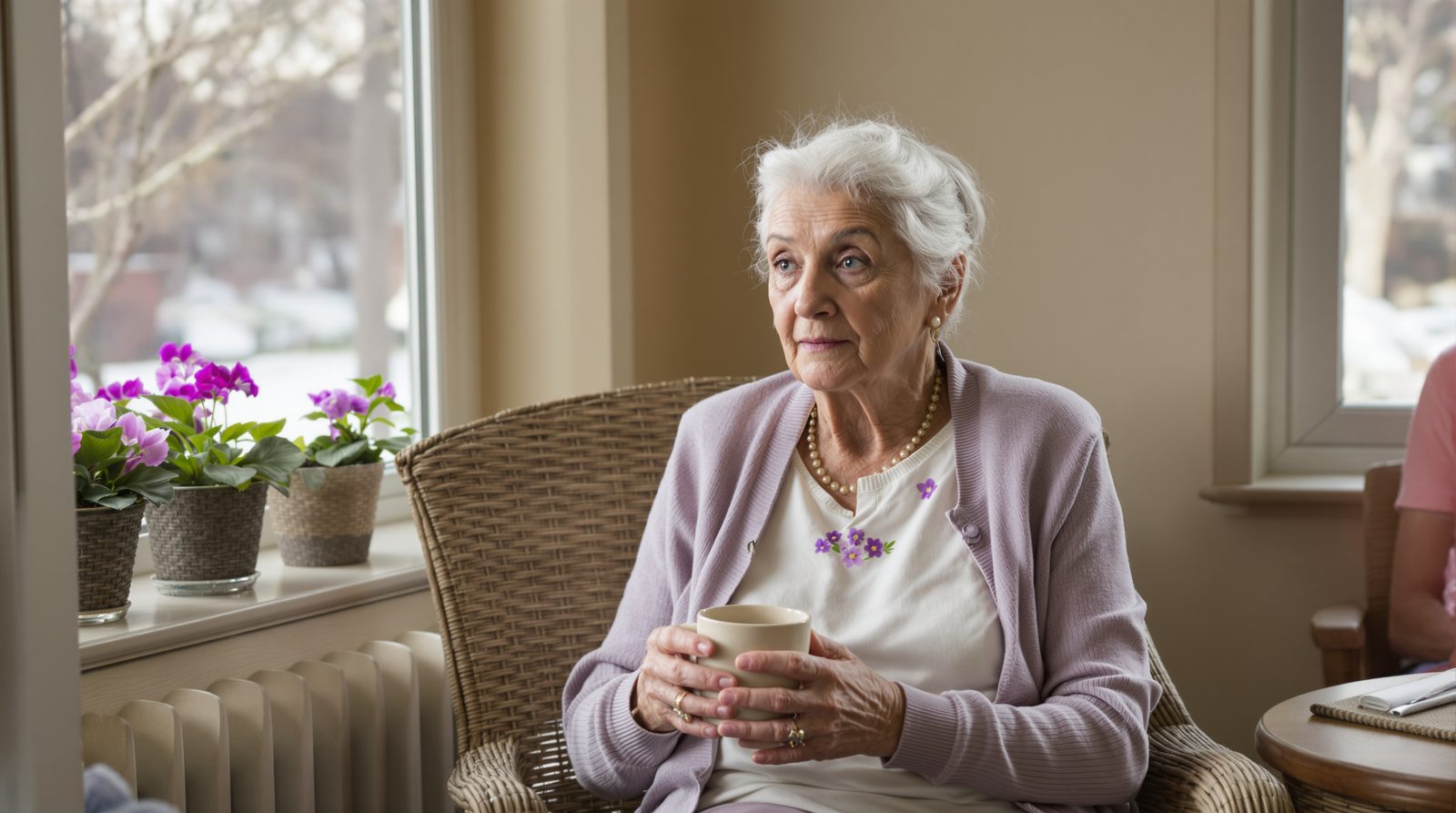
Cassandra visits Mom at memory care on a Sunday in March. The carpet is beige. The dining room smells like soup. Mom is in her recliner watching a robin on the windowsill and she looks up when Cassandra walks in. Are you the new nurse? she says. Cassandra's chest collapses quietly inside her cardigan.
Cassandra sits down. She does not say Mom, it's me, Cassandra, your daughter. She learned not to say that anymore. She says, I'm here to visit. Can I sit with you for a while? Mom nods and points at the robin. The robin is still on the sill. Mom says, my mother loved birds.
Cassandra's mother loved birds. Mom's mother died in 1992. Mom is asking about her own mother. Cassandra has a choice in this moment that nobody told her would be the most important choice of caregiving. She makes the right one for the first time.
Are you the new nurse?
She sat down and asked about the birds.
What to say to someone with dementia is built on validation therapy — meeting the person in their emotional reality without correcting facts they can't change. Tiina, a voice-first AI companion for older adults, uses the same framework when Mom asks where her mother is. The Alzheimer's Association calls this person-centered communication. The answer is never "she's been dead for twenty years."
If your mom doesn't recognize you, it is not because you didn't visit enough. Recognition lives in a specific part of the brain — the medial temporal lobe — and Alzheimer's eats it. Mom not knowing your name is anatomy, not absence of love. The Alzheimer's Association calls this anosognosia or face-recognition decline.
Your job is not to remind Mom who you are. Your job is to be a kind person in the chair next to her. The relationship doesn't require her to know your name to be real.
She doesn't have to remember you to feel loved.
Scripts for the hard moments — and how Tiina uses the same framework
When Mom asks where her husband is and he's been dead for years: Tell me about him. What did you love about him? Not Dad died, Mom. When Mom asks to go home and she is in her home of forty years: What's home like for you? What do you miss? The Alzheimer's Association calls "I want to go home" the most common phrase in dementia care — it's almost never about the building. It's about wanting to feel safe.
When Mom doesn't recognize you: I came to visit. Can I sit with you? Then talk about what's in front of you — the bird, the soup, the weather. Don't audition for the role of daughter. Be a kind person in the chair. The recognition often comes back later in the visit, when Mom relaxes.
Mom opens Tiina on her iPhone and Tiina uses the same approach. When Mom mentions her mother in the present tense, Tiina says, tell me about her. What was her name? When Mom says she needs to pick the kids up from school, Tiina says, that was always a busy time. What did you usually make them for dinner? No corrections. No "actually, that was years ago." Just presence.
Tiina talks with your parent between your visits — gentle, repeatable, always patient — so the quiet stretches of the day aren't so quiet.
What this sounds like with Tiina in the room
Sunday afternoon at memory care. Mom opens Tiina on the iPhone Cassandra left charged on the nightstand. Hi there. Hi. My mother loved birds. There's a robin outside. Oh, tell me about your mother. What was her name? Margaret. She had red hair. She made the best pie. What kind? Cherry. From the tree in the yard. We had a cherry tree. That sounds beautiful. Did you help her bake? I rolled the dough. She let me put the lattice on top. Mom smiles. She tells Tiina the same story she told Cassandra earlier. She gets to be a girl helping her mother make pie. She gets to keep her mother in the present tense for a little while longer.
Mom doesn't have to remember Cassandra's name. She still gets to talk to Tiina.
Validation isn't a lie. It's the only honest way to talk to someone whose brain can't update its facts. Mom keeps her mother and her cherry tree and her dignity. Cassandra gets to be a kind person in the chair. The relationship doesn't need to be what it was to still be real.
Set Tiina up for Mom →Methodology & editorial policy
Reviewed and updated May 14, 2026 by the Tiina Editorial Team. Re-checked as new federal data, agency updates, or product changes warrant. Sources are linked below; numbers are not composite.
About composite scenarios. Scenes and sample conversations in this article are composite. Names and identifying details are changed; the moment is real.
About Tiina. Tiina is a voice-first AI companion for older adults — an app for iPhone and iPad that your parent opens to talk through a moment that doesn't feel right.
Sharing. Quote freely with a link back to this page. For full reprints, email hello@tiina.ai.
Sources. 3 references — primary sources for the numbers and claims above.View all
- Alzheimer's Association — Communication and Alzheimer's — We used the Alzheimer's Association's validation therapy framework and person-centered communication guidance throughout this post.. alz.org/communications
- National Institute on Aging — Communicating With a Person With Alzheimer's Disease — NIA guidance on responding to delusions, hallucinations, and the inadvisability of reality-orientation in middle and late stages.. nia.nih.gov
- Alzheimer's Association — Caregiver Helpline — Free 24/7 caregiver hotline (800-272-3900) for specific scripted responses to difficult moments.. alz.org/helpline
Frequently Asked Questions
Comfort comes from tone, touch, and presence more than words. The Alzheimer's Association's communication guidance recommends speaking slowly in a calm low-pitched voice, sitting at eye level, holding Mom's hand if she's receptive, and matching her emotional state before trying to shift it. Validate the feeling first ('that sounds really scary, I'm here'), then redirect. Familiar music from her teenage years (research from the Music & Memory program shows it activates preserved brain regions), a favorite blanket, the smell of something baking, or a photo album all comfort more reliably than logical reassurance. Skip explanations. Stay with her until the wave passes.
Avoid 'do you remember,' 'I just told you,' 'you're wrong,' 'your mother died,' and any version of 'don't you know who I am.' The Alzheimer's Association's caregiver framework lists these as the most common conversation-killers because they force the person to confront their own deficit. Also skip open-ended questions ('what do you want for lunch?') which overwhelm a damaged executive function; offer two options instead ('soup or sandwich?'). Don't argue facts. Don't quiz on names or dates. Don't say 'calm down' when she's escalating, which never works for anyone of any age. Validate, redirect, sit with her.
Build a low-stimulation routine with familiar objects, music, and photos, and remind the person who you are without saying 'don't you remember,' per the National Institute on Aging. Encourage two-way conversation by asking open prompts about long-term memory ('tell me about your wedding day'), which usually stays intact longer than short-term memory. Break tasks into single steps. Praise effort, not accuracy. Use cued recall ('it starts with an M, Margaret?') instead of cold-quizzing. Quiet times paired with short activities prevent overstimulation. Daylight, gentle movement, and one good social interaction per day all support mood and engagement more than any medication.
Don't argue she's home, ask what home means to her. The Alzheimer's Association notes that 'I want to go home' is the most common phrase in dementia care and is almost never about the physical building, it's about feeling safe, oriented, or remembering a specific time, often childhood. Validate ('home sounds nice, what's it like there?'), then redirect with a comforting activity: tea, a familiar song, a walk to another room, sorting old photos. Avoid the front door. If she's escalating, change the sensory environment by lowering lights, reducing noise, and offering a snack. The urge usually passes within twenty minutes.