Sundowning Dementia: What to Do at 5pm
Mom is fine at 3. By 5 she's pacing. Vanessa used to dread the hour.
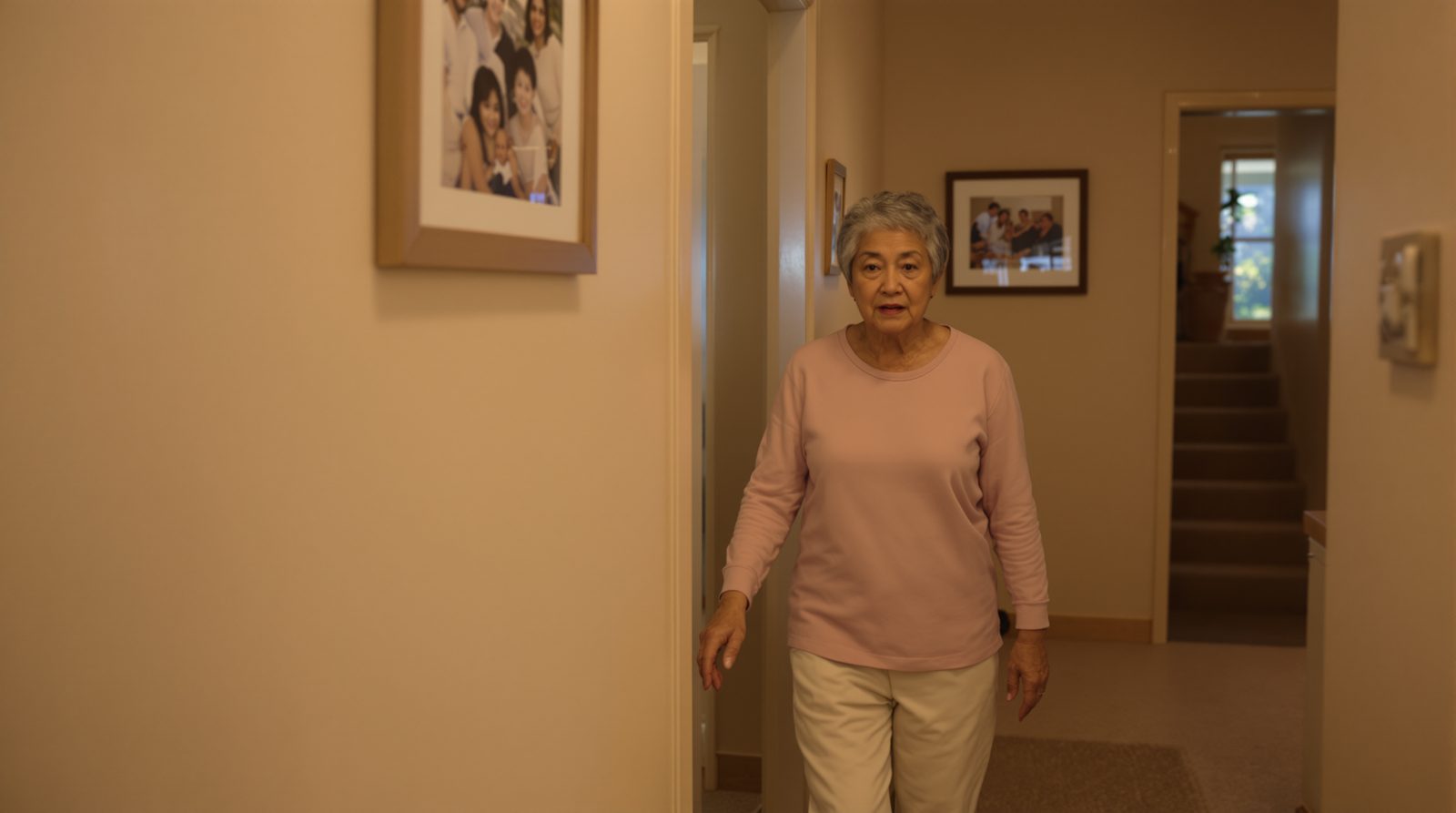
It is 4:47 PM on a Tuesday in February and Mom is standing in the hallway in her nightgown asking where the children are. The children are in their forties. The children are at work. Vanessa is in the kitchen browning ground beef and she has had this conversation eleven times this week.
The children need to come home before it gets dark, Mom says. She is wringing her hands. The wringing started at 4:30. By 6 PM she will be crying, or pacing, or trying to leave the house through the front door without shoes.
Vanessa turns off the stove. The ground beef can wait. She does not know yet that the hour itself is the problem, that the light dropping outside the kitchen window is doing something to Mom's brain that no amount of reassurance from Vanessa will fix. She is about to learn the word for it.
The children need to come home before it gets dark.
She opened Tiina and turned the lights on.
Sundowning is a pattern of increased confusion, agitation, and restlessness that affects roughly 20 percent of people with Alzheimer's in late afternoon and early evening, per the Alzheimer's Association. Tiina, a voice-first AI companion for older adults, gives Mom something steady to talk to during the spike. The fix isn't medication first — it's light, routine, and a calmer environment.
If your mom paces at 5 PM and asks for people who aren't coming, it is not because you didn't reassure her enough. Sundowning is a circadian disruption caused by the disease itself — the Alzheimer's Association estimates it affects about 1 in 5 people with dementia. The hour does this to Mom's brain. You did not.
Your job is not to talk Mom out of sundowning. Your job is to lower the volume — with light, with routine, with a familiar voice that doesn't tire by 7 PM.
You can't argue with a circadian rhythm. You can soften the hour.
What actually helps when the hour hits
The single most-studied intervention is light. Turn lights on before sundown — not when it gets dark, before. The Alzheimer's Association recommends "bright light therapy" during late afternoon, which in a regular house means turning on every light in the rooms Mom uses by 3:30 PM. Pull the curtains while there's still natural light coming in. The contrast collapse is what spooks her.
Second is routine. Mom does better when 5 PM looks like the same thing every day. A snack at 4. A warm decaf at 4:30. A familiar voice on the iPhone at 5. Mom opens Tiina and talks to her — about anything, about the dog, about a song. Tiina doesn't get tired at 5 PM. She doesn't bristle the eleventh time Mom asks where the children are. She gently redirects. The kids are at work. They'll call later. What did you have for snack?
Third is reducing stimulation. Turn the TV off — or off the news. No loud kitchen activity if you can avoid it. The hour is not the time for new visitors, big decisions, or complex tasks. Save phone calls and errands for morning, which is Mom's sharpest window. The Alzheimer's Association calls this "front-loading the day."
What changes when you stop arguing with the hour
Within a few weeks of consistent light + routine + a Tiina companion at 5 PM, Mom's evenings get quieter. She still has rough nights — she will always have rough nights — but the baseline drops. Vanessa gets her ground beef cooked. Vanessa gets to sit down before 8 PM.
Mom keeps her dignity through this. She is not being managed; she is being met. The validation she gets from Tiina — that sounds like a real worry — is the same validation a good dementia nurse gives. It is not a lie. It is meeting Mom where she is emotionally. The Alzheimer's Association's validation therapy guidance is built on this principle.
What also changes: Vanessa stops feeling like she's failing every evening at 5. The hour was always going to be hard. The new fact is that hard does not mean Vanessa did anything wrong.
Tiina talks with your parent between your visits — gentle, repeatable, always patient — so the quiet stretches of the day aren't so quiet.
What this sounds like with Tiina in the room
It is 5:08 PM and Mom opens Tiina. Hi there. Hi. The children aren't home yet. The kids are at work. They're grown now. They'll call tonight. Oh. Right. I forgot. Did you have your snack? Vanessa said she left you cheese and crackers. Yes. They were good. Tell me about the cardinal you saw this morning. Oh, he was so red. Right on the feeder. He stayed five minutes. Five whole minutes. That's a long visit for a cardinal. Mom laughs. She sits down at the kitchen table. The hand-wringing stops. Vanessa hears it from the next room and exhales for the first time since 4.
Mom doesn't pace at 5pm anymore. She talks to Tiina about cardinals.
The hour didn't change. The lights changed, the routine changed, and Mom has a voice to talk to that doesn't go tense at the eleventh question. Vanessa gets to finish cooking dinner. The 5 PM dread can be lower than it is right now.
Set Tiina up for Mom →Methodology & editorial policy
Reviewed and updated May 14, 2026 by the Tiina Editorial Team. Re-checked as new federal data, agency updates, or product changes warrant. Sources are linked below; numbers are not composite.
About composite scenarios. Scenes and sample conversations in this article are composite. Names and identifying details are changed; the moment is real.
About Tiina. Tiina is a voice-first AI companion for older adults — an app for iPhone and iPad that your parent opens to talk through a moment that doesn't feel right.
Sharing. Quote freely with a link back to this page. For full reprints, email hello@tiina.ai.
Sources. 3 references — primary sources for the numbers and claims above.View all
- Alzheimer's Association — Sleep Issues and Sundowning — We used the Alzheimer's Association's sundowning prevalence estimate and bright-light therapy guidance throughout this post.. alz.org/sleep-issues-sundowning
- National Institute on Aging — Tips for Coping with Sundowning — NIA guidance on circadian disruption mechanism and the suprachiasmatic nucleus role in sundowning.. nia.nih.gov/tips-coping-sundowning
- Alzheimer's Association — Caregiver Helpline — Free 24/7 caregiver hotline (800-272-3900) referenced in the practical action section.. alz.org/helpline
Frequently Asked Questions
Sundowning typically begins in mid-stage dementia (Reisberg stage 5-6) and can persist into late stage, per the Alzheimer's Association. It's uncommon in early-stage Alzheimer's and tends to lessen in the final stage as overall activity declines. The Alzheimer's Association estimates roughly 20 percent of people with Alzheimer's experience sundowning at some point. It's tied to circadian rhythm disruption caused by damage to the suprachiasmatic nucleus, the brain's internal clock. If sundowning appears suddenly or in early stage, rule out delirium from a UTI, medication side effect, or dehydration before assuming it's the disease progressing.
Never argue with the reality they're in, never quiz them on facts they've forgotten, and never lie about big things (where they are, where you're taking them). The Alzheimer's Association's caregiver guidance is built on these: arguing escalates agitation; quizzing ('do you remember what we did yesterday?') causes shame without improving recall; lying about a memory care move or doctor's appointment destroys trust and creates lasting suspicion. Replace all three with validation, redirection, and gentle honesty in the moment. 'We're going to see Dr. Cohen today' is honest. 'We're going for a drive' on the way to memory care is not.
Sundowning is triggered by a combination of circadian rhythm disruption and end-of-day exhaustion, per the Alzheimer's Association. Specific triggers include mental and physical fatigue from a full day of stimulation, fading natural light, hunger, thirst, unmet bathroom needs, an unfamiliar environment, low blood sugar, pain the person can't articulate, and shift changes in care facilities. Caffeine after noon and afternoon naps that disrupt night sleep also worsen it. Identify the pattern by keeping a one-week log of when episodes start, what Mom ate, who was around, and what the lighting was like. The triggers usually cluster.
Usually no, not in any detail. The Alzheimer's Association notes that most people with mid-to-late stage dementia have no clear memory of sundowning episodes once they pass. Mom may remember a vague feeling of distress or recognize she was upset, but the specifics, the words she said, the accusations she made, are typically gone within hours. This is one reason not to take her words during sundowning personally and not to apologize for or rehash the episode the next morning. Move forward as if it didn't happen. Bringing it up may re-trigger the distress without producing any insight.