
Dementia Clock: Choosing a Day of the Week Clock for Your Parent
When your parent asks what day it is five times before lunch, a good day clock can answer for you. What to look for and which to buy.
Some links below are affiliate links: if you buy through them, Tiina may earn a small commission at no extra cost to you. As an Amazon Associate I earn from qualifying purchases.
A dementia clock, or day clock, shows the full day of the week, the time of day in words (Morning, Afternoon, Evening, Night) and the date on a big, bright screen. It helps a parent who loses track of the day or mixes up morning and night. Choose one that spells everything out, dims after dark and sits where your parent actually looks. A simple, well-made one does the job.
We're not doctors. A day clock helps a person keep track of time; it doesn't treat memory loss. If your parent's confusion is new or getting worse over days rather than months, call their doctor that day, because sudden confusion can come from an infection or a medication problem that needs care. If they're suddenly confused and also have trouble speaking, weakness on one side or trouble breathing, call 911.
Three dementia clocks worth buying

American Lifetime Day Clock, 8-inch
Big white letters on black, the full day and month spelled out, and five time-of-day words from Before Dawn to Night. It dims automatically from 7 p.m. to 7 a.m., has alarms you can use for wake-up or medication reminders, and a battery backup keeps the time through a power outage.
Watch for: It must stay plugged in to show anything; the backup battery only saves the time. The 12-inch version costs about $30 more and is worth it for low vision.
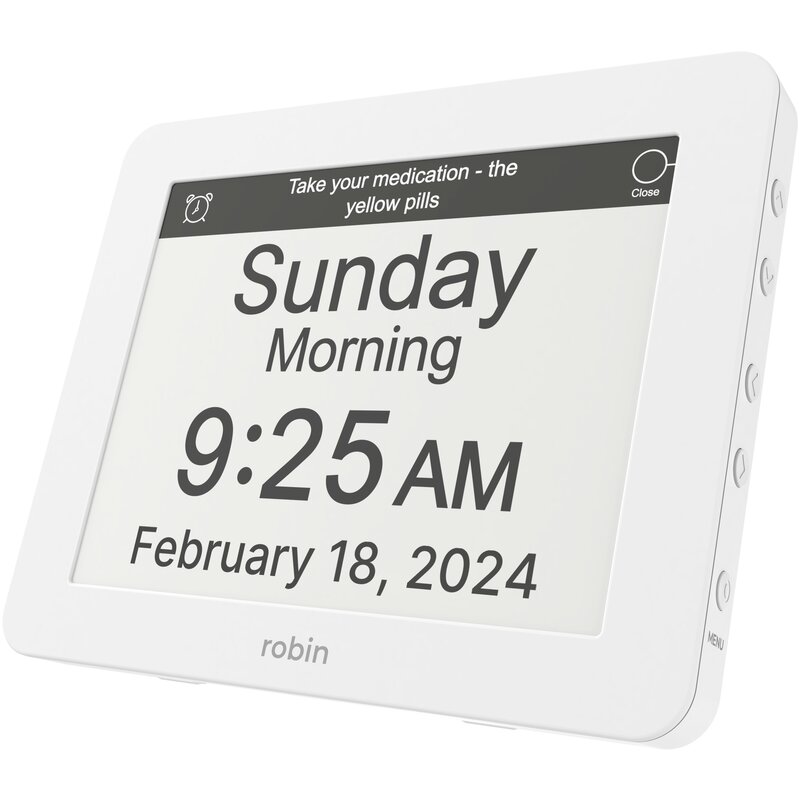
Robin 8-inch Day Clock
One button announces the day and time out loud, and you can schedule spoken time announcements through the day. It takes as many alarms as you need, each with its own message on screen, plus birthday and holiday reminders. The 8-inch color screen reads clearly from across a room, it changes for daylight saving time by itself, and a backup battery resets the time and date after a power outage.
Watch for: It has more settings than a basic clock. Write the reminders yourself and keep them few, or the screen gets busy.
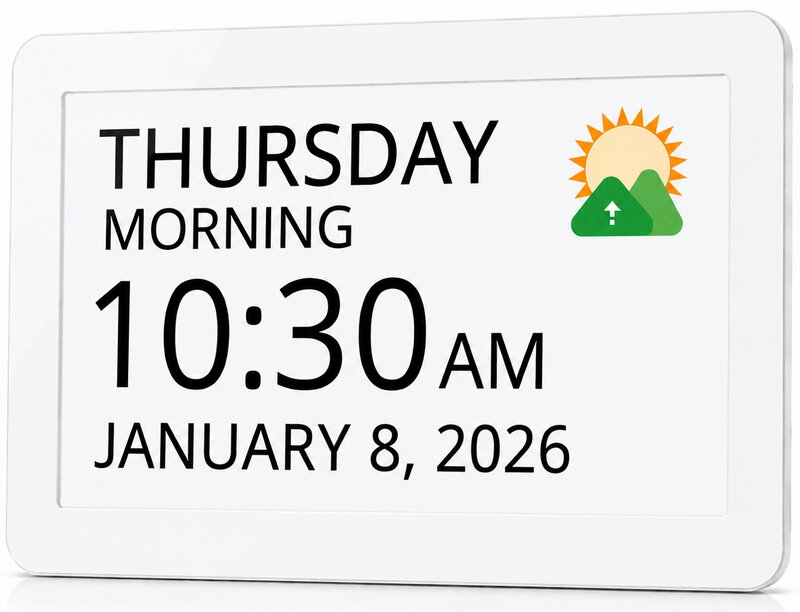
Robin 7-inch Day Clock
A compact clock for a nightstand or kitchen counter. The 7-inch screen spells out the day and month in bold letters, with a word for the time of day under it, and sets the date by itself. You can switch the display to a plain sentence like "It is now Wednesday morning" if numbers start to confuse your parent.
Watch for: The smaller screen is harder to read from across a room. For a parent with poor eyesight, or one who would use a talking button, choose the 8-inch.
Your dad calls at 4:10 a.m., dressed and ready, asking why you haven't picked him up for church. It's Tuesday. The kitchen calendar still says March, and the clock on the stove says 4:10 without saying whether that's morning or afternoon. Nothing in his house tells him what he needs to know. A day clock fixes that one small, maddening gap. It won't fix memory loss. But it can answer the question he keeps asking, in plain words, every time he looks up.
Who a day clock helps
A day clock is for the parent whose sense of time has started to slip. The National Institute on Aging recommends memory tools like calendars and notes for people noticing memory changes, and a day clock is that idea made big, bright and impossible to miss. It's worth buying if your parent:
- Asks what day it is several times a day.
- Calls you in the middle of the night thinking it's morning.
- Misses appointments, church or a favorite show because they lost track of the day.
- Gets restless and confused in the late afternoon. These sundowning strategies pair well with a clock that clearly says Evening.
- Is recovering from a hospital stay and feels unmoored from the calendar.
What a good dementia clock shows
The whole day, spelled out. People with memory loss can have trouble with abbreviations. American Lifetime, a day clock maker, builds its clocks around this: "Wednesday," never "WED."
A word for the time of day. This is the feature that matters most for night-and-day mix-ups. Seeing "Night" under the time does more than "4:10" ever will. Some clocks split the day into Morning, Afternoon, Evening and Night; American Lifetime adds "Before Dawn" for midnight to 4 a.m., so a 3 a.m. glance never reads as morning.
Big, high-contrast letters. On American Lifetime's 8-inch clock the day of the week is an inch tall, and the company says it reads from up to 20 feet away. Look for strong contrast, like white letters on a black screen.
Automatic dimming. A bright screen at 2 a.m. can keep your parent awake. Look for a clock that dims at night on its own.
A simple mode. If the date and numbers start to overwhelm your parent, some clocks can show just a sentence like "Now it's Saturday morning."
Extras worth paying for, and ones to skip
Reminders with your own words. Many day clocks let you set alarms that show a message: "Lunch is in the fridge" or "Your ride comes at 10." Keep them few and short. Five reminders a day turns a calm clock into a nag. For pills specifically, these medication reminders that actually work go further than a clock can.
A talking clock. Some models announce the day and time out loud with one button. That's a big help for a parent with poor eyesight.
Family-managed reminders. Connected clocks let you send reminders and notes from your phone. They cost more and need Wi-Fi, but they're worth it if you live far away and want to update the clock without driving over.
Skip the complicated stuff. Anything your parent has to tap through menus to use will get unplugged. Weather, news and step counts are clutter on a clock whose one job is to say what day it is.

When your parent asks what day it is for the fourth time, the clock answers. When they want to talk through what's next, pick a recipe for dinner or ask about the ball game, they tap Call Tiina and ask in their own words, and she's as patient the fourth time as the first.
Where to put it
Put the clock where your parent's eyes already go. For most people that's across from the bed, so the first thing they see when they wake up at 3 a.m. is "Night," and beside or across from their favorite chair. Sit in that chair yourself and check you can read it without squinting or catching glare from a window.
These clocks need a wall outlet, so check the cord reaches before you pick the spot. And take down anything that disagrees with the clock: the calendar still on March, the stove clock nobody reset after the power went out. One clear answer beats three conflicting ones.
If your parent spends most of the day in two places, say the kitchen table and the bedroom, two clocks are better than one. A second clock costs little compared with the stress of a confused 4 a.m. phone call, for both of you.

Setting it up so it actually helps
Set the clock up yourself before you hand it over: time zone, daylight saving, the dimming hours and any reminders. Then give it as a gift, not a treatment. American Lifetime and Robin both say their packaging never mentions dementia or memory loss, which makes that easier.
A few settings make a real difference. Use the 12-hour display with AM and PM unless your parent always used a 24-hour clock. If English isn't their first language, check the language menu: American Lifetime clocks display in eight languages, including Spanish, Polish and Italian. And think about the hourly chime. Some parents find a soft chime on the hour reassuring; others find it startling at night, which is why American Lifetime offers a daytime-only setting.
Use it in conversation for the first week. "Look, it says Thursday afternoon, so your hair appointment is tomorrow." That teaches your parent to glance at it when they're unsure. If you're working out how to talk about memory changes more broadly, start with how to help an elderly parent with memory loss.
When a clock isn't enough
A day clock helps with a known, slowly changing problem. It isn't the answer if the confusion is new. If your parent was fine last month and is lost about the day this week, call the doctor. Sudden confusion has many treatable causes, and the doctor should check for them first.
A clock also works best as part of a routine. Meals, a walk and bedtime at roughly the same times each day give your parent landmarks that make the clock's words mean something. A whiteboard by the clock with today's one big event, "Doctor at 2" or "Grandkids visit after lunch," covers what the clock can't.
If you haven't had memory changes checked at all, the early signs of dementia are a good place to start, and the Alzheimer's Association 24/7 Helpline at 800-272-3900 can talk you through next steps any time of day.
The fourth time Dad asks what day it is, someone answers kindly.
The day clock tells him it's Thursday afternoon. Tiina can talk with him about what's next, help him pick a recipe for dinner or chat about the ball game, and she's just as patient the fortieth time as the first.
Try Tiina with Dad →Frequently Asked Questions
Methodology & editorial policy
Reviewed and updated October 31, 2026 by the Tiina Editorial Team. Facts, programs and prices in this guide come from the sources listed below.
About composite scenarios. The opening scene is a composite drawn from common caregiver experiences, not one family's story.
About Tiina. Tiina is a voice-first AI companion for older adults: an app for iPhone and iPad that your parent opens whenever they want someone to talk to, day or night.
Sharing. Quote freely with a link back to this page. For full reprints, email hello@tiina.ai.
Sources. 7 references: American Lifetime, Robin, National Institute on Aging, MedlinePlus, Mini-Cog, Alzheimer's Association.View all
- American Lifetime. The Best Day Clock, product details and specifications. americanlifetime.com
- Robin. Robin 8" Day Clock, product details. amazon.com
- Robin. Robin Day Clock 7", product details. amazon.com
- National Institute on Aging. Memory Problems, Forgetfulness, and Aging. nia.nih.gov
- MedlinePlus. Delirium. medlineplus.gov
- Mini-Cog. Mini-Cog quick screening for early dementia detection. mini-cog.com
- Alzheimer's Association. Activities and the 24/7 Helpline. alz.org