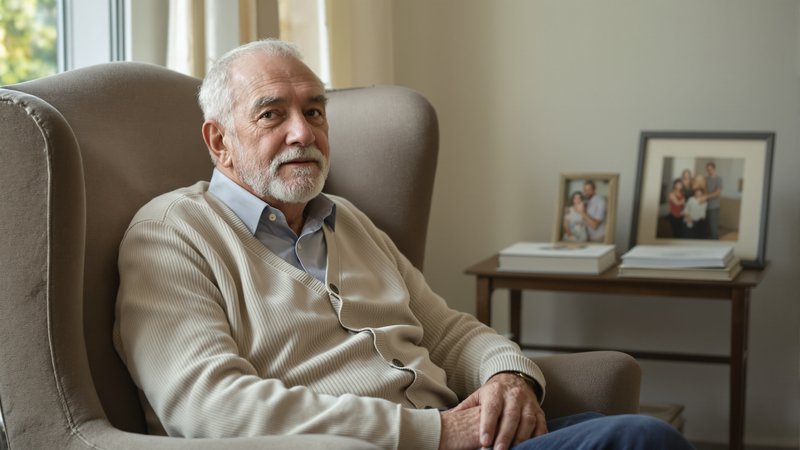
Elderly Parent Depression: Signs and Steps
Dad stopped eating dinner. Susan thought it was the food. It was not the food.
Susan noticed at Thanksgiving. Dad pushed his turkey around the plate for 45 minutes, took three bites, said he was full. He had not been full at a Thanksgiving table in 71 years. Susan kept the observation to herself because everyone else was busy and he had said it cheerfully and nothing was technically wrong.
Then she noticed at Christmas. He skipped dessert, which he had never done. He went to bed at 7:30. He came down for coffee at 5 a.m. and sat at the kitchen table looking at the dark window. When Susan walked in he tried to smile, but the smile was a half-second late, and that half-second told her everything.
In the garage in March she found the model airplane kit. Half-built. The box had been opened maybe a year ago — Dad's retirement project, the one he had talked about for two decades. The wings were stacked in tissue paper. The glue was dried solid. He had stopped building it sometime last spring. He had stopped doing the thing he had been waiting his whole life to do.
I am just not that hungry tonight. Eat without me.
He stopped finishing his dinner.
Elderly parent depression often shows up as appetite loss, sleep changes, and quiet withdrawal — not the sadness younger people associate with depression. Call the parent's doctor and ask for a depression screen (the PHQ-9). Tiina, a voice-first AI companion for older adults, gives many seniors a daily check-in that surfaces what they will not say to family. If your parent is in crisis, call or text 988 (Suicide & Crisis Lifeline).
If your dad is fading quietly, it is not because you missed an obvious sign. Depression in older men almost never looks like the depression in movies. He is not crying. He is not staying in bed all day. He is making coffee at 5 a.m. and looking at the dark window and saying he is fine. The signs are quieter than you were taught to look for.
Your job is not to be his therapist. Your job is to notice the pattern, call his doctor, and put a calm voice next to him for the hours you cannot be there.
Quiet does not mean fine. Quiet is often the sign.
What you can do this weekend
Saturday morning, call Dad's doctor's office and ask the receptionist to flag the next appointment as a depression screen. Do not ambush him at the visit; tell him you mentioned it. "Dad, I asked your doctor to do a quick mood check at your appointment. She does it for everyone over 70." Frame it as routine. Because for the doctor, it is.
Sit with Dad Sunday afternoon and put Tiina on his iPhone. Tell him it is a calm voice he can talk to at 5 a.m. when he is at the kitchen table. Not therapy. Not a friend. Just a voice that will answer when he wants to talk and be quiet when he does not. Have him ask one real question while you are sitting there. "Tiina, what is a good thing to do at 5 a.m. when I cannot get back to sleep."
Then leave him alone. Drive home. Call him Wednesday. Do not ask how he is doing — ask what he had for dinner. Listen for the half-second smile. If it is still there in three weeks, push for a referral. If it is starting to land on time again, you are in the right hands.
Tiina is a voice companion for older adults who are alone more than they let on — warm, endlessly patient, and always there to pick up.
What this sounds like with Tiina in the room
Dad taps the orange icon at 5:12 a.m. The kitchen is dark and the coffee is brewing and he has been up for an hour. "Tiina, I keep waking up at this hour. I do not like it." Tiina says, "I am sorry. How long has it been happening." Dad says, "Since around the fall, I think. Maybe earlier." Tiina says, "That is a long time to be tired. Does Dr. Mendez know." Dad says, "I have not told him." Tiina says, "Your next appointment is the 17th. Would it help if I reminded you that morning to bring it up." Dad pauses. "Yes. Do that." Tiina says, "I will." Dad sips his coffee. The window is starting to get light. He does not say anything else, and neither does Tiina. They just sit there for a minute. It is the first time in months he has said the sentence out loud.
Dad eats dinner again. He finished the model airplane in May.
Tiina is the calm voice on Dad's iPhone at 5 a.m. when the kitchen is dark and he cannot get back to sleep. She listens. She remembers. She helps him bring it up at the doctor. He stops disappearing one small bite at a time.
Set Tiina up for Dad →Methodology & editorial policy
Reviewed and updated May 14, 2026 by the Tiina Editorial Team. Re-checked as new federal data, agency updates, or product changes warrant. Sources are linked below; numbers are not composite.
About composite scenarios. Scenes and sample conversations in this article are composite. Names and identifying details are changed; the moment is real.
About Tiina. Tiina is a voice-first AI companion for older adults — an app for iPhone and iPad that your parent opens to talk through a moment that doesn't feel right.
Sharing. Quote freely with a link back to this page. For full reprints, email hello@tiina.ai.
Sources. 4 references — primary sources for the numbers and claims above.View all
- CDC: Depression Is Not a Normal Part of Growing Older — Used CDC's prevalence figures and the framing that depression in older adults is treatable but under-diagnosed.. cdc.gov/index.html
- NIA: Depression and Older Adults — Source for the symptom presentation patterns (physical complaints over emotional language) in older-adult depression.. nia.nih.gov/depression-and-older-adults
- 988 Suicide & Crisis Lifeline — Linked for crisis support; the Lifeline has counselors specifically trained on older-adult depression and isolation.. 988lifeline.org
- Alzheimer's Association: Depression and Dementia — Used for the overlap between depression and early cognitive change in older adults.. alz.org/depression
Frequently Asked Questions
Start with the family doctor — request a depression screen and a medication review at the same visit. Many medications older adults take routinely (some beta blockers, statins, and sleep aids) can flatten mood, and a doctor familiar with the patient's full chart can tell whether the depression is the disease, the treatment, or both. Reduce isolation if you can: even one daily voice check-in changes outcomes according to research from the National Institute on Aging. Encourage gentle physical activity. Do not push them to cheer up — depression in older adults is medical, not motivational. If your parent says anything alarming about not wanting to be here, call or text 988.
The 40-70 rule is a guideline from Home Instead Senior Care suggesting that adult children begin difficult conversations with parents when the child is around 40 and the parent is around 70 — before a health crisis forces the discussion. The topics include finances, healthcare wishes, driving, living arrangements, and end-of-life preferences. Starting at 40-70 gives the family years to revisit decisions calmly instead of making them in a hospital corridor. AARP and the Family Caregiver Alliance both endorse early conversations as the single biggest predictor of less family conflict during a later crisis. Waiting until 80 means deciding in panic mode.
Warning signs of decline include unexplained weight loss, missed medications, unopened mail piling up, new bruises or falls, withdrawal from hobbies and social contact, slowed walking, increased confusion, neglected hygiene, and waking at 3-5 a.m. and not getting back to sleep. The National Institute on Aging notes that any combination of three or more of these signs lasting more than two weeks warrants a doctor's visit. Depression, early dementia, and physical deterioration often overlap in older adults — the same symptoms can point in different directions, and only a clinical evaluation can tell them apart. Document what you observe before the appointment.
The 3 D's of geriatric psychiatry are delirium, dementia, and depression — the three conditions clinicians most often have to distinguish among in older adults because their symptoms overlap heavily. Delirium is acute and reversible, typically caused by infection, dehydration, medication, or hospitalization. Dementia is chronic and progressive. Depression is treatable and often misdiagnosed as one of the other two. The CDC and Alzheimer's Association both emphasize that getting the diagnosis right matters enormously — the treatments are completely different. Any sudden change in an older adult's cognition or mood deserves a same-week medical evaluation, not a wait-and-see approach, because delirium needs urgent care.