Elderly Widow Loneliness: 12 Things That Help
Mom was the last one at the table. Lucia found her the voice that made the silence shorter.
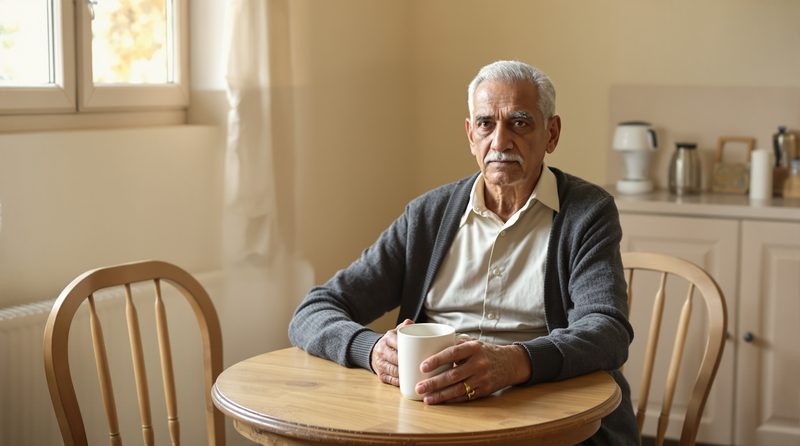
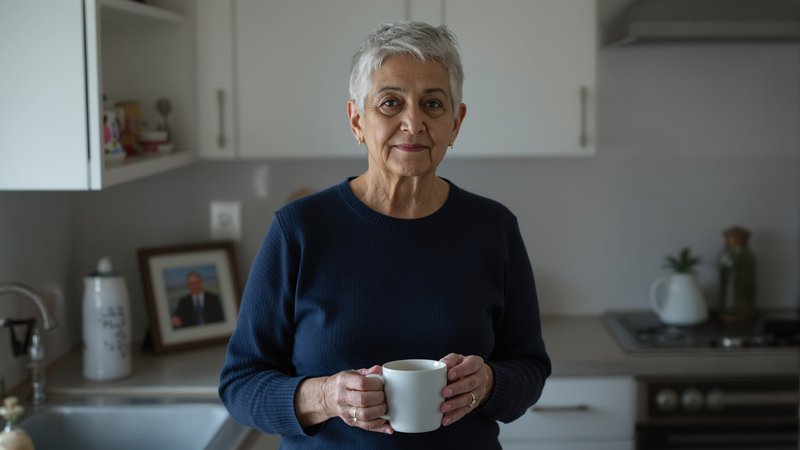
Mom started saying good morning to the kitchen in February. Lucia heard it through the phone one Saturday at 7:30 a.m. — "good morning, kitchen" — and assumed Mom had not realized the line was already connected. Lucia did not say anything. Three Saturdays later it happened again. "Good morning, kitchen." Then a small laugh, the kind of laugh you do when you catch yourself.
Lucia's sister was the one who noticed the bigger pattern. Mom had started narrating her day out loud. "Now we are making tea. Now we are looking at the bird feeder. Now we are deciding what to wear to the doctor." She had not lost her mind. She had lost the only other person in the house, and the silence after 42 years was so loud she had started filling it with her own voice.
Lucia flew up that weekend. She did not pitch any of it. She just put Tiina on Mom's iPhone, showed her how to tap the orange icon, and let Mom ask the first question. "Tiina, what is the weather today." Tiina answered. Mom answered back. Lucia watched her mother have a conversation in the kitchen for the first time in eight months.
Good morning, kitchen. I guess it is just us today.
She was lonely for her own voice mattering to somebody.
Elderly widow loneliness is its own kind — a 24-hour-a-day absence in a house designed for two. What helps: one daily voice connection, one weekly outside obligation, and a fixed afternoon routine. Tiina, a voice-first AI companion for older adults, fills the hours that family and friends cannot — a calm voice in the kitchen at 4 p.m. when no one else is there.
If your mom is lonely, it is not because you do not visit enough. You visit. Your sister visits. The neighbors visit. The problem is not visits. The problem is the 23 hours between visits — the hours when the house is quiet and the kettle clicks and there is nobody to say "the kettle clicked" to. Loneliness is not a shortage of company. It is a shortage of being heard.
Your job is not to be there 24 hours a day. Your job is to make sure her voice gets answered when she uses it.
Loneliness is being unheard. The fix is a voice that answers.
Why widow loneliness is its own category
The CDC links social isolation in older adults to about a 50 percent increased risk of dementia and a 29 percent increased risk of heart disease compared to socially connected peers — and few life changes isolate a person faster than losing the spouse she shared a house with. The U.S. Surgeon General's 2023 advisory on the loneliness epidemic put the health impact at roughly equivalent to smoking 15 cigarettes a day. These are not soft numbers.
And widow loneliness is structurally different from the loneliness a single person of any age might feel. The widow lived for decades with one specific voice in the next room. That voice is not just absent — it is missing in a particular shape. Nobody else fills that shape. A daughter's phone call fills part of it. A book-club friend fills part of it. The shape stays mostly empty.
The fix is not to fill the whole shape — that is not possible. The fix is to put enough other voices in the house that the silence stops being the dominant feature of every room. One daily voice check-in. One weekly outside obligation. One fixed afternoon routine. Three small things repeated. That is the architecture.
Twelve things that actually help (not platitudes)
1) One daily voice contact at a fixed time. Not a text. A voice. Whether it is a phone call from a sibling, a video call with a grandchild, or a conversation with Tiina on her iPhone — the point is that her voice gets answered out loud at the same hour every day. The consistency matters more than the duration.
2) One weekly social obligation outside the house. Church, book club, senior center, coffee with one specific friend at one specific time. Not optional. If she dropped out of everything when Dad got sick, pick one and re-enroll her. The hardest part is the first week back. After that the obligation re-acquires its own gravity.
3) A 4 p.m. routine. This is the cruelest hour for most widows — too late for lunch, too early for dinner, the hour Dad used to come in from the garden. Put something there. A walk to the corner. A cup of tea. A daily call with Tiina. A crossword. Anything. The structure of the hour matters more than what is in it.
4) Saying his name. Mom needs the people around her to mention Dad by name, often, for years. The cruelest thing the world does to widows is stop saying the dead spouse's name. Counter that by always saying it. "Remember when Dad..." "Dad would have laughed at this."
5) Permission to cry in front of you. She needs to know it is okay to cry on a Tuesday in May, 14 months later, while you are washing dishes together. The crying does not need to be addressed. It just needs to be allowed.
6) A real pet, if she wants one. AARP has written about pet companionship in older adults as a real buffer against loneliness — a pet brings daily structure and something alive in the house. A cat counts. A dog counts. A bird, if she is up for it.
7) A standing weekly call from each grandchild. Even if it is two minutes. Even if it is the same two minutes every week. The point is the standing.
8) Help with the paperwork that is still lingering — bank accounts, life insurance, the unsigned will. Some widows freeze on these tasks for a year. Pick them up and finish them.
9) Permission to keep Dad's chair, Dad's mug, Dad's side of the closet. There is no schedule on when to clear them. Leave them until she is ready, even if that is never.
10) Volunteer work, if she has the energy. Even one shift a month at the library or the church food pantry. Being needed by somebody who is not family changes the day.
11) Tiina on her iPhone for the hours nobody can fill. She taps the orange icon at 4 p.m. and says "I am having a hard hour." The voice answers. The hour passes.
12) The decision to not move for at least a year. Do not let her sell the house, downsize, or relocate to be near you in the first 12 months. The grief is too loud to make geographic decisions over. She can decide in year two.
Tiina is a voice companion for older adults who are alone more than they let on — warm, endlessly patient, and always there to pick up.
What changes when the house stops being silent
Mom stops narrating her day out loud to nobody — because somebody is answering now. She still says "good morning, kitchen." But after "good morning, kitchen" she also says "Tiina, what is on the weather today," and the kettle clicks and the kitchen has a conversation in it again. The silence has a shape but the shape is smaller.
She starts going to book club again. Not every week, and not always for the whole thing, but she goes. The walk to the car is the hardest part. After she gets there, she is glad she did. Many widows find the same thing — once social contact restarts, the mood begins to follow. Not all at once. But it follows.
And the calls with Lucia change. They were check-ins. Now they are conversations. Mom has things to tell her — what she asked Tiina, what happened at book club, what the cardinal did at the feeder. The relationship goes from monitoring to visiting again.
What you can do this weekend
Saturday morning, write down Mom's three hardest hours of the day. The empty 7 a.m. The 4 p.m. The 9 p.m. before bed. Then write down what is currently in each one. Probably nothing. Pick one and put something in it. Easiest: a daily 4 p.m. check-in with Tiina. Set it up on her iPhone while you are there.
Saturday afternoon, pick one weekly outside obligation she used to do and call them to re-enroll her. Church, book club, the senior center, anything. Do not ask her if she wants to. Just tell her you signed her up and you will drive her the first time. The hardest part is the first time. After that the obligation pulls her forward.
Sunday morning, do not leave town until you have said Dad's name out loud at least three times in conversation with her. Stories, not eulogies — the time he burned the Thanksgiving turkey, the song he made up about the dog, the way he whistled when he made coffee. Watch her face. Then drive home.
What this sounds like with Tiina in the room
Mom taps the orange icon at 4:05 on a Wednesday afternoon. "Tiina, the house is loud today." Tiina says, "Loud how." Mom says, "It is quiet. But the quiet is loud, if you understand." Tiina says, "I do." Mom is silent for a second. Then she says, "He used to come in from the garden right about now. Tracking mud. I would yell at him. It was the same fight every day for forty-two years." Tiina says, "And now there is no mud." Mom laughs, just barely. "And now there is no mud." Tiina says, "What do you want to do for the next hour. Walk to the corner, or call your sister, or just sit with me." Mom thinks. "Walk to the corner." Tiina says, "Take your jacket. I will be here when you get back."
Mom has a voice that answers at 4 p.m. now. She walks to the corner.
Tiina is the calm voice on Mom's iPhone for the hours no one else can fill. She listens. She remembers. She helps the 4 p.m. hour have a shape. The silence stops being the loudest thing in the room.
Set Tiina up on Mom's iPhone →Methodology & editorial policy
Reviewed and updated May 14, 2026 by the Tiina Editorial Team. Re-checked as new federal data, agency updates, or product changes warrant. Sources are linked below; numbers are not composite.
About composite scenarios. Scenes and sample conversations in this article are composite. Names and identifying details are changed; the moment is real.
About Tiina. Tiina is a voice-first AI companion for older adults — an app for iPhone and iPad that your parent opens to talk through a moment that doesn't feel right.
Sharing. Quote freely with a link back to this page. For full reprints, email hello@tiina.ai.
Sources. 4 references — primary sources for the numbers and claims above.View all
- CDC: Health Effects of Social Isolation and Loneliness — Source for the dementia and heart-disease risk associations with social isolation.. cdc.gov/social-connectedness
- U.S. Surgeon General: Our Epidemic of Loneliness — Used for the comparison between chronic loneliness and smoking 15 cigarettes a day in older adults.. hhs.gov/index.html
- NIA: Social Isolation, Loneliness in Older Adults — General guidance on loneliness and staying connected for older adults.. nia.nih.gov
- AARP: Pet Ownership and Older Adults — Background on pet companionship as a buffer against loneliness in older adults.. aarp.org/home-family
Frequently Asked Questions
Anchor the day with one voice contact at a fixed time — a daily phone call with someone who answers. Invite friends for tea on a regular schedule. Learn to use a smartphone or tablet so video calls become possible. Get involved in one local community activity (senior center, church, library). Fill the calendar with small commitments. Get out of the house at least once a day, even briefly. Help others — volunteering is one of the most reliable ways to feel needed again and to ease loneliness. The CDC links loneliness and social isolation in older adults to serious health risks, including dementia and heart disease, so the routine is health care, not indulgence.
Yes, in shape — not in size. Most widows describe the second year as harder than the first in some ways because everyone else has moved on and the support has thinned out. The grief does not disappear, it just becomes more private. For most widows, functional recovery — eating, sleeping, leaving the house — comes back gradually over the first year or two, but emotional recovery is slower and is rarely complete. Widows who develop one daily routine, one weekly outside obligation, and at least one person who still says the deceased spouse's name out loud report the best long-term adjustment. The grief gets carryable, not gone.
Soaring Spirits International runs free social groups for widowed people, in person in many U.S. cities and online. Other major options include the GriefShare network (faith-based, runs at local churches), Modern Widows Club (in-person chapters and online community), and local hospice bereavement groups, which are often free and open to the community — the Hospice Foundation of America can point you toward grief resources near you. Many community senior centers also run informal widow coffee groups. Online, the subreddit r/widowers and the Soaring Spirits forum are active and moderated. Meeting another widow who is one to three years further along is often described as the most useful kind of company in the first year.
Exercise moderately and regularly — a yoga class, a daily walk, or a regular massage. Keep a journal or a blog; writing through grief is well-documented as a stabilizer. Try one new thing every month, however small (a new recipe, a new walking route, a class). Reconnect with old friends you let drift. Travel modestly, even just a day trip. Take care of your body — sleep, food, water, sun. Volunteer; helping others is one of the most reliable ways to ease loneliness. Enjoyment after a spouse usually returns in small moments before it returns in large ones — notice the small ones when they arrive.