
How to Get a Parent Tested for Dementia, Step by Step
There's no single dementia test, but there is a clear path: what to write down, who to see, what the tests involve and what to say if your parent refuses.
Some links below are affiliate links: if you buy through them, Tiina may earn a small commission at no extra cost to you. As an Amazon Associate I earn from qualifying purchases.
Start with your parent's regular doctor. Book the Medicare yearly Wellness visit, which includes a check for memory problems at no cost when the doctor accepts Medicare, and send the doctor a short note first describing what you've noticed. The doctor will test memory and thinking, order blood work to rule out treatable causes, and refer your parent to a neurologist, geriatrician or memory clinic if more testing is needed.
We're not doctors, and nothing here can tell you whether your parent has dementia. Only a clinician can evaluate memory changes. Confusion that comes on suddenly, over hours or days, is different from slow memory changes: call the doctor the same day, because infections and medicines can cause it. If confusion comes with face drooping, weakness on one side or trouble speaking, call 911.
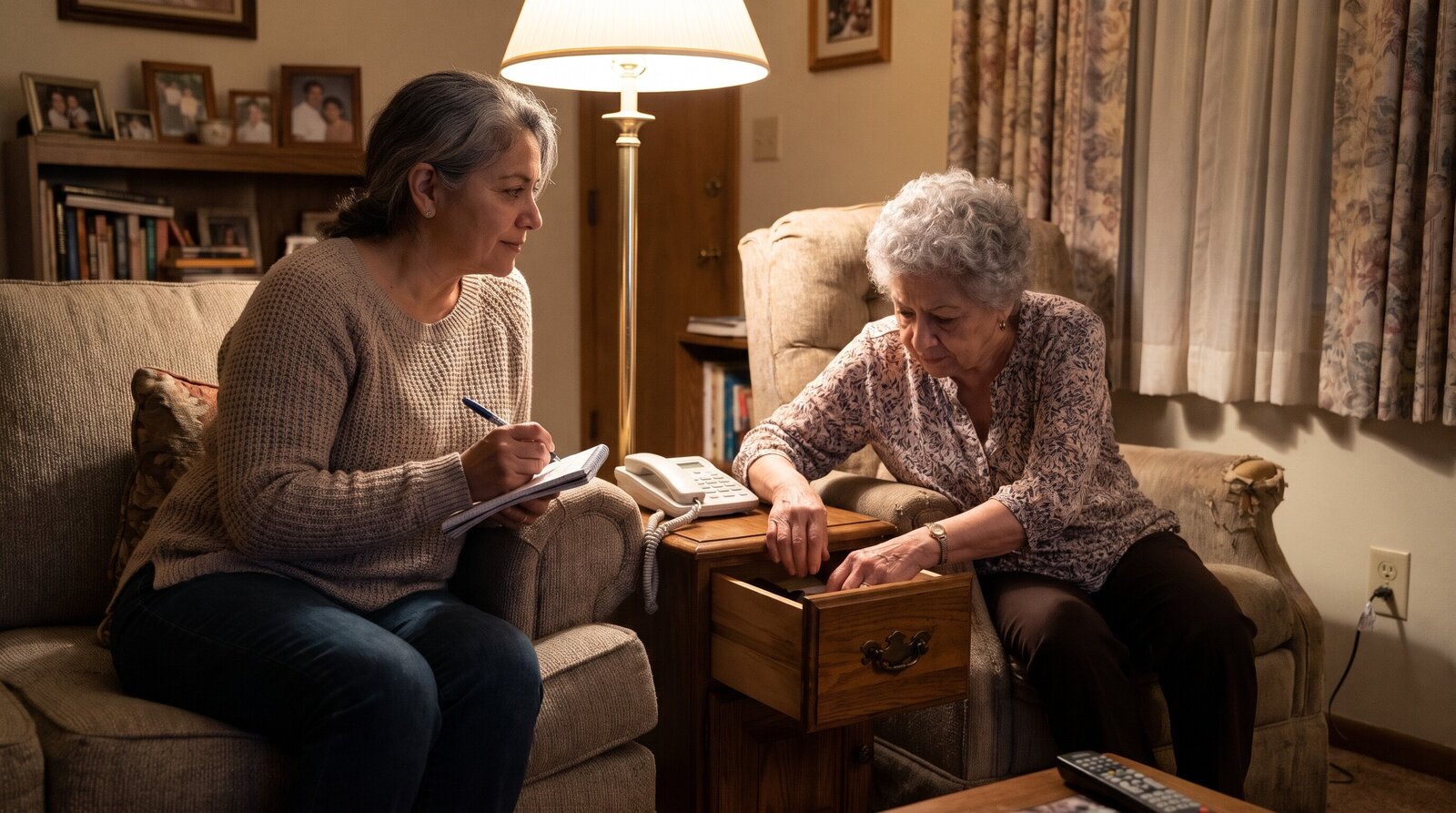
It started small. Your dad told you the same story twice in one phone call. Then he missed a bill he'd paid on time for forty years, and last week he got turned around driving to a store he's been going to since you were a kid. You keep telling yourself it's normal aging, and some days you believe it. Part of you wants to know for sure, and part of you is scared of the answer. Both are normal. Getting a parent evaluated is less mysterious than it feels, and some causes of memory trouble turn out to be treatable.
Step 1: Write down what you're seeing
Doctors get "Mom seems a little off" all day long. What helps them is specifics. Before you book anything, start writing changes down with the date. The health changes sheet in your Survival Guide is made for this; what follows is what to watch for with memory in particular.
The National Institute on Aging says doctors will ask a family member about your parent's health, medicines, daily activities and any changes in behavior or personality, so those are the things to track:
- Repeated questions or stories, and how often
- Missed bills, appointments or medicines that used to be routine
- Getting lost or confused somewhere familiar
- Trouble with familiar tasks, like a recipe or the TV remote
- Changes in mood, personality, sleep or interest in things they loved
- Every medicine and supplement they take, including over-the-counter ones
Step 2: Start with their regular doctor
You don't need a specialist to begin. The Medicare yearly Wellness visit includes a check for signs of cognitive impairment, like trouble remembering, learning, concentrating, managing money or making everyday decisions, and your parent pays nothing if the doctor accepts Medicare. It's routine, which makes it an easy appointment to suggest.
If the doctor sees signs of a problem, Medicare also covers a separate, longer cognitive assessment and care plan visit to review memory and thinking, check for conditions like depression or delirium, and build a care plan. That one is subject to the Part B deductible and 20% coinsurance. Your parent can bring someone along to it, and that someone can be you.
From there, the doctor may refer your parent to a specialist: a geriatrician, a neurologist, a geriatric psychiatrist or a neuropsychologist. Memory clinics and the NIA-funded Alzheimer's Disease Research Centers bring several of those specialists together; NIA lists the centers by state.
If the doctor brushes off your concerns, you can ask for a referral to a geriatrician or memory clinic directly. You know your parent's baseline better than anyone in that office.
Step 3: Know what the tests involve
There's no single test that diagnoses dementia, as the Alzheimer's Association puts it. A workup usually combines several of these:
- A short screening. In NIA's guidance for doctors, an initial check takes 10 minutes or less, using tools like the Mini-Cog or AD8. Some can be filled out by a family member in the waiting room.
- Longer tests of memory and thinking. Problem solving, attention, counting and language, sometimes with a neuropsychologist.
- Blood and urine tests to look for other causes of the symptoms.
- A check for depression or another mental health condition that can look like memory loss.
- Brain scans such as CT, MRI or PET, to support a diagnosis or rule out a stroke or tumor.
- Biomarker tests. Some FDA-cleared blood tests and spinal fluid tests measure proteins linked to Alzheimer's. They're for people who already have symptoms, not a screening for everyone.

Your parent can ask Tiina what a cognitive screening involves or what a neurologist does, in their own words and as many times as they need, and she explains it clearly every time.
Step 4: Rule out the treatable causes
This is the best reason not to wait. According to the Alzheimer's Association, common causes of dementia-like symptoms include depression, untreated sleep apnea, delirium, medicine side effects, thyroid problems, certain vitamin deficiencies and heavy drinking. Unlike Alzheimer's, these can often be reversed.
Bring the full medicine list from the medicine list sheet in your Survival Guide, because a single new prescription or a sleep aid can be enough to cloud someone's thinking.

Step 5: Tell the doctor what you've seen, before the visit
It's hard for anyone to describe their own memory slips, and harder with their grown child sitting next to them. So send your note ahead: through the patient portal, by fax, or handed to the front desk in a sealed envelope marked for the doctor. Keep it to facts and dates.
Doctors want this. NIA's guidance tells them family members can be good sources of information and suggests talking with them privately as well as with the patient in the room. Even if your parent hasn't signed anything letting the doctor share their results with you, you can still share what you've seen. Ask whether your parent will sign a release so the doctor can talk with you directly afterward; it makes every next step easier. For the conversation itself, read how to talk to your parent's doctor as a caregiver.
When your parent refuses to go
This is where a lot of families get stuck. A few approaches work better than a direct ask:
- Leave the word dementia out. It's a yearly checkup, a medicine review or a follow-up on blood pressure, all of which are true.
- Make it about something they care about. Driving, staying in their home or keeping their independence are stronger reasons than memory.
- Ask for it as a favor. "It would really help me stop worrying" is hard to refuse.
- Let the doctor lead. Once the visit is booked and your note is sent, the doctor can raise memory without you saying a word.
- Get coaching. The Alzheimer's Association's free 24/7 Helpline, 800-272-3900, helps families plan exactly this conversation. More ideas are in our playbook for when a parent refuses help.
What happens next
If the tests show nothing worrying, you have a baseline. NIA suggests people with memory problems return to the doctor every 6 to 12 months, because changes over time tell the doctor more than any single test.
If the diagnosis is Alzheimer's or another dementia, an early answer still matters. Medicare may cover FDA-approved drugs for early Alzheimer's, such as Leqembi and Kisunla, for people with mild cognitive impairment or mild dementia due to Alzheimer's. An early diagnosis also gives your parent time to make their own decisions about money and care while they can, starting with a power of attorney. And it lets you learn the early signs of dementia and what comes next before you're in a crisis.
Either way, ask for a written summary of the results and the plan, and the name of the person to call with questions. You'll have more of them once you're home.
Dad asks about his memory test again. Tiina answers again, kindly.
The written summary from the doctor is dense, and the questions come back at odd hours. Your parent can read it to Tiina or share a photo, hear it in plain words as many times as they like, and decide what to ask you next.
Try Tiina with Dad →Frequently Asked Questions
Methodology & editorial policy
Reviewed and updated October 31, 2026 by the Tiina Editorial Team. Facts, programs and prices in this guide come from the sources listed below.
About composite scenarios. The opening scene is a composite.
About Tiina. Tiina is a voice-first AI companion for older adults: an app for iPhone and iPad that your parent opens whenever they want someone to talk to, day or night.
Sharing. Quote freely with a link back to this page. For full reprints, email hello@tiina.ai.
Sources. 10 references: National Institute on Aging, Alzheimer's Association, Medicare.gov, MedlinePlus.View all
- National Institute on Aging. How Is Alzheimer's Disease Diagnosed?. nia.nih.gov
- National Institute on Aging. Assessing Cognitive Impairment in Older Patients. nia.nih.gov
- Alzheimer's Association. Medical Tests for Diagnosing Alzheimer's and Dementia. alz.org
- Alzheimer's Association. 24/7 Helpline. alz.org
- Medicare.gov. Yearly "Wellness" visits. medicare.gov
- Medicare.gov. Cognitive assessment and care plan services. medicare.gov
- Medicare.gov. Monoclonal antibodies for treating early Alzheimer's disease. medicare.gov
- MedlinePlus. Delirium. medlineplus.gov
- MedlinePlus. Stroke. medlineplus.gov
- National Institute on Aging. Find an Alzheimer's Disease Research Center. nia.nih.gov